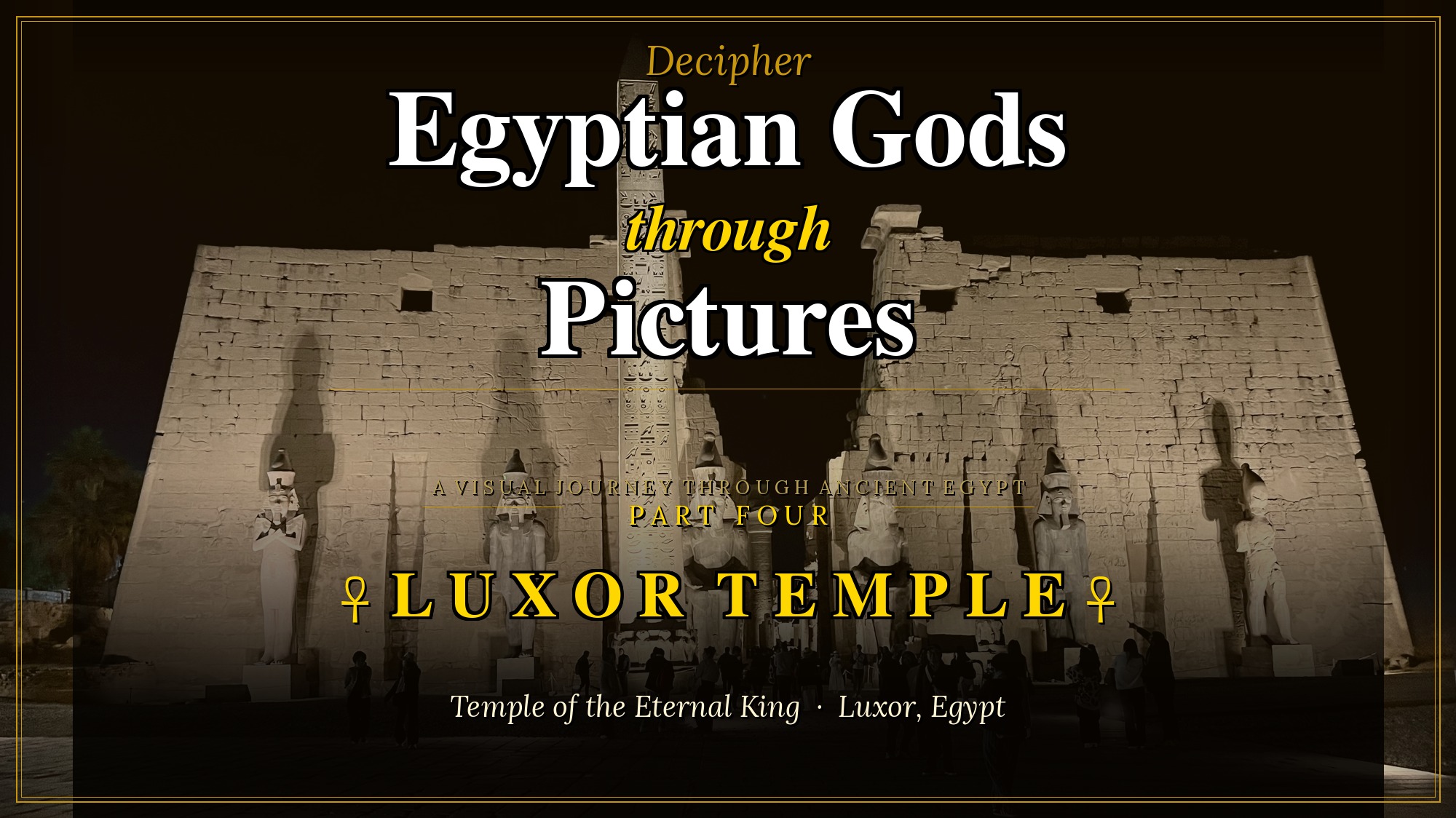
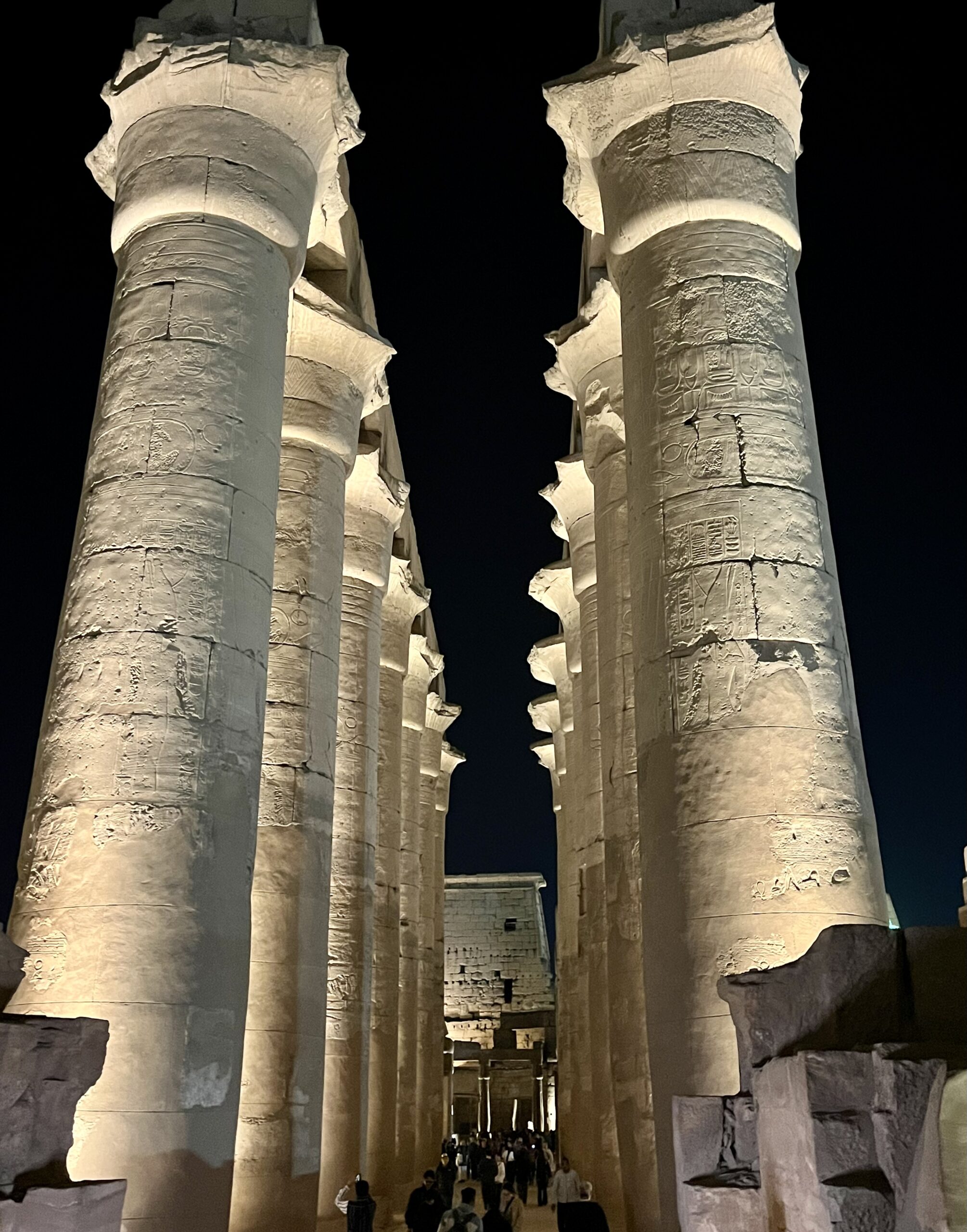
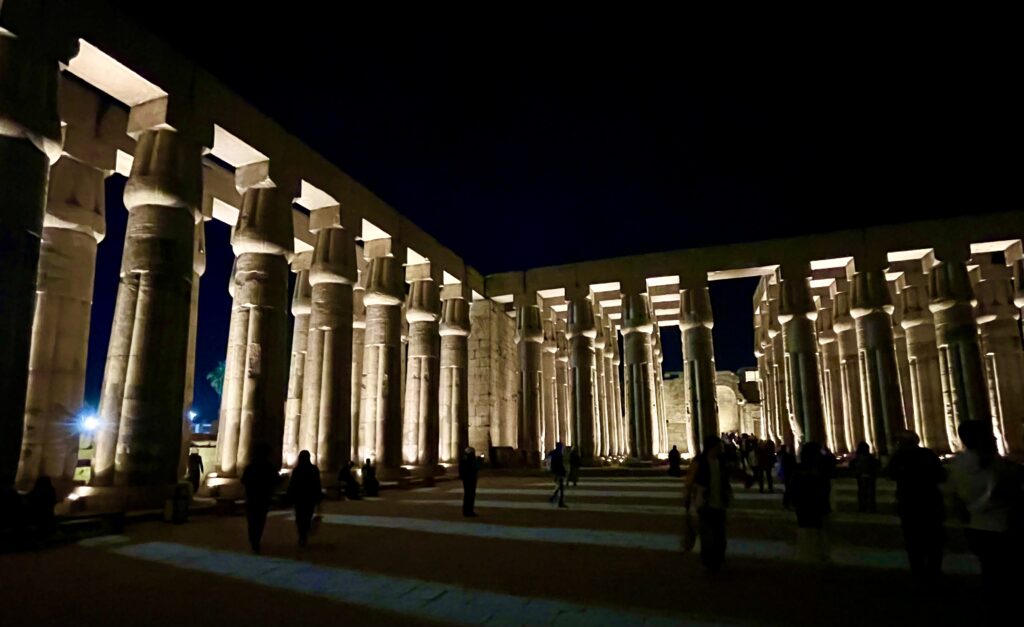
Most temples in Egypt are a daytime proposition — you go in the morning, beat the heat, and leave before lunch. Luxor Temple is the exception. It is the one ancient site in Egypt that genuinely belongs to the night. After dark, the floodlights turn the sandstone columns a deep molten amber, the mosque on top of the ancient walls glitters against a purple-black sky. The carvings, which in direct sunlight compete with squinting and sweat, reveal themselves slowly in the warm artificial glow — sharper, more legible, more alive than they look at noon.
And what you are looking at, whenever you visit, is a monument that has been in continuous religious use for more than 3,300 years — first as an Egyptian temple, then as a Roman military chapel, then as a Christian church, and finally as a functioning mosque still active today, built directly on top of the ancient stones. Nowhere else in Egypt can you watch 3,000 years of religious history stacked on top of itself quite so literally — or quite so beautifully, once the sun goes down.
This is Part 4 of the Egypt Travel Visual Guides series. Unlike Karnak — which is a city you could spend days wandering — Luxor Temple is compact, intensely beautiful, and almost always visited too quickly. Most tourists spend 45 minutes and leave. This guide is designed to slow you down. Each section gives you a specific thing to look for, so that when you stand in front of a wall of carvings, you are reading it — not just photographing it.
In This Guide
Egyptian Gods Luxor Temple — Fast Facts Before You Look at the Pictures
Luxor Temple sits on the east bank of the Nile, about 3 kilometers south of Karnak, at the heart of what was once the ancient city of Thebes. While Karnak was the religious powerhouse — the administrative Vatican of the gods — Luxor Temple had a very different and very specific purpose. It was built almost entirely for one event: the Opet Festival, the annual ceremony in which the living Pharaoh came here to have his divine right to rule renewed by the god Amun-Ra.
In other words: Karnak was where the gods lived. Luxor Temple was where the Pharaoh came to prove he was one of them.
The Basics
Detail
Built by
Primarily Amenhotep III (18th Dynasty) and Ramesses II, with later additions by Tutankhamun, Horemheb, and the Ptolemaic kings.
Date built
Main construction ~1390–1352 BCE; continuously modified through the Roman period (1st–3rd century CE).
Location
East Bank of the Nile, central Luxor city. The temple is literally in the middle of a modern town — cafés and hotels surround it.
What it is
A New Kingdom temple dedicated to Amun-Ra in his fertility aspect (Amun-Min). Site of the annual Opet Festival, where the Pharaoh’s divine kingship was ceremonially renewed.
The Lone Obelisk: Why Is There Only One?
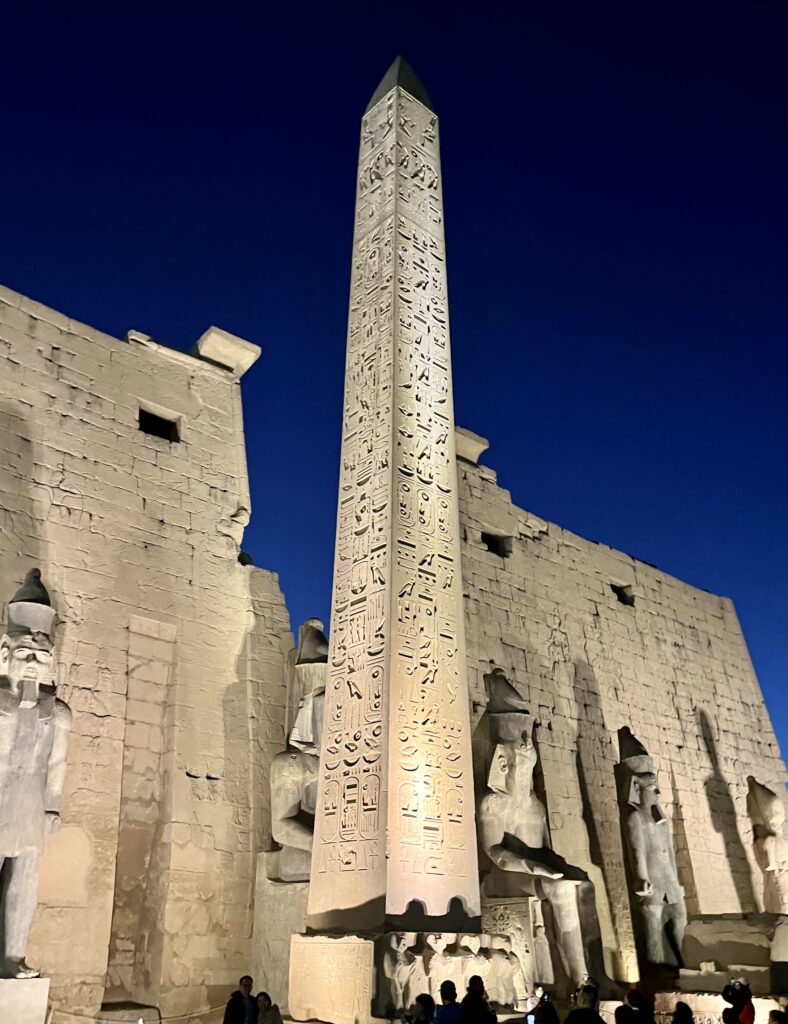
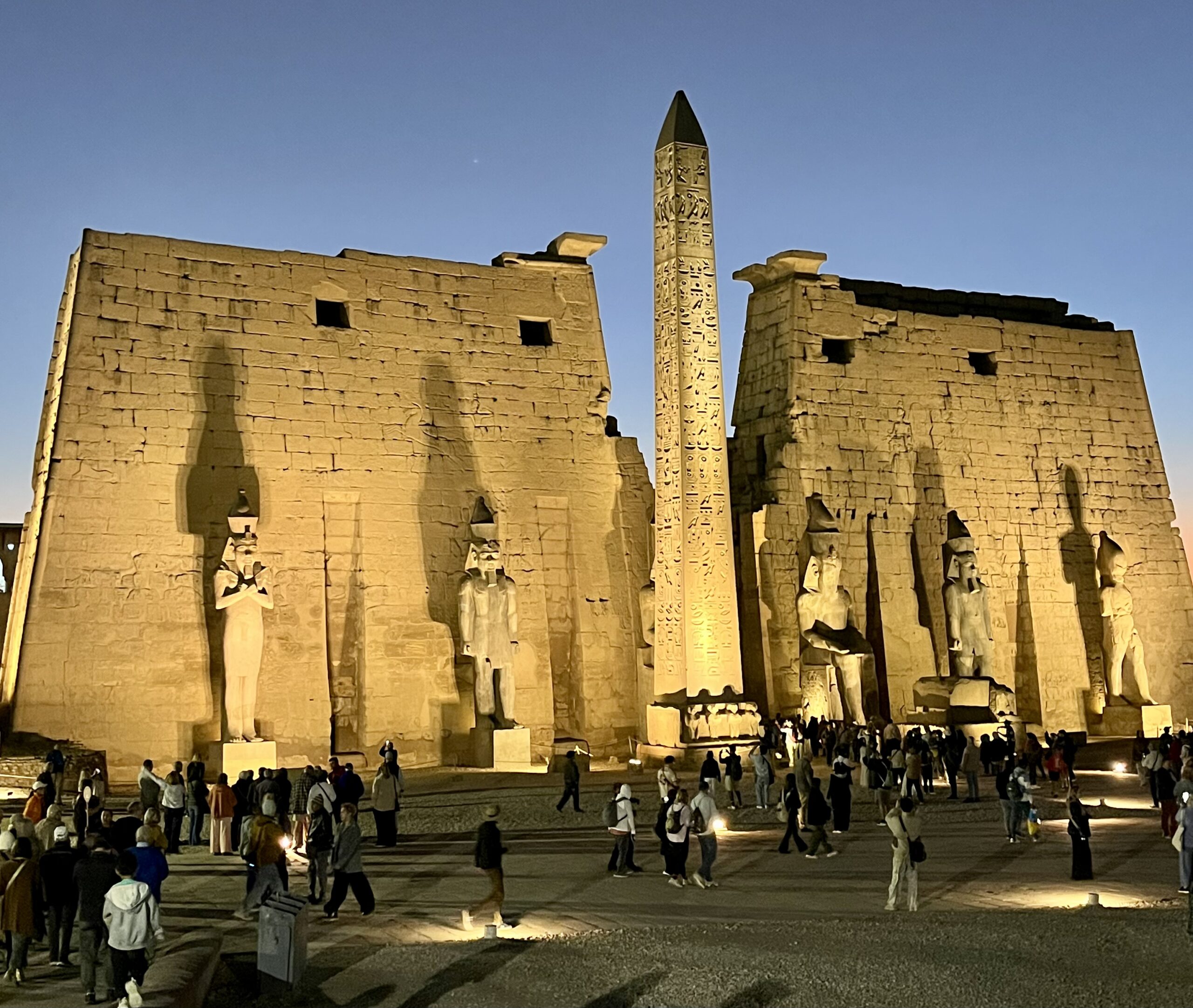
The very first thing you notice when approaching Luxor Temple is that something is missing. The entrance pylon — the massive gateway tower — has only one obelisk standing in front of it. There is an empty square pedestal to the left where its twin used to be.
In the Karnak guide (Part 3), we mentioned that obelisks always came in pairs. We also promised to explain why Luxor has only one. Here is the story.
🗼 Paris Has the Other One
Ramesses II originally erected two matching pink granite obelisks at the entrance to Luxor Temple, each around 25 meters tall and weighing approximately 250 tons. They had stood there for more than 3,000 years when, in 1829, the Egyptian ruler Muhammad Ali offered both of them as a diplomatic gift to France.
France only managed to move one. Transporting a 250-ton granite needle across the Mediterranean in the 1830s was an engineering undertaking so costly, complex, and frankly terrifying that after successfully erecting the first obelisk in the center of Place de la Concorde in Paris in 1836, France quietly informed Egypt that they would be keeping only the one, thank you very much.
The second obelisk technically belonged to France for over 150 years until the 1990s, when the French President officially “gave it back” to Egypt so it could remain at Luxor forever.
✨The Missing Bling
Like Hatshepsut’s obelisks at Karnak, the pyramidion at the top of this obelisk was originally covered in electrum (gold-silver alloy). However, it was stripped away by looters or later rulers shortly after the decline of the New Kingdom. Gold was far too valuable to be left sitting on a mountaintop for centuries.
The obelisk in Paris, however, had better luck. In 1998, the French government decided to restore the jagged, bare granite top to its original pharaonic splendor. It was done to celebrate the long-standing relationship between France and Egypt and to mark the 150th anniversary of the monument’s arrival in Paris. A 12-foot-high pyramid cap (pyramidion) made of bronze and covered in 23.5-carat gold leaf was placed on top. The project cost roughly 1.5 million francs and was famously sponsored by the fashion house Yves Saint Laurent.
💡 The Missing 2 Meters
If the Paris obelisk looks a little ‘shorter’ in your photos than the one in Luxor, your eyes aren’t playing tricks on you. It is actually 2 meters shorter. The Ancient Egyptians built them at slightly different heights to trick the human eye into seeing them as a perfect, symmetrical pair. The Luxor Obelisk was the left one with a height of 25 Meters and weigh 250 tons, whereas the Paris Obelisk was the right one with a height of 23 Meters and weigh 220 tons.
Ancient Egyptian architects were masters of forced perspective. They knew that if you stood two perfectly identical obelisks side-by-side, the one further from the viewer’s natural path might look smaller or “off-balance” due to the surrounding pylons.
The Trick: They carved the right-hand obelisk (now in Paris) slightly shorter and slimmer than the left one to compensate for the way light and shadows hit the temple entrance.
The Result: When they both stood at the First Pylon, they appeared to be the exact same size to a person walking down the Avenue of Sphinxes.
👁 How to Read the Remaining Obelisk
The Cartouches: Look for the oval loops running in a vertical column down each face. These are Ramesses II’s royal names. He was not shy about self-promotion — his name appears on virtually every surface of every monument he ever touched, including several he didn’t actually build.
The Baboons: Look at the very base of the obelisk where it meets the pedestal. You’ll see carved baboons with their arms raised in a posture of worship. This is not decorative quirk — baboons were sacred to the god Thoth, and ancient Egyptians observed that baboons make a distinctive chattering sound at dawn, which they interpreted as the animals greeting and worshipping the rising sun. The baboons at the base of an obelisk are permanently positioned to greet the first light, every morning, forever.
The First Pylon: The World’s Oldest War Propaganda
The tower-gateway you walk through to enter Luxor Temple is the First Pylon of Ramesses II, and it is covered from base to cornice in one of the most ambitious pieces of political spin in recorded history: the Battle of Kadesh.
In approximately 1274 BCE, Ramesses II fought the Hittite Empire at Kadesh (in modern-day Syria). The battle was, by most honest historical accounts, a draw — Ramesses walked into a trap, nearly lost his entire army, personally charged the enemy lines to avoid capture, and then both sides went home. A peace treaty was eventually signed. It is actually the oldest surviving peace treaty in history, a copy of which hangs in the United Nations building in New York.
What Ramesses carved onto his temple walls tells a slightly different story.
⚔️ What the Carvings Actually Show
The pylon reliefs depict Ramesses as a giant figure in his chariot, towering over a chaotic mass of tiny enemies who are fleeing, drowning in the River Orontes, and being trampled by his horses. Gods stand behind him, conferring divine blessing. His army, who in reality were ambushed and nearly annihilated before Ramesses rallied them, appears nowhere in these carvings — this is a solo performance.
This scene repeats at Abu Simbel, at Karnak, at Abydos, and at the Ramesseum. Ramesses II carved the same battle on the walls of every major temple he built or modified — a marketing campaign that ran across the entire country simultaneously. It worked. For the next 3,000 years, including for us right now, Ramesses II is the name everyone knows.
🏛️ The “Six-Statue” Entrance
Remember how Ramesses II had four statue of himself at the entrance of the Great Temple of Abu Simbel? Here he did it again – at the entrance to the First Pylon, you can see six statues of Ramesses II, two seated, four standing, guarding the Obelisk.
The seated Ramesses II are depicted in the classic, rigid seated pose of a Pharaoh with hands resting flat on their knees. This pose conveys absolute stability, eternal peace, and immovable power.
Among the standing Pharaohs, there are two poses telling you exactly which “state of being” the Pharaoh.
Left Foot Forward (Striding): This represents the Living King. It is a gesture of action, vitality, and power in the physical world. He is stepping out to govern or protect.
Feet Together / Hands Crossed (Mummiform): This represents the Pharaoh as Osiris, the god of the dead and the afterlife.
👁️ Why Are Some Seated and Others Standing?
The arrangement of these six statues—two seated and four standing—is a deliberate “visual map” of Ramesses II’s power. While they are all the same man, they are not doing the same job.
When you see them positioned next to the obelisk, they are acting as a multi-layered security force for the temple’s “Solar Antenna.”
The two largest statues are the Seated ones. In Egyptian iconography, a seated Pharaoh represents the Office of Kingship. Because they are seated, they signify that the King is “at home” in his temple, presiding over the land.
The four Standing statues represent the Active Power of the King. The striding ones are the “bodyguards” of the entrance. If the obelisk is a ray of light, the standing statues are the soldiers protecting that light, whereas the mummiform one link the kings own eternal life to the daily cycle of the sun.
🎯 The British Museum Myth and the “Resurrection”
Some people might tell you that one of the original standing Ramesses II at Luxor temple is at the British Museum – but that is not true. Yes, there’s a “Younger Memnon” in London. That was hauled away by Giovanni Belzoni in 1816 and has been in the British Museum ever since. However, It was never part of the Luxor Temple entrance. Instead, it used to be at Ramesses II’s mortuary temple on the West Bank of Luxor.
The two standing statues you see here on the right side of the entrance (near where the second obelisk would be) were reconstructed from fragments that had been lying in the dirt at the temple for centuries.
This is why they look “new” or in better condition—they were recently cleaned and reassembled.
For decades, these were just piles of broken granite.
Egyptian archaeologists, in collaboration with international teams, spent years identifying the pieces and winching them back into place.
The Great Court of Ramesses II
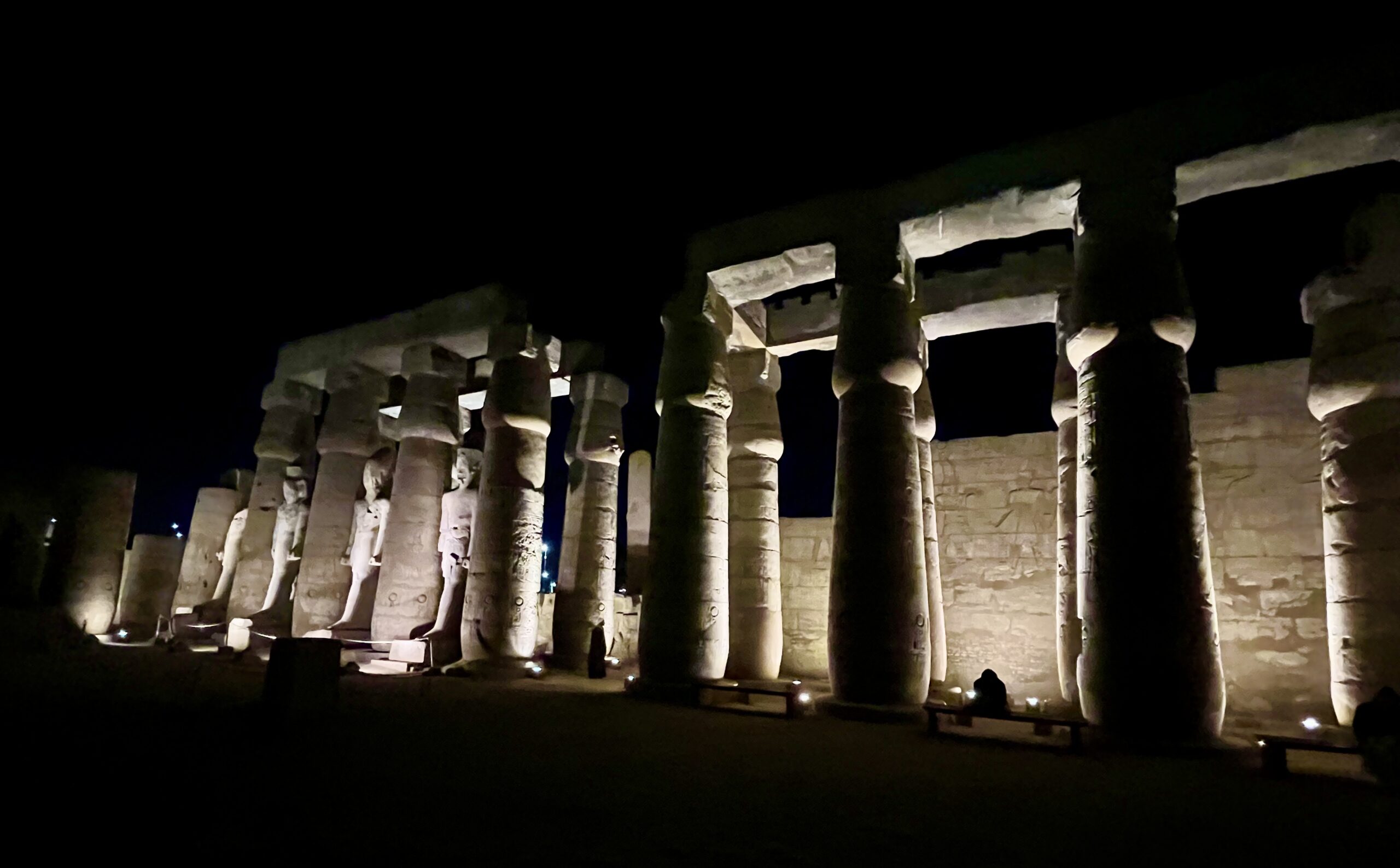
As you step through the massive First Pylon, you are greeted by the Great Court of Ramesses II. This expansive open-air courtyard is famous for its “double row” of columns that run along the perimeter. These columns feature closed papyrus bud capitals, designed to look like bundles of unbloomed flowers. Tucked between the columns, you can see several colossal statues of Ramesses II standing at attention.
Interestingly, this court is built at a slight angle to the rest of the temple to align with the Avenue of Sphinxes outside. In the corner of this court sits the ancient shrine of Thutmose III and, unexpectedly, the 13th-century Mosque of Abu al-Hajjaj built directly on top of the ancient ruins.
🕵️ Counting the Giants
Ramesses II didn’t do anything small. To frame his first courtyard, he erected 74 columns and tucked nearly a dozen colossal statues between them. It’s a massive display of 19th Dynasty ‘branding’ that hits you the moment you walk through the gate.
The columns don’t form a complete rectangle. Because of the Thutmose III Shrine in the corner and the First Pylon at the front, the double rows run along the sides and the rear of the court.
🎯 The “Drunken” Alignment
If you look at a map of Luxor Temple, the Great Court isn’t straight; it’s tilted at a 7-degree angle compared to the rest of the temple.
The Reason: Ramesses II didn’t make a mistake. He had to pivot the entire courtyard to the east so the main gate would line up perfectly with the Avenue of Sphinxes leading to Karnak. It was a choice of urban planning over architectural symmetry.
👁 The 17 Hidden Princes
On the rear wall of this court, there is a famous relief showing a procession of 17 of Ramesses II’s sons.
Ramesses had over 100 children. This wall was like a royal “family portrait” meant to show the strength and future of his dynasty. Each prince is shown with the “sidelock of youth,” a braided strand of hair worn by royal children.
🏛️ The Luxor Reverse-Time Walk
Walking “backwards” through the history of Luxor Temple is the most natural way to experience it, because as you walk deeper into the complex, you are actually traveling further back in time.
The first court you see, the Great Court of Ramesses II, is youngest part of the temple. Ramesses II “tacked” this court onto the front of the existing temple over 100 years after it was finished. Everything here is designed to show off the power of the 19th Dynasty.
As you leave the Great Court, you enter the 14-column “hallway” – The Great Colonnade. This is the architectural hand-off. It was started by Amenhotep III, but finished by Tutankhamun and Horemheb around 1370–1330 BC, before the Great Court of Ramesses II. After the tall colonnade, the temple opens up again into a beautiful courtyard. This is the oldest major section of the temple and the “Original” Heart – The Sun Court of Amenhotep III built around 1390 BC.
The Great Colonnade: Walking Inside a Festival
Once you pass through Ramesses II’s pylon and courtyard, you enter a long, double row of massive papyrus-bud columns: the Great Colonnade of Amenhotep III, built about 80 years before Ramesses was born. This corridor was the ceremonial processional route for the Opet Festival, and its walls are covered in one of the most complete narrative sequences surviving from ancient Egypt.
There are 14 massive columns in total, arranged in two rows of seven. They were designed to mimic a giant papyrus swamp, which in Egyptian mythology represents the “Island of Creation.”
The Opet Festival was held annually during the flood season (roughly August–September), when the Nile was at its highest and agricultural work had stopped. It lasted between 11 and 27 days. The statues of Amun-Ra, his wife Mut, and their son Khonsu were carried in gilded barques (sacred boats) from Karnak to Luxor Temple along the Avenue of Sphinxes, with priests, musicians, soldiers, and the entire population of Thebes lining the route.
🚢 What Was Actually Happening During Opet?
Inside the innermost sanctuary of Luxor Temple — a room that only the Pharaoh and the highest priests could enter — a ritual took place that has no parallel anywhere else in the ancient world. The Pharaoh entered the sanctuary and merged, spiritually and ritually, with his own divine double: his Ka.
The Ka was the Egyptian concept of the divine life-force. Every human had one. But the Pharaoh’s Ka was special: it connected him directly to the gods, specifically to Amun-Ra. During the Opet ceremony, the Pharaoh’s human self and his divine Ka were reunited. He entered as a man. He left as a god — or at least, as the gods’ chosen representative on earth, with his authority renewed for another year.
This is why Luxor Temple was built here at all. It was not a general-purpose house of worship. It was a very specific machine for performing a very specific ritual once a year.
👑 Who Built The Great Colonnade
Amenhotep III is the one who actually erected the 14 massive columns you see in the photo. He designed the scale and the “Open Papyrus” style. However, he died before the walls surrounding the columns could be carved or decorated.
👑 Who DecoratedThe Great Colonnade
Tutankhamun (King Tut), the son of Akhenaten, and the grandson of Amenhotep III.
After the “Amarna Period” (the reign of his father Akhenaten), Tutankhamun returned the capital to Thebes and wanted to prove his loyalty to the old gods.
He commissioned the incredible relief carvings on the walls behind the columns. These carvings show the Opet Festival (the big parade from Karnak to Luxor). Most of the “storytelling” you see on the walls today is thanks to King Tut.
🎯 The “Name Thief”: Horemheb
Tutankhamun was the Pharaoh who commissioned the original Opet reliefs on the colonnade walls. He died young — around 19 years old — and his successor Horemheb, a military general with no royal blood and therefore no legitimate claim to the throne, methodically erased Tutankhamun’s name from the Great Colonnade, and other monuments across Egypt and replaced it with his own.
For 3,000 years, Horemheb got the credit for Tutankhamun’s colonnade.
The discovery of Tutankhamun’s intact tomb in 1922 reversed this almost entirely. Today Tutankhamun is probably the most famous Pharaoh in the world, and Horemheb is a moderately interesting footnote. History, it turns out, has a sense of irony.
The Court of Amenhotep III: The Most Beautiful Room in Egypt
Beyond the colonnade, you enter the Court of Amenhotep III — a peristyle courtyard surrounded on three sides by a double row of 64 papyrus-cluster columns. This is the architectural heart of the original temple, built around 1390 BCE, and it is the point where most visitors stop talking.
The columns here are different from Karnak. Rather than the single thick papyrus-bud shafts of the Hypostyle Hall, these columns are cluster columns — each one is actually a bundle of eight papyrus stems bound together, with the capitals flowering outward in a burst of stone petals. In the soft light of late afternoon, when the sun comes in at a low angle from the west, the shadows shift between the columns in a way that genuinely does make the room feel like the inside of a swamp at the edge of the world’s first river. This is not an accident. It never is.
🏛️ Amenhotep III: The Pharaoh Nobody Talks About
Amenhotep III ruled Egypt for around 38 years during the height of the New Kingdom, approximately 1390–1352 BCE. He was, by almost every measure, the most successful peacetime Pharaoh in Egyptian history. He inherited an empire at its largest, maintained peace through diplomacy and strategic marriages (he collected foreign princesses the way other Pharaohs collected obelisks), and spent his reign building on a scale that would not be matched until Ramesses II — who was, incidentally, building on top of Amenhotep’s own temples.
Amenhotep III’s problem is that he died before Ramesses II was born, which means he never had the opportunity to carve his own name onto someone else’s work. The monuments he built — Luxor Temple, the Colossi of Memnon, the original version of his funerary temple on the West Bank — stand largely uncredited in the popular imagination, overshadowed by the man who came 80 years later and added his face to everything.
His son, incidentally, was Akhenaten — the Pharaoh who abolished the entire Egyptian pantheon, replaced it with the worship of a single sun-disk, moved the capital, and caused a theological and political crisis that Egypt spent the next century recovering from.
🏛️ The “Open-Air” Optical Illusion
The court was designed as a Peristyle Court, meaning it was surrounded by a double row of columns but left open to the sky in the center. This wasn’t just for aesthetics; it was a “Solar Court” designed so that the sun god, Amun-Ra, could descend directly into the temple. Originally, the architraves (the horizontal beams atop the columns) were painted in vibrant blues and golds, creating an artificial “sky” that merged with the real one.
⚖️ Perfect Mathematical Symmetry
The court is a peristyle (surrounded by columns) on three sides. To achieve the aesthetic perfection Amenhotep III was known for, the 64 columns are divided into a very deliberate layout:
The East and West Sides each has a double row of 11 columns (11 x times 2 = 22 per side). The South Side also features a double row, but with 10 columns per row (10 x times 2 = 20). The Total is 22 + 22 + 20 = 64. This creates a perfectly balanced “U” shape that guides the eye toward the inner sanctuary.
As a “Sun Court,” the number of columns relate to the passage of time. While 64 isn’t a direct calendar number like 365, it is a multiple of 8. In Egyptian mythology, the Ogdoad was a group of 8 primordial deities who represented the state of the world before creation. By using a multiple of 8, the architecture reinforces the idea of the temple as the “First Place”—the site where creation began.
The “Eye of Horus” Fractions is also in play here: in Egyptian mathematics, the Eye of Horus was used to represent fractions (1/2, 1/4, 1/8, 1/16, 1/32, 1/64). The final piece, 1/64, was the smallest unit, believed to be supplied by the god Thoth to make the eye “whole” again. Having 64 columns symbolically represents totality and healing—the idea that the temple is a complete, restored divine body.
🏗️ Contrast with Ramesses II
To appreciate the 64 columns, one must look at the Great Court of Ramesses II added later. Ramesses used 74 columns in his courtyard. His layout is larger and more “crowded,” with Ramesses himself interjected in between the columns, whereas Amenhotep’s 64 columns are spaced with a specific “breathable” ratio that scholars call the Golden Age of Proportions. It feels elegant and light, rather than imposing and heavy.
3,300 Years of Religion in One Wall
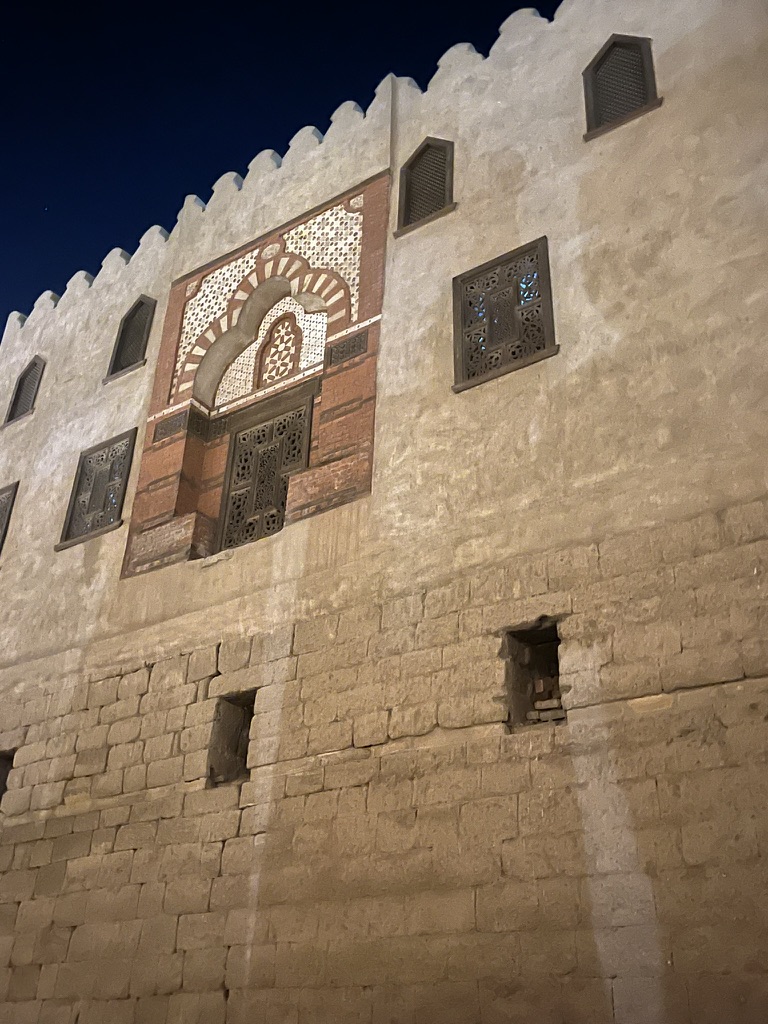
Look at this photograph carefully. You do not need a caption. The bottom half of the frame is ancient Egyptian sandstone — large, rough-cut blocks from the original pylon wall, 3,300 years old, with the small rectangular niches cut into the stone that once held wooden flagpoles flying the temple’s ceremonial banners. The top half is the plastered white facade of the Mosque of Abu Haggag — a 13th-century CE Islamic mosque with its ornate Moorish arch, latticed geometric windows, and crenellated roofline. The seam between them runs horizontally across the middle of the photograph, clean and unambiguous. This is what 3,300 years of unbroken religious use looks like from the outside.
There is no other building on earth quite like this. The mosque is not beside the temple, or near the temple, or built from temple stones. It is built on top of the temple, its foundations resting directly on the ancient pylon walls, its floor sitting at the level the medieval town had reached after centuries of Nile silt and accumulated debris had buried the Egyptian structure beneath it. The mosque’s congregation has been climbing up to pray here since the 13th century. They are still climbing up today.
✍️ The Temple That Was Buried Alive
After the decline of ancient Egyptian religion (roughly 4th–5th century CE), the Luxor temple gradually stopped being maintained. The annual Nile floods deposited silt year after year. Mud-brick houses were built on top of the silt. More silt. More houses. Over roughly 1,400 years, the town of Luxor simply grew upward and over the temple, layer by layer, until the upper sections of columns were poking out of the ground at what was then street level, and the lower sections were completely underground.
This is why:
The mosque sits so high — its 13th-century floor is the old town level, meters above the ancient temple floor
The colossal statues in Ramesses II’s court were buried to the chest or higher when found
The Avenue of Sphinxes was entirely underground with houses built directly over it
Some columns in the court still show the old soil line — a faint discoloration on the lower drums where the stone was buried for centuries versus exposed to air above
So when you look at the photo of the mosque wall again — that seam halfway up where the ancient Egyptian stonework meets the medieval mosque facade — that seam is roughly where the ground level was in the 13th century when Abu Haggag arrived. Everything below it was underground. Everything above it was the visible world.
🕌 The Mosque That Refused to Move
The Mosque of Abu Haggag is named after a local Islamic holy man, Yusuf Abu Haggag, who settled in Luxor in the 12th century and is buried beneath the mosque floor. His tomb became a pilgrimage site, and the mosque was built around it — on top of the ancient temple walls that were, at that point, buried and forgotten under the medieval town.
When European archaeologists began seriously excavating Luxor Temple in the 1880s, the mosque presented an obvious problem: clearing the temple fully would require demolishing it. The solution adopted — and maintained to the present day — was simply to leave it in place. The mosque has an active congregation. Friday prayers are still held. The muezzin’s call to prayer drifts down over the columns of Amenhotep III every week, as it has for 800 years.
This is not a compromise or an oversight. It is a deliberate acknowledgment that the religious life of a place does not stop because archaeologists arrive. Luxor Temple was never a dead monument waiting to be rediscovered. It was always in use. The mosque is proof.
✍️ The Full Inventory: Four Religions, One Site
The mosque is the most visible layer, but it is not the only one. Luxor Temple has been repurposed by every major religion that passed through Egypt:
Egyptian (1390 BCE – ~4th century CE): The original temple, dedicated to Amun-Ra, in continuous ritual use for nearly 1,800 years.
Roman (1st–3rd century CE): The Roman army converted the innermost sanctuary into a military shrine dedicated to the Imperial Cult. They plastered over the Egyptian wall paintings, painted their own frescoes, and installed a small Roman apse. The plaster has mostly crumbled away now — in the sanctuary room you can see Roman architectural framing with Egyptian gods visible through the cracks behind it.
Christian (4th–7th century CE): After Constantine legalized Christianity, a Coptic church was established inside the temple complex. Crosses were carved into column walls. Some of the Egyptian reliefs were plastered over for the second time in the same rooms. Traces remain if you know where to look.
Islamic (13th century CE – present): The mosque, still active, still climbing above the ancient stones in the photograph above.
The seam you can see in this photograph — rough ancient sandstone below, smooth medieval plaster above — is not just an architectural curiosity. It is the most compressed timeline of human religious history in a single frame that exists anywhere on earth.
🎯 Trivia Worth Knowing: The Niche in the Wall
Look at the lower half of the photograph again. You can see small rectangular cutouts in the ancient stonework — three of them are visible just above ground level. These are flag-pole niches, cut into the pylon face to hold the cedar poles from which the temple’s enormous ceremonial pennants flew. The poles themselves are long gone, but every major Egyptian pylon had them — you can see similar niches at Karnak and at Edfu.
In antiquity, the flags would have been visible from across the Nile, billowing above the temple entrance, marking the house of the god from miles away. Now the niches are dark holes in a wall that has a mosque sitting on top of it. The ancient Egyptians, if nothing else, built things that lasted long enough to become someone else’s foundations.
The Wall Where Three Civilizations Meet
Most people walk straight through this room on their way to something more photogenic. Don’t. Stop and look at the corner.
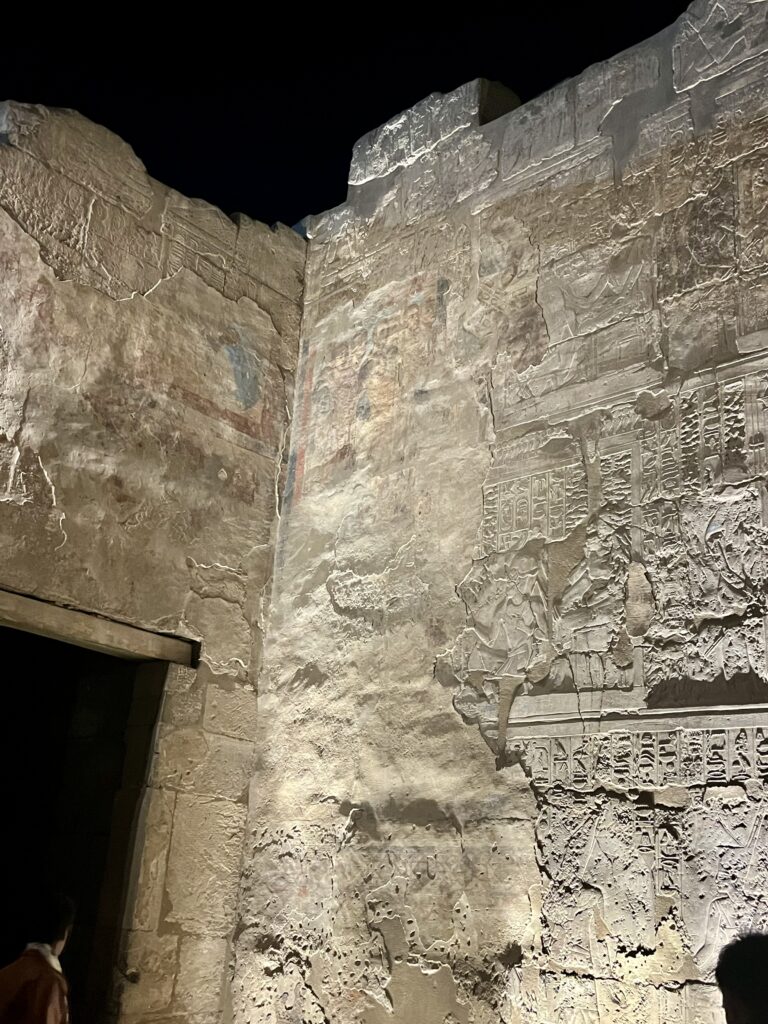
The left wall is flat, grey, and cracked — that’s Roman plaster, slapped on by the Roman army garrison sometime around the 2nd century CE when they decided to convert this Egyptian sanctuary into their own military shrine. The right wall is covered edge-to-edge in carved Egyptian figures and hieroglyphs — that’s the original 3,300-year-old decoration that the Romans apparently couldn’t be bothered to cover. And along the left edge, where the Roman plaster has been slowly peeling away for the last 1,700 years, you can see the original Egyptian paintwork bleeding through — still red, still blue, still vivid — underneath.
🎨 The Paint That Survived Because It Was Buried Twice
Here is the irony: the Roman soldiers who plastered over these Egyptian paintings accidentally saved them. Sealed behind plaster in a dark room for 1,700 years, the original Egyptian pigment was protected from sunlight, wind, and tourists. Every exposed surface outside has bleached to pale beige. This paint, hidden behind someone else’s renovation, is still the original colour the Egyptian painters mixed 3,300 years ago.
The red is iron ochre — basically rust. The blue is a man-made pigment the Egyptians invented around 3,250 BCE by baking sand, copper, and calcium together. It was the world’s first synthetic paint colour, and some of it is still on this wall, still blue, because a Roman soldier covered it up and forgot about it.
🎯 Trivia Worth Knowing: Why the Romans Plastered Rather Than Carved
Every Pharaoh who came before them picked up a chisel and carved their own name and face into the existing walls. The Romans did not. Why?
Because Romans didn’t do carved walls. Their version of sacred decoration was fresco — painting on wet plaster — the same technique used in Pompeii, the Roman catacombs, and every Roman building from Britain to Baghdad. They weren’t vandals; they were just redecorating in the only style they knew. Plastering over 3,300-year-old Egyptian masterwork to put up the Roman equivalent of magnolia paint was, to them, perfectly normal interior design.
The Egyptians, for the record, would have been horrified. Blank wall space in an Egyptian temple was theologically unacceptable — empty space meant chaos, covered space meant order. The Romans had absolutely no idea they were committing a cosmic crime. They just needed somewhere to hang a portrait of the Emperor.
👁 Three Things to Spot in This Room
The color seam: Look along the left edge of the plaster where it meets the un-plastered wall. That thin strip of red and blue is the original Egyptian paint, exposed only where the plaster has fallen away.
The relocated door: The low doorway cut into the plastered wall was put there by the Romans — the original Egyptian entrance was somewhere else entirely. They moved the door to suit their own floor plan, with the same casual confidence with which they plastered over everything else.
✍️ The Full Timeline of This One Room
Four different civilizations. One sanctuary. Here is the complete handover record:
Period and Who
What They Did
Evidence Still Visible
~1390 BCE – Amenhotep III (Egyptian)
Built and decorated the sanctuary. Every wall carved and painted.
The densely carved right wall. The red and blue paint bleeding through the plaster on the left.
~2nd century CE – Roman military garrison
Converted the sanctuary into an Imperial shrine. Plastered over the Egyptian paintings.
The grey cracked plaster on the left wall. The semicircular Roman apse. The Corinthian columns.
~4th century CE – Early Christians (Coptic)
Scratched crosses into the walls. Used the space as a church. Plastered over some surfaces for the second time.
Faint cross carvings on column and wall surfaces throughout the temple.
since 13th century CE – Islamic community
Built the Mosque of Abu Haggag directly on top of the ancient pylon walls above. Still holding Friday prayers.
The mosque sitting on the ancient stonework — visible in the seam photograph in the previous section.
The Conqueror Who Dressed Up as a Pharaoh
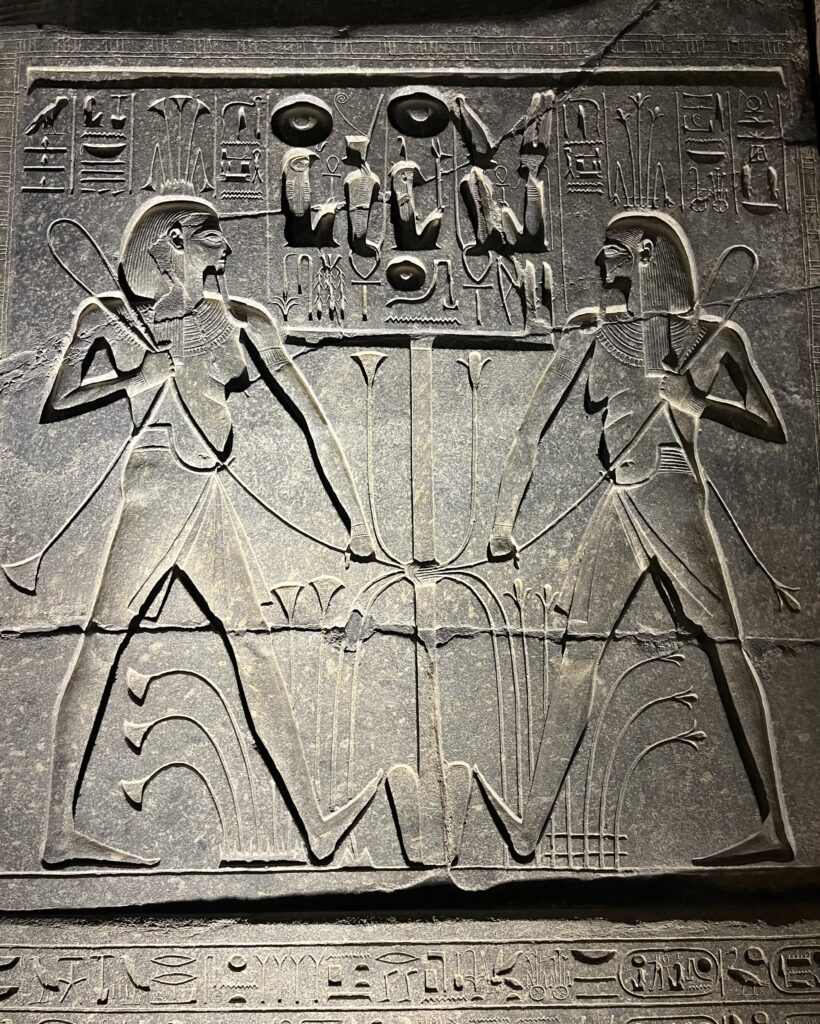
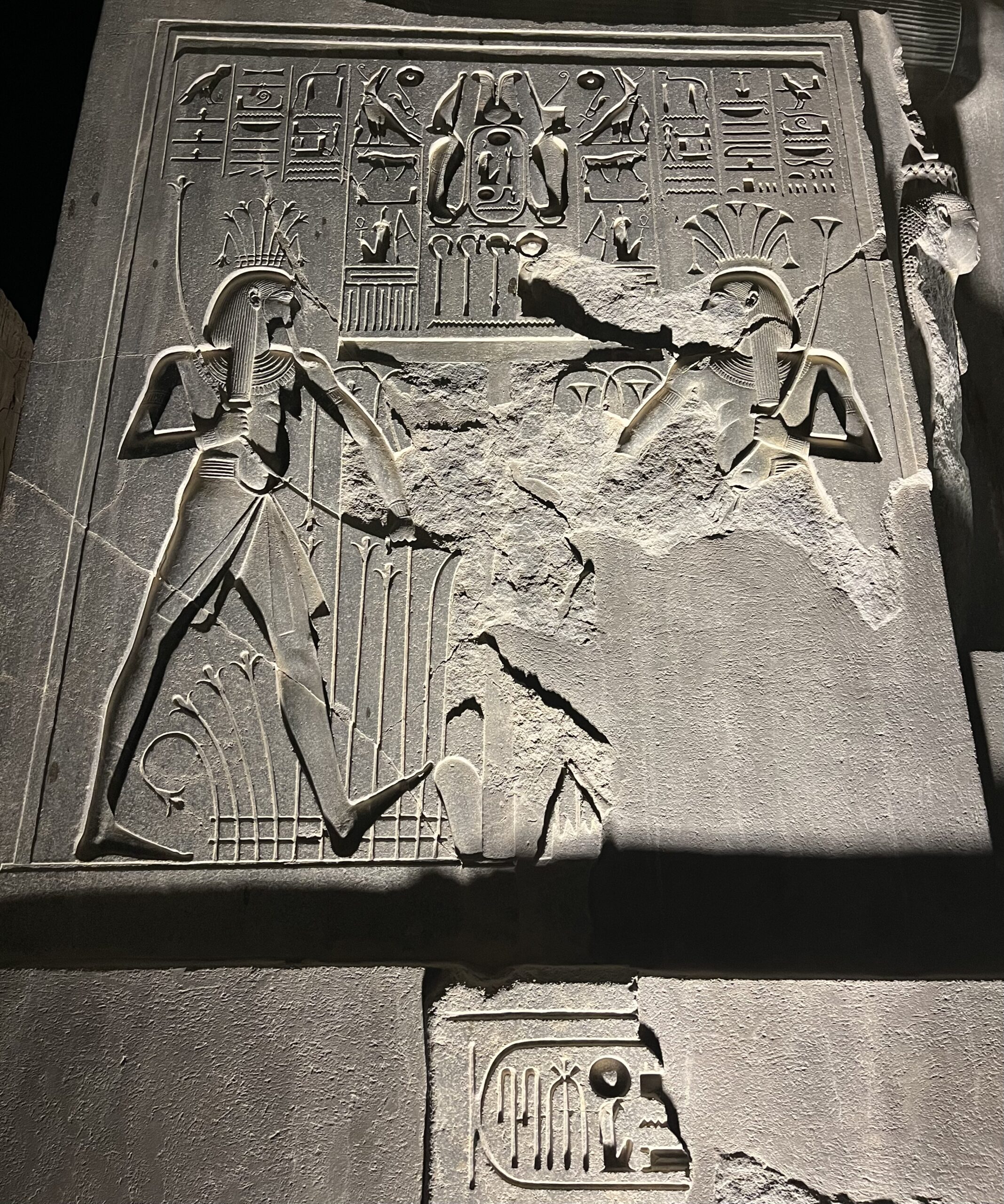
Before you look at the carvings, look at the stone. Dark grey, almost black, polished smooth. This is black granite — and it does not belong to the same temple as everything else you have been walking through. The warm beige sandstone everywhere else was built by Egyptian Pharaohs over 1,500 years. These two panels were commissioned by Alexander the Great, around 323 BCE, as part of a small inner shrine he had inserted into the heart of Luxor Temple after conquering Egypt.
Yes, that Alexander. The Macedonian. The one with the horse. He conquered Egypt at age 23, got himself declared the son of a god at a desert oracle, and — apparently feeling that paperwork was important — commissioned this granite shrine with himself carved in full Egyptian Pharaonic regalia, performing rituals before the gods as though he had been born to the throne. The two panels are opposite walls of that same tiny shrine. Together they tell the complete story of what Alexander needed Egypt to believe about him.
👁 Reading the Two Panels
Panel 1 (the intact image): Alexander — left figure, human head, tall feathered crown — faces a human-headed god on the right. That figure with the tall double-feathered crown is Amun-Ra in his classic human form, the King of the Gods and the supreme deity of Luxor Temple. Between them at the base is the sema-tawy — the lotus and papyrus bound together, the symbol of a unified Egypt. Amun is endorsing Alexander’s rule over the whole country. Alexander is accepting it. The transaction is carved in granite so nobody forgets.
Panel 2 (the damaged image): Alexander again on the left, same crown, same posture. The figure on the right is different — look carefully at the right edge despite the heavy damage and you can still make out the unmistakable profile of a falcon beak. This is Ra-Horakhty, the falcon-headed sun god, presenting Alexander with divine authority over the sun itself.
Look at the very base of Panel 2, below the main border. That rectangular cartouche — the oval loop that every Pharaoh used to sign their monuments — contains Alexander’s name written in hieroglyphs. A Greek-Macedonian name, transliterated sound by sound into the ancient Egyptian writing system, enclosed in the same royal seal that Narmer used at the very beginning of Egyptian history and Cleopatra would use at the very end. The hieroglyphic equivalent of signing your name in someone else’s alphabet on someone else’s most sacred wall. Alexander did it in granite, so it would last. It has.
🎯 The Oracle That Started All of This
When Alexander arrived in Egypt in 332 BCE, his first act was not military. He made a 500-kilometre detour into the western desert to visit the oracle of Amun at the Siwa Oasis — a journey so gruelling that several of his men nearly died of thirst. When he arrived, the chief priest greeted him as “son of Amun.” Whether this was genuine theology, diplomatic flattery, or carefully arranged political theatre is something historians have argued about ever since.
Alexander never publicly confirmed what the oracle told him in private. He never denied it either. He returned from Siwa as the legitimate divine Pharaoh of Egypt — the biological son of a god, by Egyptian theology — and these two granite panels are the permanent record of that claim. Amun on Panel 1 and Ra-Horakhty on Panel 2 are both confirming the same thing: this Greek-Macedonian conqueror is one of us.
🔨 Why Is the Falcon Panel Destroyed?
The heavy damage to Panel 2 is deliberate iconoclasm — almost certainly carried out during the Christian period in Egypt (4th–6th centuries CE). Early Christians moving through the temples systematically destroyed the faces and figures of pagan gods, because they had absorbed enough Egyptian folk belief to know that the image held the deity’s power. Destroy the image, neutralize the god.
Notice what the target was: specifically the falcon-headed Ra-Horakhty, and specifically the center of the panel where the ritual exchange between Alexander and the god was taking place. The left figure — Alexander himself — is largely intact. It was the god they were after. The Christian iconoclasts were not interested in erasing a long-dead Macedonian conqueror. They were interested in killing a pagan deity. The granite took the blow, Ra-Horakhty lost his face, and Alexander survived — which would not have surprised him in the slightest.
✍️ Alexander Never Came Back
Alexander left Egypt in 331 BCE and never returned. He died in Babylon in 323 BCE at age 32 — possibly typhoid, possibly poisoning, possibly his own lifestyle catching up with him. His tomb was built in Alexandria, the city he founded and named after himself, and has never been found. It is one of archaeology’s most persistent missing objects.
Egypt passed to his general Ptolemy, who founded the Ptolemaic dynasty — 300 years of Greek-speaking rulers who built Egyptian temples, wore Egyptian crowns, carved hieroglyphs they could not read, and presented themselves as Pharaohs. The last of them was Cleopatra VII — remarkably, the first in her entire dynasty who actually bothered to learn Egyptian. Three centuries of cultural cosplay, and it took until the very end for someone to learn the language. These two granite panels are where the whole performance began.
📍 Related Guides and Diaries
[My 12-Day Egypt Diary (Part 3)]: Luxor’s Tombs and the Journey Home — Karnak, Luxor Temple, the Valley of the Kings, Hatshepsut, Deir el-Medina, Medinet Habu, feluccas at sunset, and a 3 a.m. farewell to Cairo.
[Egypt Cultural Guide] — hospitality, food, hidden gems, and what Egypt gives you beyond the monuments.
[My 12-Day Egypt Diary (Part 1)]: Pyramids, Planning, and the Chaos of Cairo — arrival, the Citadel, Coptic Cairo, Giza, the GEM, and getting wonderfully lost in Islamic Cairo.
[My 12-Day Egypt Diary (Part 2)]: Aswan, Abu Simbel, and Sailing the Nile — the cruise decision, Nubian village, Philae, Abu Simbel at dawn, Kom Ombo, Edfu, the Esna Lock, and arriving Luxor by river.
Next in the series: Visual Guide To Egyptian Gods (Part 5): Valley of the Kings — Coming Soon
Hi, I’m Frank J – Egypt Self-Guided Travel. I explore Egypt solo and share tips, stories, and practical advice to help you plan your own adventures safely and enjoyably.