Karnak is not just a temple. It doesn’t have the quiet, isolated beauty of Philae, and it wasn’t built by a single king with a single vision. Karnak is a city. It is the ultimate ancient architectural arms race, where over thirty different pharaohs spent 2,000 years tearing down, building over, and out-sizing each other to prove who loved the gods the most. It is chaotic, massive, and entirely overwhelming—unless you know what you are looking at.
This is Part 3 of a new series: Egypt Travel Visual Guides. We’re breaking down the history of these massive sites through my own photography. Because Karnak is so large (you could fit multiple European cathedrals inside its main precinct), it is easy to get “temple fatigue.” These visual clues and “Tini-Tiny Details” will help you bypass the rubble and “read” the walls and columns like an expert.
In This Guide
Egyptian Gods Karnak – Fast Facts Before You Look at the Pictures
Karnak was the “Vatican” of ancient Egypt. During the New Kingdom, it was the administrative and religious center of the empire. The pharaohs believed that as long as the rituals at Karnak were maintained, the universe would function correctly. Because it was the most important religious site, every pharaoh from the Middle Kingdom down to the Ptolemaic Greek kings (like the ones who built Philae) had to leave their mark here.
The result is a 250-acre complex of overlapping pylons, halls, and shrines. The main, central axis that most tourists walk through is dedicated entirely to one god: Amun-Ra, the King of the Gods.
The Basics
Detail
Built by
Roughly 30 different Pharaohs (including Senusret I, Hatshepsut, Thutmose III, Seti I, and Ramesses II).
Date built
Begun ~2055 BCE (Middle Kingdom); continuously expanded through the Ptolemaic period (~30 BCE).
Location
East Bank of Luxor, ancient Thebes — the religious capital of Egypt’s New Kingdom.
What it is
The largest religious complex in the world. The main precinct is dedicated to Amun-Ra, his wife Mut, and their son Khonsu. (the war god).
The Avenue of Sphinxes: The Ultimate Bodyguards
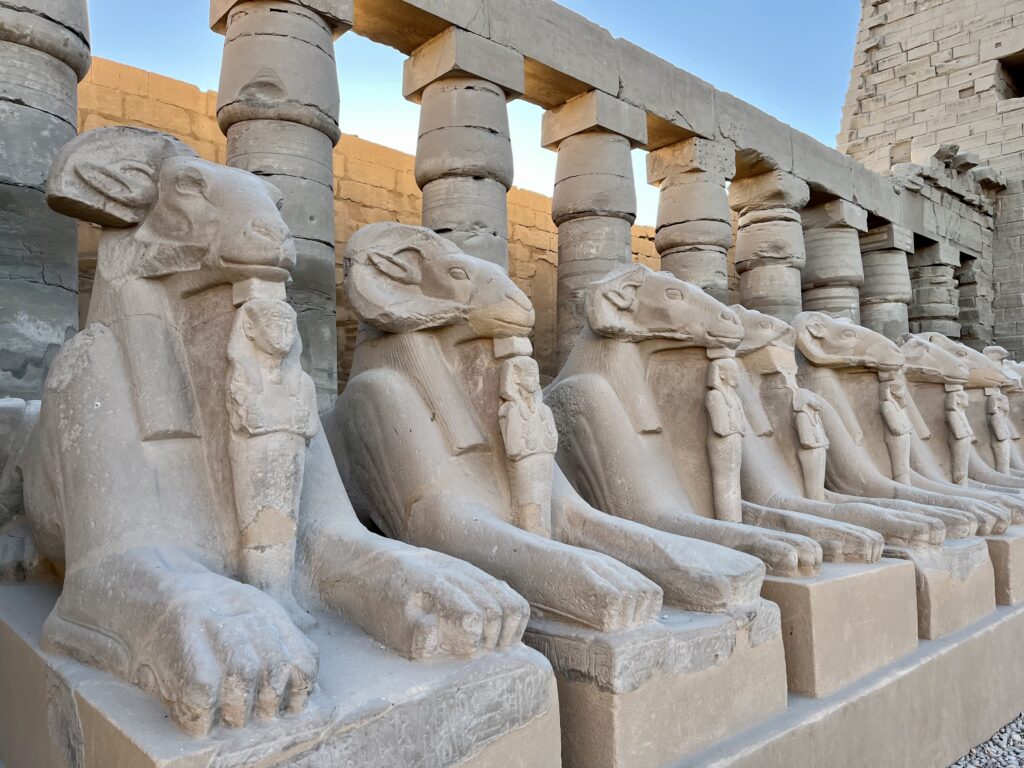
Before you even reach the First Pylon, you walk through a gauntlet of massive stone creatures. You are probably used to seeing sphinxes with human heads (like the one at Giza), but these are different.
The Ram Head: Look at the heavy, curved horns on the heads of these beasts. The ram is the sacred animal of Amun-Ra. By putting a ram’s head on a lion’s body, the architect is combining the supreme wisdom and creation power of Amun with the physical strength of a lion.
✍️ Who is Amun-Ra?
Amun-Ra is not actually one god; he is two gods mashed together for political and religious power.
Amun (“The Hidden One”): Originally, Amun was just a local god of Thebes (modern-day Luxor). He was the god of air and wind—invisible, everywhere, and mysterious.
Ra (“The Sun”): Ra was the ancient, supremely powerful sun god from the north (Heliopolis). He was visible, bright, and the creator of life.
When the kings from Thebes managed to conquer and unite all of Egypt (kicking off the Middle and New Kingdoms), they wanted their hometown god, Amun, to be the most important deity. To make the rest of the country accept this, the priests merged Amun with the already-famous Ra.
The result was Amun-Ra, the “King of the Gods.” He possessed both the invisible, mysterious power of the wind and the visible, life-giving power of the sun. He was the ultimate, undeniable creator of the universe.
🦁 Why the Ram + Lion (The Criosphinx)?
To the Ancient Egyptians, the ram (Ovis plura) was the ultimate symbol of virility and fertility. Because Amun-Ra was the “Creator of All Things,” the ram’s aggressive creative energy was the perfect match for a god who “breathed life” into the world.
When you see the ram-headed sphinxes (called Criosphinxes) lining the entrance to Karnak, you are looking at a “Power Combo”:
The Ram Head (Amun): Represents the soul, wisdom, and the life-giving spirit.
The Lion Body (Ra): Represents the fierce, physical protection of the Sun and the Pharaoh’s military might.
👁 How to Read a Ram Sphinx
Notice how the horns of the Karnak rams curl tightly around their ears. Amun’s name means “The Hidden One.” The spiral shape of the horns represents the infinite, complex nature of a god you cannot see, but whose power is everywhere.
Now look closely between the paws of the sphinxes. You’ll see a tiny statue of the King. This is a visual “insurance policy”—it shows that the King’s physical body (the lion) is guided by the god’s supreme wisdom (the ram).
🛠️ The Three Types of “Sphinxes” You’ll See
As you move away from the heart of the Amun-Ra temple at Karnak and walk the Avenue of Sphinxes (or Ram Road) towards the Luxor Temple, the rams (representing the god) slowly turn into humans (representing the king).
There are actually three distinct styles of statues along that 2.7-kilometer road. At the First Pylon of Karnak and the northern section of the avenue, the Sphinx appears in lion body and ram head, as in the picture, representing the wisdom/fertility of Amun + the physical strength of the Pharaoh; after exiting the Karnak temple in the south, it becomes a complete ram body and head; then when it goes further south of the avenue leading into Luxor Temple, it appears as a Lion body with a Human head.
Why do they change? Because the avenue was the stage for the Opet Festival, where the statues of the gods were carried from Karnak to Luxor Temple. At the Karnak end, the statues are Rams because you are in the “House of Amun.” The focus is on the God. At the Luxor end, the statues become Human-headed because Luxor Temple was dedicated to the “Royal Ka”—it was the place where the Pharaoh’s divine right to rule was renewed each year. The focus shifts from the God to the King.
The Great Hypostyle Hall: The Forest of Giants
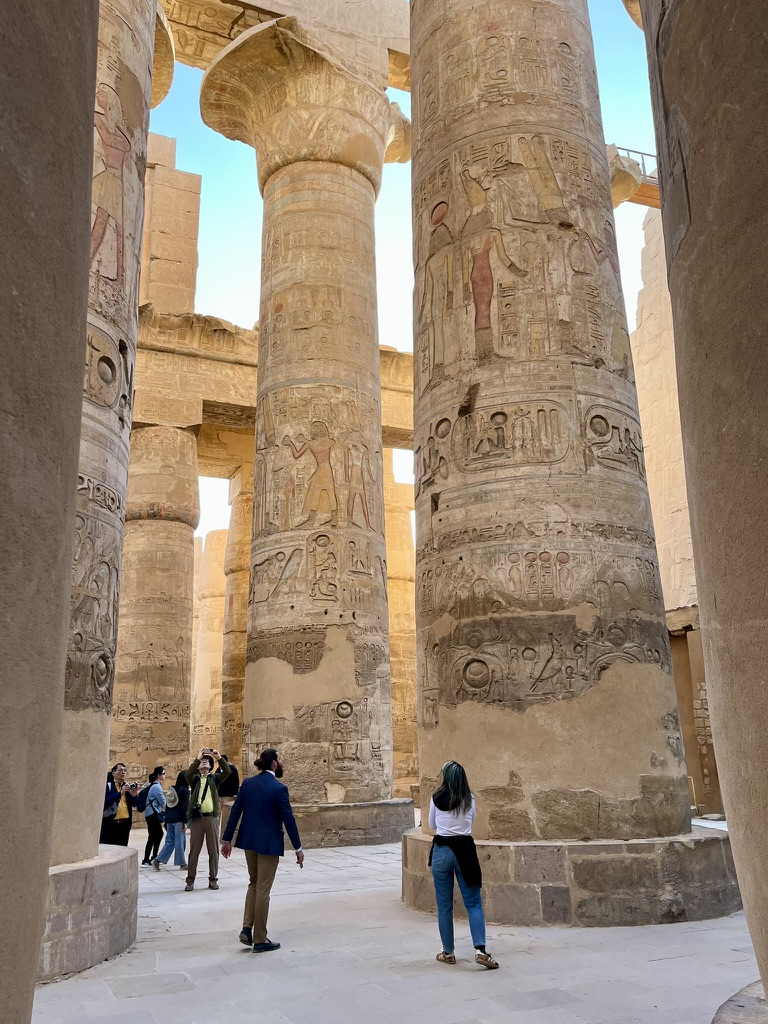
If you remember the West Colonnade from Philae, you know that Egyptian columns were designed to look like a primordial swamp. The Great Hypostyle Hall at Karnak takes this to the extreme. There are 134 massive sandstone columns here. It is so large that the Cathedral of Notre Dame could comfortably sit inside this single room.
The Egyptians believed the world began as a dark, watery swamp called Nun. As the primeval waters receded, a mound of earth emerged, and life began.
The Scale: By making the columns so massive and tightly packed, the architects created a literal “stone forest.”
The Symbolism: Walking into the hall is meant to feel like shrinking down and walking through a giant thicket of papyrus plants at the dawn of time. The columns aren’t just supports; they are the plants of the first marsh.
💡 The Open vs. Closed Papyrus Trick
To understand the genius of this room, look at the tops (the capitals) of the columns.
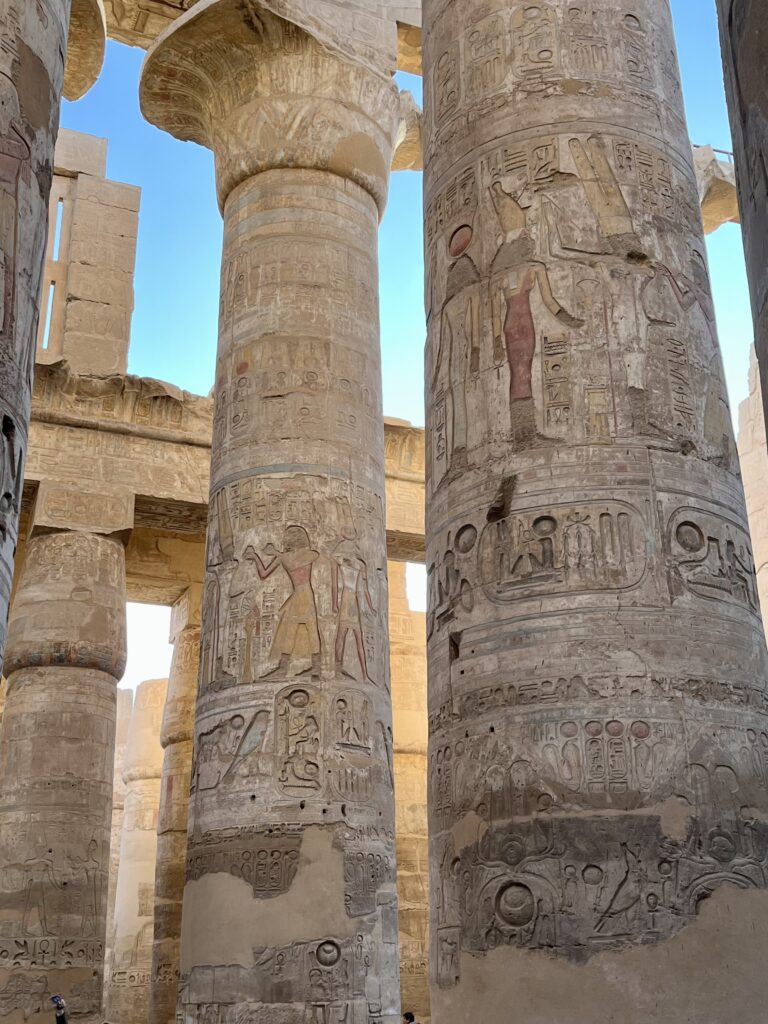
The Center Aisle (The Giants): Look at the 12 columns running straight down the middle. They are 69 feet tall, and their capitals flare outward in a wide bell shape. These are Open Papyrus flowers.
The Side Aisles (The Forest): Now look at the 122 columns on the left and right. They are shorter (42 feet tall), and their tops curve inward like a bud. These are Closed Papyrus flowers.
Why the difference? It is an ancient lighting hack. By making the center columns taller, the architects (working for Seti I and Ramesses II) created a gap near the ceiling. They installed heavy stone grids in this gap (clerestory windows) to let shafts of sunlight pour into the center aisle. The center papyrus flowers are “open” because they are touching the sunlight. The side columns are “closed” because they remain in the dark, swampy shadows of the temple.
✍️ Gradual Sacredness (The “Filter” Effect)
As you move from the bright, open courtyards into the massive, towering shadows of the Hypostyle Hall, the scale makes the human visitor feel small and insignificant. This serves to transition the traveler from the “world of men” into the “house of the god.” The overwhelming height of the stone was designed to “crush” the ego of the visitor, preparing them for the silence and darkness of the inner sanctuary where Amun-Ra lived.
A forest of 134 columns, towering above your head in near-darkness, lit only by clerestory windows high above — the psychological effect was entirely intentional.
👁 What Are the Carvings Actually Showing?
The walls and columns of the hypostyle hall are covered in two types of scenes that repeat across virtually every Egyptian temple — once you know what to look for, you’ll see them everywhere.
The Offering Scene (the “Gift Delivery”): The Pharaoh stands facing a god, arms extended, presenting offerings — wine, incense, flowers, or the symbol of Maat (a feather representing cosmic order). The god, usually seated or standing rigidly upright, receives the offering. The message is always the same: the King is doing his job as the intermediary between humanity and the divine. In exchange, the gods guarantee his rule and Egypt’s prosperity.
The Smiting Scene (the “Don’t Mess With Me”): The Pharaoh grips a cluster of enemies by the hair with one hand and raises a mace above his head with the other. A god stands behind him, endorsing the act. This is the most ancient scene in Egyptian art — it appears on the Narmer Palette from 3100 BCE and is still appearing at Karnak 2,000 years later. It is not a record of a specific battle. It is a statement of principle: the Pharaoh, backed by the gods, is the force that holds chaos at bay.
🎯 Trivia Worth Knowing: The Movie Columns
The columns in Karnak were used in the 1978 film Death on the Nile for the famous boulder scene — presented as Abu Simbel in the film. It was Karnak all along. The production team simply couldn’t get access to Abu Simbel for filming, so they used the hypostyle hall instead and hoped audiences wouldn’t notice. Most didn’t, but you do now.
The “Power Trio” of Thebes: Amun, Mut, Khonsu
Just like Philae had its “Triple Threat” of Osiris, Isis, and Horus, Karnak is ruled by the Theban Triad. You will see these three figures carved onto almost every wall, obelisk, and pylon in the complex.
Here, the right-hand column acts as a vertical “Who’s Who” of the gods.
On the top level: On the left is the guest star, the falcon-headed Ra-Horakhty (the sun god). The you see the “Parents.” First Mut in her signature Double Crown of Upper and Lower Egypt and vulture headdress, and finally Amun-Ra, the Father, King of the Gods, identifiable by his two incredibly tall, vertical ostrich feathers (plumes).
On the Bottom Level: This is where you found Khonsu, the son. He is the seated, mummy-shaped figure on the far right. He is easy to spot because of the large Lunar Disk (the moon) sitting in a crescent “bowl” on his head.
🌙 The Moon vs. The Sun
Many travelers mistake Khonsu for Ra because they both have a “circle” on their heads. The visual “cheat code” is simple: If the circle is solid and belongs to a falcon, it’s the Sun (Ra). If the circle sits in a crescent “bowl” and belongs to a mummy-shaped figure, it’s the Moon (Khonsu).
🔴 The Survival of Red
Notice the reddish-brown paint still visible on the Pharaoh’s kilt and Mut’s dress. This isn’t modern restoration; it’s original 3,000-year-old pigment. Red was one of the heartiest colors because it was made from ochre (iron-rich earth), which survived the desert sun much better than the delicate blues and greens.
🛡️ The “Mummy” Defense
Unlike his parents, who have visible arms and legs to show they are ready for action, Khonsu is wrapped like a mummy. This signifies his role as a god of healing and protection. The Egyptians believed that his “wrapped” form held immense magical energy that could be used to drive away evil spirits while people slept under his moon.
☀️ The “Solar Showdown”: Ra-Horakhty vs. Amun-Ra
When you are looking at the walls of Karnak, you’ll see two different gods who both seem to be “The Sun.”
Ra-Horakhty (The Morning Sun): Always has a Falcon Head topped with a simple, bright red Sun Disk wrapped by a cobra (the uraeus). His name means “Ra-Horus of the Two Horizons.” He represents the sun at its most energetic—rising in the east and setting in the west. He is the god of action, light, and the physical sun you see in the sky.
Amun-Ra (The Creator): Usually has a Human Head wearing a flat-topped crown with two tall, vertical ostrich feathers. He is the “merged” version of the mysterious wind god (Amun) and the sun (Ra). He represents the supreme power of the universe. While Ra-Horakhty is the light of the sun, Amun-Ra is the soul behind it. He is the CEO; Ra-Horakhty is the Head of Operations.
As the “King of the Gods” in Thebes (Luxor), Amun-Ra has a clear family unit: his wife Mut (the Mother) and his son Khonsu (the Moon). You see this “Power Trio” everywhere in Karnak. Ra-Horakhty, on the other hand, doesn’t really have a “family” at Karnak. He is usually depicted as a lone power or associated with the Pharaoh. In Egyptian mythology, Ra is often seen as the “Grandfather” of all gods, existing before everyone else.
The Obelisks: The Family Feud in Stone
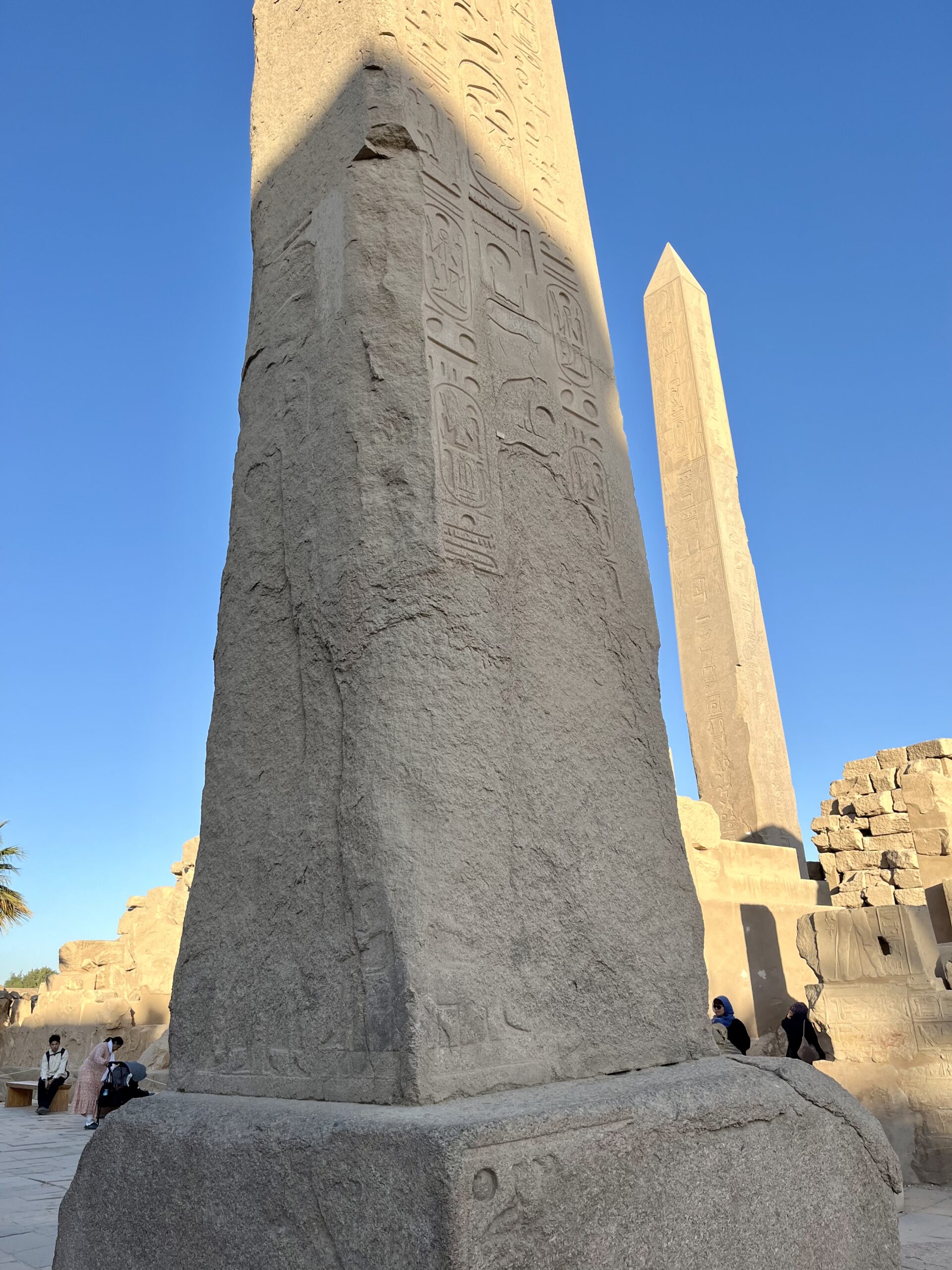
As you walk past the Hypostyle Hall, you will see two massive needles of solid pink granite piercing the sky. These are the obelisks of Thutmose I (the shorter one) and his daughter, the female Pharaoh Hatshepsut (the taller one).
Hatshepsut’s obelisk is the tallest surviving obelisk in Egypt (nearly 97 feet tall and 320 tons). After she died, her stepson, Thutmose III, tried to erase her legacy. But rather than spending the massive resources required to tear her giant obelisk down, he built a tall sandstone wall entirely around it to hide it from public view.
The Irony: That wall actually protected her obelisk from weathering for thousands of years. When the wall eventually fell away, her obelisk was in better condition than anyone else’s in the temple!
👤 Hatshepsut’s Stolen Obelisk
Hatshepsut (yes, the same Hatshepsut who was honored in the Temple of Hatshepsut on the west bank of Luxor) was Egypt’s most successful female pharaoh — she ruled for more than twenty years, officially presenting as male, depicted in the double crown and ceremonial beard in reliefs. Her father and she erected two obelisks at Karnak, both still standing, both among the tallest in Egypt. One reaches 97 feet.
After her death, her successor Thutmose III attempted to erase her from history: her name was chiselled from inscriptions, her statues were smashed and buried, her images were painted over. In the case of the obelisks — which were too large and too prominent to destroy — he built a wall of stone around them, hiding them from view while leaving them structurally intact.
When that wall was eventually dismantled by archaeologists, the obelisks were found perfectly preserved beneath it. Hatshepsut had anticipated something like this. Her obelisks are inscribed with the following: “Now my heart turns this way and that, as I think what the people will say — those who shall see my monuments in years to come, and who shall speak of what I have done.”
She was right. We are still speaking of what she did. Thutmose III is a footnote in her story.
⚡ The “Lightning Rod” for the Sun
The Egyptians called an obelisk a tekhenu. Its primary purpose was to act as a connection point between the earth and the sky.
The Function: When the sun rose over Karnak, the gold tip would catch the first light and reflect it across the city before the sun was even visible. It literally “captured” the sun god’s power and channeled it down into the temple.
The Shape: The four-sided pillar represents a single, frozen ray of sunshine.
The Tip: The pyramid shape at the very top (called a pyramidion) was originally covered in electrum—a mix of gold and silver.
You’ll notice that obelisks almost always came in pairs (🧐 you may wonder why Luxor Temple has a single one, we will discuss that in the Visual guide for the Luxor temple). They were placed like twin sentinels at the entrance (pylons) of a temple.
Balance: This represents the Egyptian concept of Ma’at (balance and harmony). You had one for Upper Egypt and one for Lower Egypt, or one representing the Day and one for the Night.
👁 How to Read an Obelisk
The Vertical Column of Hieroglyphs: Reading runs top to bottom on each face. The central column typically contains the royal titulary — the pharaoh’s five official names, each enclosed in a cartouche (an oval loop that indicates a royal name).
The Pyramidion at the Top: Even without the original electrum sheathing, look for the seam line where the main shaft transitions to the point. Many pyramidions carry their own separate inscription — a short dedicatory text to the sun god Ra, whose rays the tip was designed to receive first at dawn.
The Cartouches: Wherever you see oval loops in the inscriptions, those are cartouches — royal name enclosures. The loop represents the sun’s path encircling creation and the pharaoh’s name within it. Two cartouches side by side on the same face usually mean the pharaoh’s birth name and throne name are both recorded.
✍️ The Obelisk That Left Egypt
One of Karnak’s obelisks now stands in Istanbul’s Hippodrome, where the Roman Emperor Theodosius I had it erected in 390 AD. It took 32 days to raise it. The base is decorated with scenes of Theodosius watching chariot races, which has nothing to do with Karnak or Amun — but that is what happens to ancient monuments when empires change hands. The original obelisk was carved for Thutmose III, around 1450 BCE. It had already been standing for nearly 1,800 years when the Romans took it.
The Giant Scarab at the Sacred Lake: Seven Times for Luck
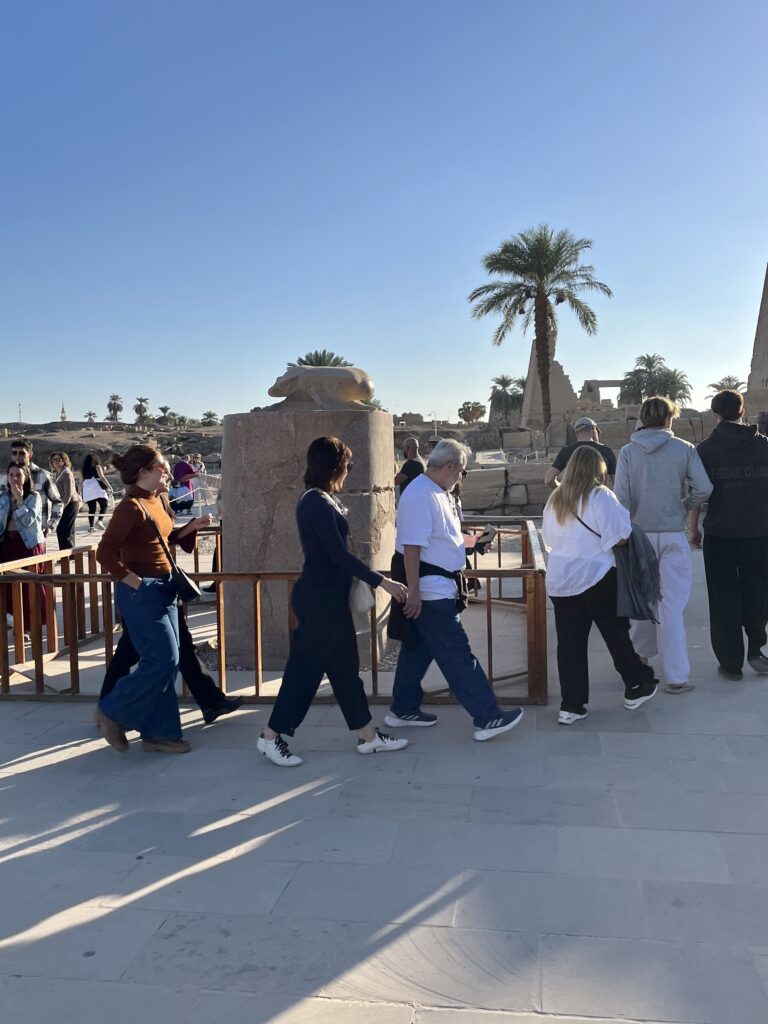
Beyond the main temple precincts, at the edge of the Sacred Lake, sits a large granite scarab beetle on a plinth. It is a symbol of Khepri — the scarab-headed god who represented the rising sun, transformation, and the cycle of rebirth.
The scarab beetle was observed by ancient Egyptians pushing balls of dung across the ground and burying them — a behaviour that, when you know nothing about beetle biology, looks exactly like a god rolling the sun across the sky and burying it at night. The Egyptians made Khepri the god of the dawn specifically because of this association: every morning the sun rose anew, “reborn” from the earth, just as the scarab beetle’s eggs hatched from their buried dung ball.
❓ How Many Times do I Walk Around the Scarab
Most guide at Karnak will tell you to walk around it seven times for luck. The number seven was sacred in Egyptian cosmology — representing completeness, the seven stars of the Big Dipper, the seven Hathors who predicted a child’s fate at birth. Whether seven circuits around a granite beetle delivers anything useful is genuinely unclear. It produces a smile in a place of considerable weight and scale, which may be the actual point.
However, depending on who you ask at the temple, the number of laps can change the “reward.”
3 Times
General good luck for the rest of your trip.
5 Times
Success in business, wealth, or finding a new job.
7 Times
Specifically for marriage or fertility (finding a partner or having a child).
9 Times
To get rid of a “bad luck” streak or a specific problem.
🔄 The “Anti-Clockwise” Rule
If you believe the myth, you must walk counter-clockwise. This mimics the direction of the sun’s journey or the way athletes run around a track.
Since the scarab represents Khepri (the rising sun), circling it in this direction is seen as “powering up” the monument. You are essentially walking in harmony with the sun’s daily journey from birth to rebirth.
In addition, walking counter-clockwise keeps your left side—the side of your heart—closest to the sacred stone. In many ancient traditions, keeping the heart toward the object of veneration is a sign of respect and spiritual “attunement.”
🎯 Trivia Worth Knowing: The Scarab and the Heart
In the Book of the Dead, the most important object placed on a mummy was a heart scarab — a carved beetle placed over the heart before burial, inscribed with Chapter 30 of the Book of the Dead. This text instructed the heart not to testify against its owner during the Weighing of the Heart ceremony, where the deceased’s heart was measured against the feather of Maat. If the heart was heavier than the feather, it was eaten by Ammit — a creature with the head of a crocodile, the forepart of a leopard, and the hindquarters of a hippopotamus. If it balanced, the deceased entered the afterlife.
📜 You mentioned Book of Dead. What is it?
The Book of the Dead is not a single “book”, but a personalized survival guide usually written on papyrus scrolls and placed inside the coffin or tucked into the mummy’s wrappings, containing roughly 200 different spells. Some were for opening doors, some were for turning into a bird to fly away from danger, and some were specifically to prevent your head from being cut off in the afterlife.
Chapter 30 (specifically 30B) of the book is arguably the most practical “life hack” in the entire Book of the Dead. It is the spell that addresses the Egyptian’s greatest fear: that their own heart would betray them during the final judgment. The Egyptians believed the heart (Ib) was the seat of intelligence and memory. When you stood before the scales of Osiris, your heart was the witness. If you had lied or stolen, your heart “knew” it. Chapter 30B provided a magical script to silence the heart. The text usually says: “O my heart… rise not up against me as a witness… speak not against me in the presence of the Great God.” —
The Dirt Pile That Explains Everything
Near one of the statues in the eastern precinct, there is a small remaining pile of compacted earth — left deliberately since excavation, protected by a small sign. It is easy to walk past. It is one of the most significant architectural clues to look at in the entire complex.
This is a remnant of the construction ramp used to build Karnak. Ancient Egyptian builders had no cranes, no pulleys, no mechanical advantage beyond rope and human muscle. What they had was earth. As a wall or column rose, they packed compacted earth against it — building an earthen ramp that extended outward as the structure grew taller. Workers dragged stone up the ramp. When the column or wall reached its intended height, they carved and decorated it from the top down — then removed the ramp from the outside in, leaving the finished surface exposed as the earth came down.
🎯 Trivia Worth Knowing: The Unfinished Pylon
The First Pylon — the massive gateway at the main entrance — is actually the youngest structure at Karnak and was never finished. Look at the top: it is noticeably lower and less refined than the pylons further inside the complex. The construction ramps were never fully removed. Archaeologists found mudbricks still piled against the outer face when excavations began. Whoever was building it stopped — perhaps the pharaoh died, perhaps funds ran out, perhaps the political situation changed. The ramp material is still partially in place inside the pylon’s upper chambers, visible to anyone who climbs to the roof. Karnak was still being built, 2,000 years after it began, when Egypt’s ancient religion finally came to an end.
🧱 The “Reverse” Construction
The ramp proves that Egyptians often finished the “decorating” of these walls from the top down. They would build the wall and the ramp to the very top, then carve the highest reliefs first. As they finished a section, they would remove a layer of the ramp, move down, and carve the next level.
✍️ Mud-Brick Durability
Even though it looks like “dirt,” it is composed of thousands of sun-dried mud bricks. The fact that it has survived for over 2,300 years in the middle of a busy temple complex is a testament to how solid these construction ramps were.
💡 Why is the “Pile” only at Karnak?
Almost all major stone temples in Ancient Egypt were built using this same “ramp-and-fill” method. If you look at other “finished” temples like Philae or Edfu, you can still see evidence of this building style. Look for small, uncarved stone nubs (called “bosses”) sticking out of the walls.
However, in many other temples, these ramps were “recycled.” Mud-bricks were valuable for local farmers to use as fertilizer (sebakh) or for building houses. Because Karnak was a sacred and protected enclosure, the ramp remained relatively undisturbed until modern archaeologists realized its value as a “blueprint” for how the temple was built.
The “Fallen” Obelisk of Hatshepsut
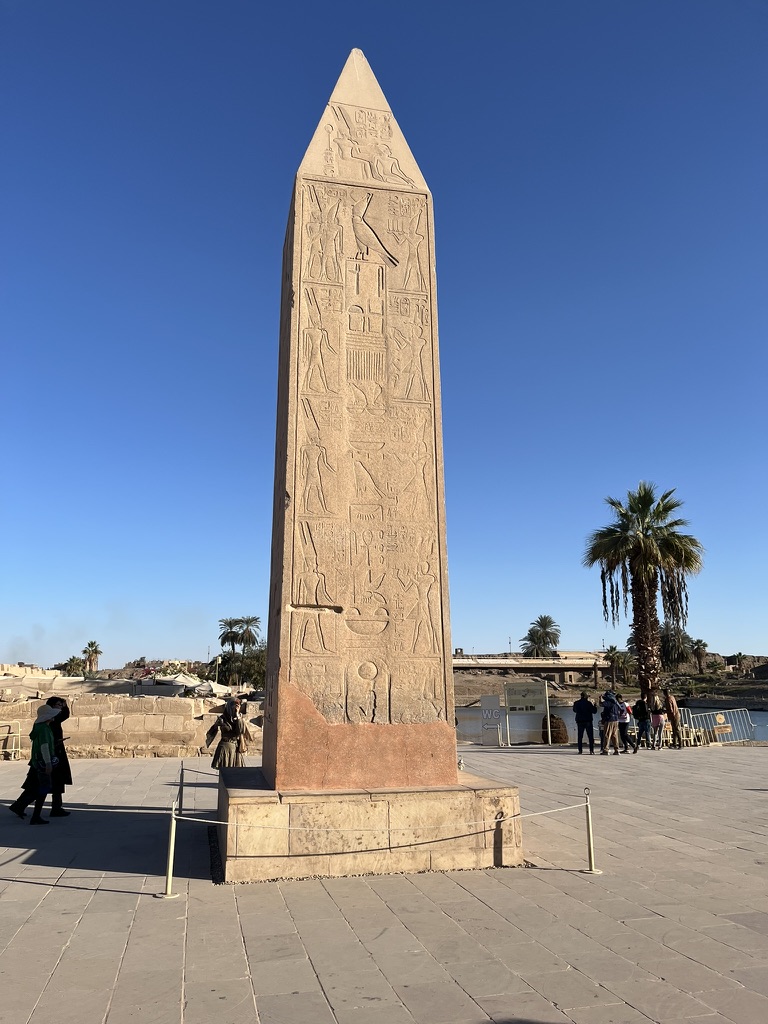
Hatshepsut originally erected a pair of massive red granite obelisks (each nearly 30 meters tall) between the 4th and 5th Pylons. One is still standing today (the tallest in Egypt), but its twin—the one in this photo—toppled over in antiquity, possibly due to an earthquake.
While it originally stood inside the main temple, this massive top section was moved near the Sacred Lake by archaeologists in the early 20th century so travelers could see the incredible detail of the carving up close.
🏛️ The “Fallen” History
This is the top section (the pyramidion) of Hatshepsut’s second giant obelisk. It originally stood over 90 feet tall near the 4th Pylon. When it fell (likely due to an earthquake centuries ago), the bottom shattered, but this top 30-foot section survived mostly intact.
For decades, archaeologists kept it lying down specifically so travelers could walk right up to it and see the delicate carvings. Around late 2021/early 2022, the Egyptian Ministry of Tourism and Antiquities officially re-erected it on a new high pedestal to protect the stone from ground moisture and “re-energized” the monument.
If you look around the area near the base of the standing section, you can often see smaller, jagged chunks of pink granite. Those are the “shrapnel” from the bottom two-thirds of the obelisk that didn’t survive the fall.
🔍 The Intimate Detail
TheKneeling: The reason this “small” piece is so special is that it allows you to see things that are normally 97 feet in the air. On the second right block on the faces of this pyramidion, you can clearly see reliefs of Hatshepsut kneeling before the god Amun-Ra.
The “Invisible” Electrum: look at the smooth, pointed tip. In ancient times, this entire top section was covered in electrum (gold and silver). Standing here by the lake, you can imagine how blindingly bright it would have been when it was at the very top of the monument, catching the first rays of the sun.
🕵️ The “Modern” Pedestal
Notice that the base it stands on now is plain, modern stone. This is a deliberate archaeological choice. By using a simple, uncarved base, experts make it clear to visitors which part is the 3,500-year-old original and which part is the 21st-century support structure.
🗺️ Obelisk,The Egyptian Original
The word Obelisk comes from the Greek word obeliskos (meaning “little spit” or “meat skewer”), but the ancient Egyptians called them Tekhenu. It is a 100% Egyptian invention.
In Ancient Egypt, an obelisk wasn’t just a tall stone; it was a “ray of the sun” turned into rock. The pointed top (the pyramidion) was meant to catch the first light of the morning sun, symbolizing the god Ra.
A true Egyptian obelisk is a monolith. It is carved from a single piece of granite. This is a massive engineering feat—the one you saw by the lake weighed hundreds of tons before it broke, yet it was pulled from the earth as one solid block. In comparison, modern obelisks are made of masonry, with tens of thousands of marble, granite, and sandstone “blocks”. In the Interior, an Egyptian obelisk is always solid, whereas the modern ones are hollow.
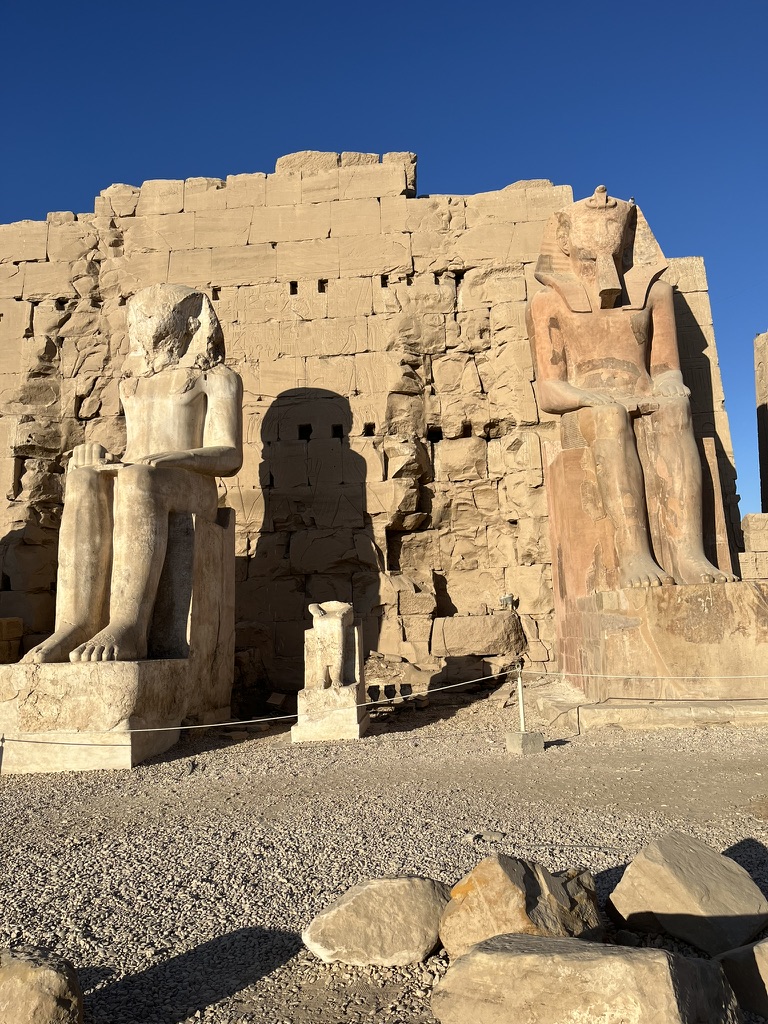
Thutmose III At The Seventh Pylon
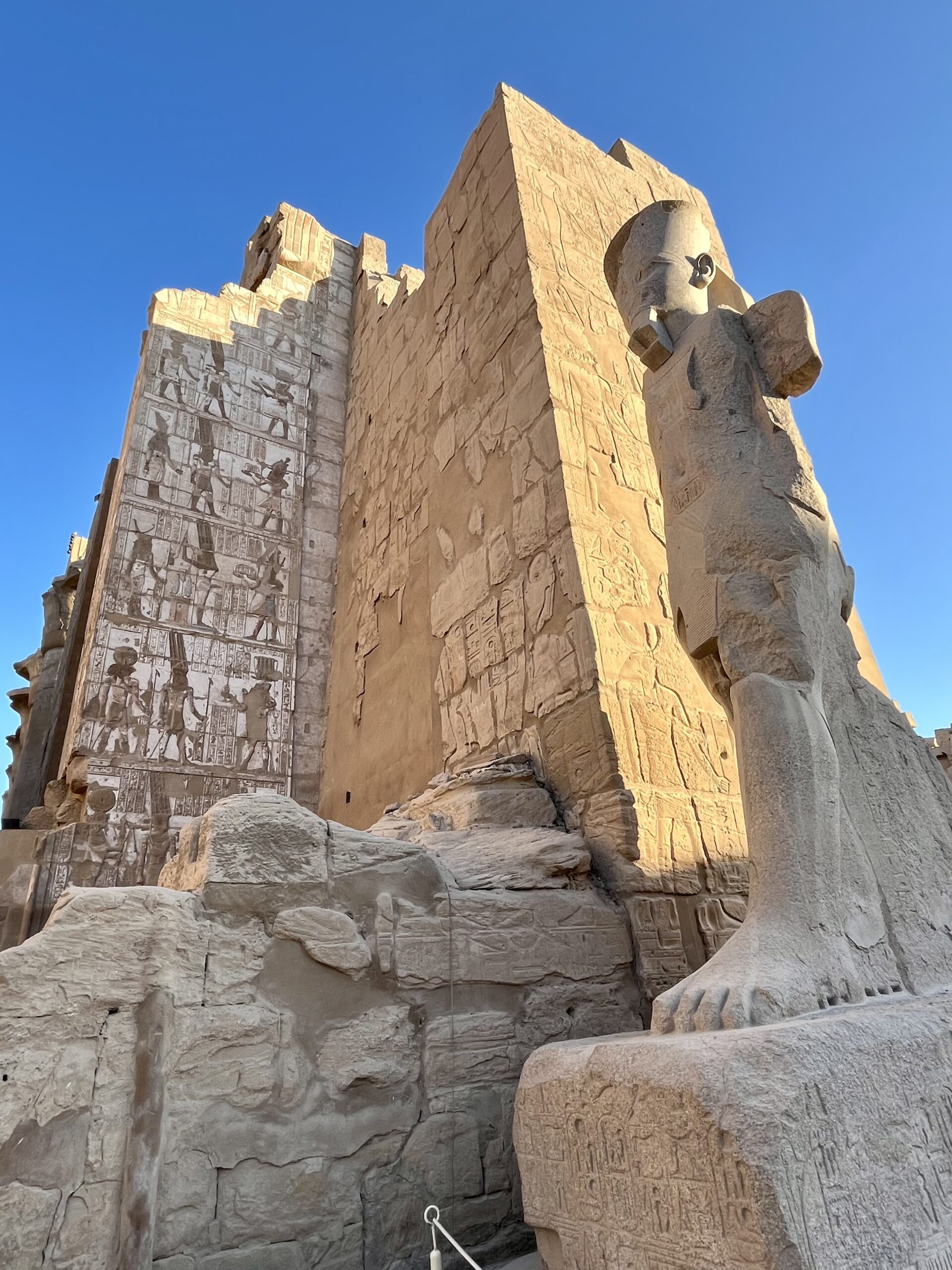
Both of the large seated colossi guarding the Seventh Pylon represent Thutmose III, the stepson and nephew of Hatshepsut who wanted to erase her legacy from the Obelisks (see The Obelisks: The Family Feud in Stone).
This area of the Seventh Pylon is the perfect example of why self-guided exploration beats a standard tour group every time. Most group itineraries are on a strict “clock” that only covers the “Greatest Hits”—the Hypostyle Hall and the Obelisks—before rushing back to the bus.
By venturing here, you’ve stepped off the main East-West “tourist highway” and onto the Southern Axis.
While thousands of people are shoulder-to-shoulder in the Hypostyle Hall, you likely had these colossi almost entirely to yourself. This allows you to actually feel the scale of the granite without a selfie stick in your line of sight. The path leads you toward what is often called the Karnak Open-Air Museum and the Sacred Lake. It feels more like a quiet archaeological park than a crowded monument. You can wander among the “blocks” of disassembled chapels that are being painstakingly put back together like a giant stone jigsaw puzzle.
🏛️ Thutmose III– Both Stepson and Nephew of Hatshepsut?
Hatshepsut was the daughter of Thutmose I. Hatshepsut’s husband (and the previous King) was Thutmose II, who was also her half-brother (they shared the same father, Thutmose I). Because Thutmose II was Hatshepsut’s brother, his son—Thutmose III—was naturally her nephew.
However, Thutmose III was not Hatshepsut’s biological son. His mother was a “secondary wife” (a non-royal woman named Iset). When Thutmose II died, Hatshepsut became the stepmother to the young Thutmose III.
👑 The Power Struggle: From Regent to Pharaoh
In a normal situation, Hatshepsut would have just been the “Queen Mother” or Regent, holding the throne until her stepson/nephew was old enough to rule.
The Military Training: While Hatshepsut focused on trade and architecture, Thutmose III was sent to the army. This turned out to be a massive advantage—he became one of the greatest generals in world history, expanding Egypt’s empire to its largest size ever once he finally took full control.
The “Promotion”: About seven years into their joint reign, Hatshepsut took the unprecedented step of declaring herself Pharaoh. She wasn’t just “acting” for him anymore; she was the King.
The Shadow Years: Thutmose III spent his teenage years and early twenties in a strange position. He was technically the King, but his aunt/stepmother was the one wearing the crown, leading the armies, and building the monuments at Karnak.
🔨 Was Thutmose III the “Bad Guy”?
For a long time, historians thought Thutmose III hated his step mother Hatshepsut and started chiseling her name off walls the second she died. However, Thutmose III didn’t start erasing her immediately. He waited until the end of his own reign (about 20 years after she died) to start the “attack.” Most Egyptologists now believe he did it to ensure his own son’s (Amenhotep II) right to the throne. By erasing the memory of a female king, he was “cleaning up” the official record so no one could challenge his family’s bloodline later.
⏳ 1st Pylon vs 7th Pylon, Who is Older
The7th Pylon (The Older Gate) was built by Thutmose III (around 1450 BCE) during the 18th Dynasty. At that time, this was the grand “Side Entrance” for royal processions coming from Luxor Temple.
The 1st Pylon (The Newer Gate) was built during the 30th Dynasty (around 380 BCE). Even though it’s the “first” thing you see when you enter today, it was actually the last major wall ever built at Karnak.
So they are nearly 1,100 years apart, and the 7th Pylon was actually built earlier.
While most buildings are built from the front to the back. Karnak was built from the inside out. The oldest parts are in the very center. As each new Pharaoh wanted to outdo the last, they added a new “front door” (Pylon) in front of the old one. By the time they got to the 1st Pylon, they had run out of space and time, which is why it remains unfinished with that “dirt pile” ramp still sitting there.
📍 Related Guides and Diaries
[My 12-Day Egypt Diary (Part 3)]: Luxor’s Tombs and the Journey Home — Karnak, Luxor Temple, the Valley of the Kings, Hatshepsut, Deir el-Medina, Medinet Habu, feluccas at sunset, and a 3 a.m. farewell to Cairo.
[Egypt Cultural Guide] — hospitality, food, hidden gems, and what Egypt gives you beyond the monuments.
[My 12-Day Egypt Diary (Part 1)]: Pyramids, Planning, and the Chaos of Cairo — arrival, the Citadel, Coptic Cairo, Giza, the GEM, and getting wonderfully lost in Islamic Cairo.
[My 12-Day Egypt Diary (Part 2)]: Aswan, Abu Simbel, and Sailing the Nile — the cruise decision, Nubian village, Philae, Abu Simbel at dawn, Kom Ombo, Edfu, the Esna Lock, and arriving Luxor by river.
Hi, I’m Frank J – Egypt Self-Guided Travel. I explore Egypt solo and share tips, stories, and practical advice to help you plan your own adventures safely and enjoyably.