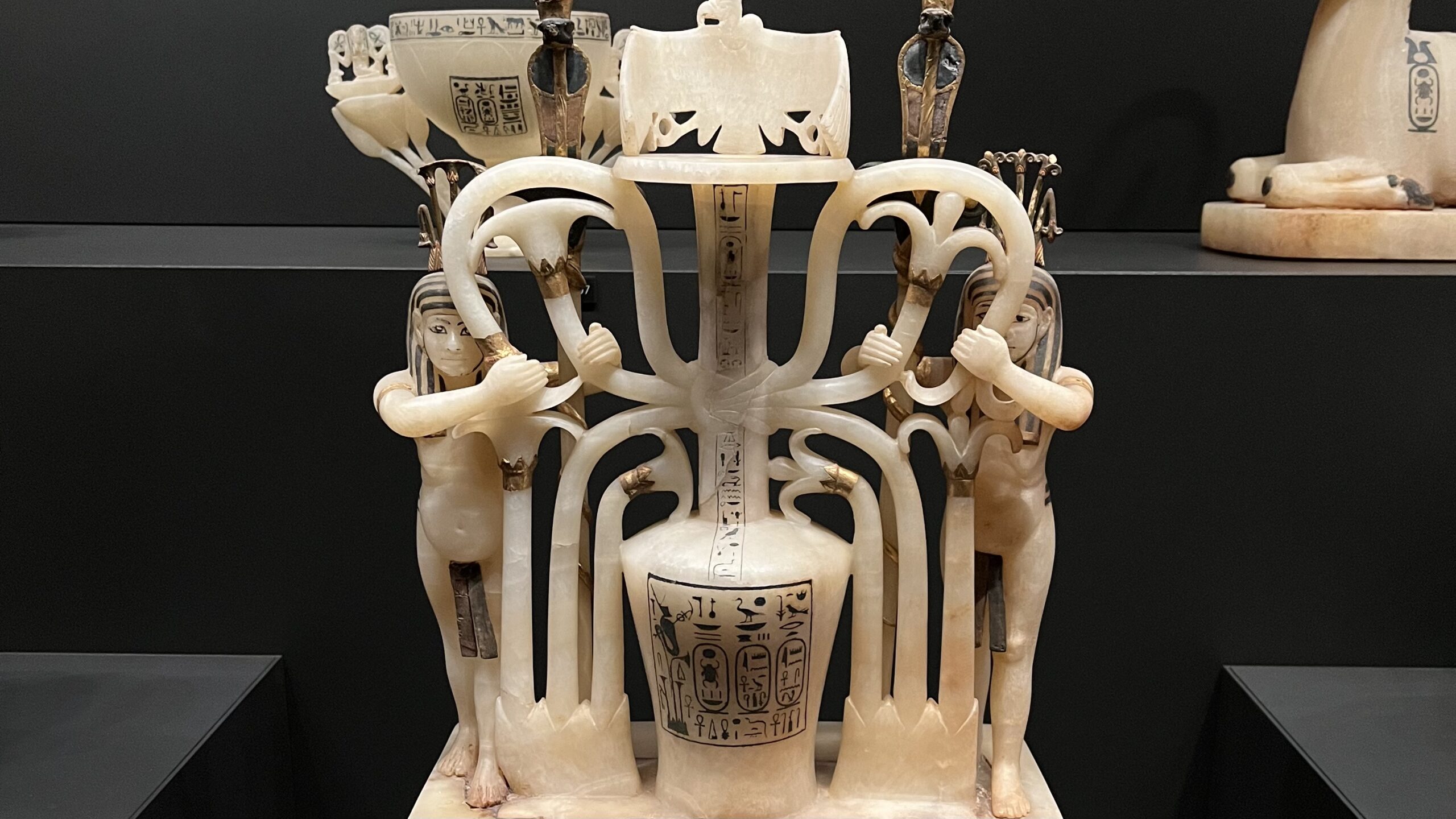
We originally planned the GEM as a supplementary stop after a morning at the Pyramids. We were wrong. By the time we walked out at nearly 9 p.m. on a Saturday — legs heavy, minds electric — it was clear that this is not just a museum. It is the most ambitious cultural institution on earth, and it deserves a full day to itself.
✍️ How to Use This Guide
This Grand Egyptian Museum guide covers everything you need to plan a self-guided visit to the GEM: the layout, every significant gallery, the must-see objects, tickets, dining, and how to get there and back without getting scammed. It draws on a full day spent here, plus the practical knowledge built up across the entire 12-Day Egypt series (Part 1, Part 2, and Part 3).
If you want the story of how our GEM day unfolded, including the Uber scam at the exit — read the Giza Uber Scam Section of the Diary..
📋 Table of Contents
I. First Impressions: What the GEM Actually Is
Most visitors arrive at the GEM after a morning at the Giza Plateau, which means they arrive already tired, already overwhelmed, and already carrying the weight of 4,500 years of history absorbed in four hours under a desert sun. This is a mistake of sequencing. The GEM is not a follow-up to the pyramids. It is their equal — a separate, full-day destination that happens to sit 2 km away.
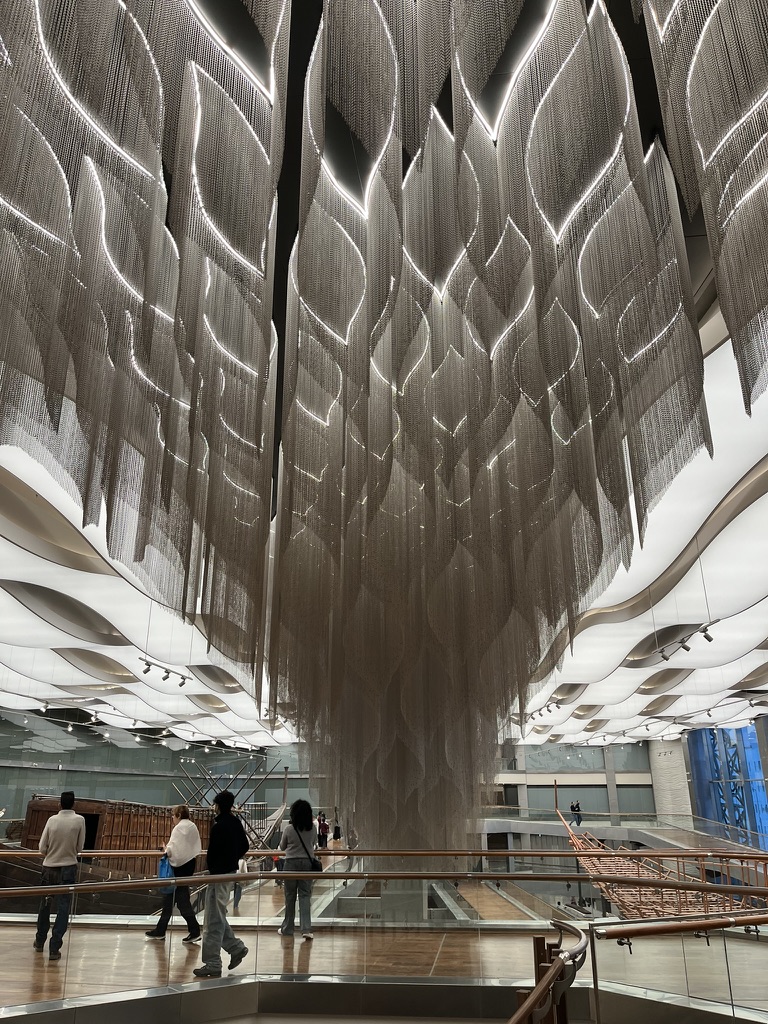
The building announces itself as you approach: a vast triangular glass façade on a scale that seems impossible until you’re standing in front of it. The sloping glass wall is subtly angled to frame the Giza Plateau in the distance, so the pyramids don’t disappear when you enter — they remain visible from inside, across the Grand Atrium and through the staircase landings, as if the building was designed to hold them in view the entire time you’re exploring what they left behind.
At 500,000 square metres — roughly 70 football fields — it is the largest archaeological museum in the world. The exhibition space itself covers 24,000 square metres, housing over 100,000 artefacts, including the complete Tutankhamun collection moved from the old Egyptian Museum in Tahrir Square. The rest of the complex houses conservation labs, research facilities, an education centre, dining, retail, and one of the most extraordinary buildings in modern Egypt.
Plan for a full day. If you’re combining GEM with the Pyramids (which is logical given the location), start at the Pyramids early to beat the tour group convoys, then cross to the GEM by midday and stay until closing. We arrived at noon and left at nearly 9 p.m. — and we didn’t feel we’d exhausted it.
II. Understanding the Layout: The “50-to-1” Scale
The GEM’s floor plan confuses first-time visitors because the exhibition space is a small fraction of the total complex. Understanding where everything is before you arrive saves meaningful time once inside.
The complex is organised around four major zones, all connected but distinctly different in character:
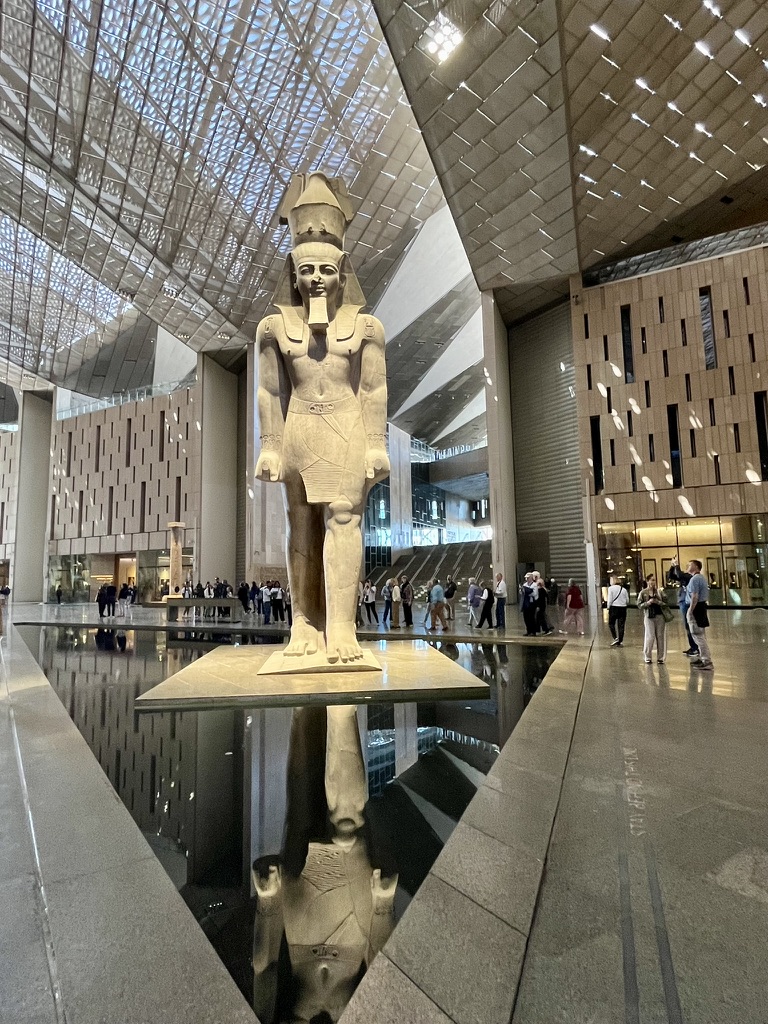
The Grand Atrium is the ceremonial heart — the vast entrance hall dominated by the 83-tonne Ramesses II statue, with the glass façade framing the pyramids behind it. This is where orientation happens and where the scale of the place first becomes real.
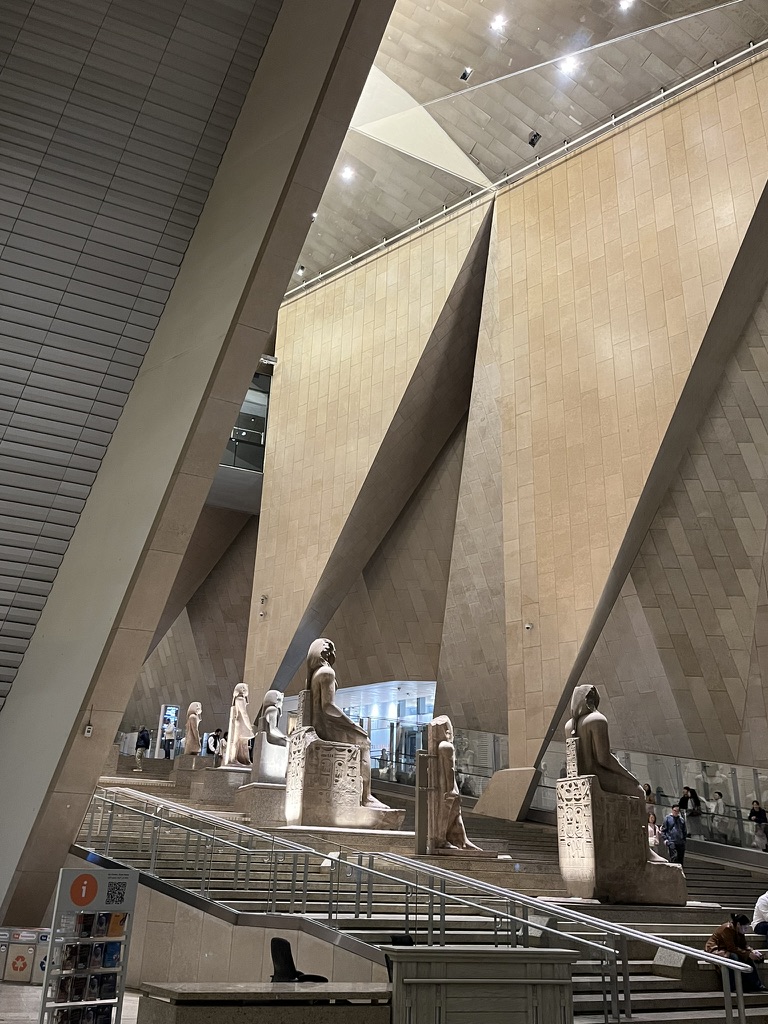
The Grand Staircase rises from the Atrium and serves as a vertical gallery in its own right — 60 colossal statues arranged across four thematic landings, taking you from the ground floor to the exhibition level. Moving walkways run parallel for those who prefer not to climb. The staircase is not just transit — it is a curated experience, and rushing up it on the escalator is a mistake.
The 12 Exhibition Halls radiate from the top of the staircase in a U-shaped flow. Halls are numbered 1 through 12 and arranged chronologically, covering Egypt’s history from prehistoric times through the Greco-Roman period. Each hall has its own thematic identity; the Tutankhamun Galleries occupy two of the twelve.
The Khufu Ships Museum is a separate building across the plaza from the main entrance. It’s included with the standard GEM ticket and houses one of the most astonishing artefacts in the world — a 4,600-year-old wooden solar boat, intact. Most visitors ask a staff member where it is only after they’ve finished the main galleries, by which point their legs are gone. Note its location at the start and visit before you run out of energy.
💡 The Orientation Move
Before entering the galleries, stand at the base of the Grand Staircase and look back through the Atrium toward the glass façade. The pyramids are framed directly in the centre of the view. The building was designed to hold that alignment — the geometry of the entrance mirrors the geometry of the plateau. It takes about ten seconds and reframes everything you’re about to see.
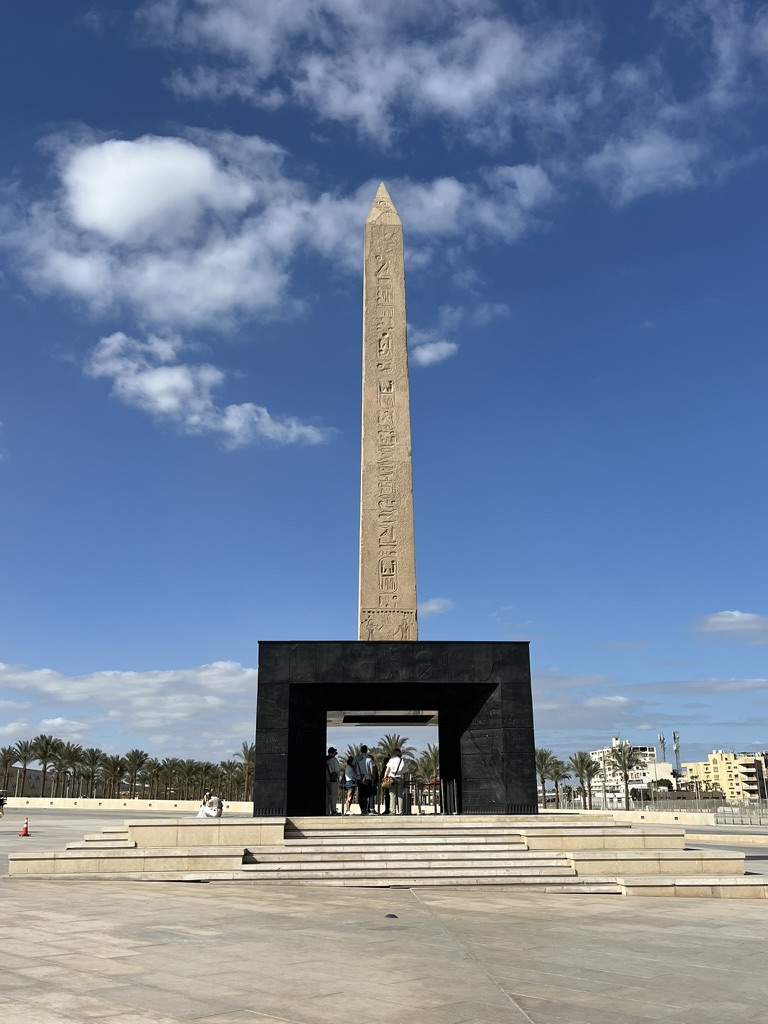
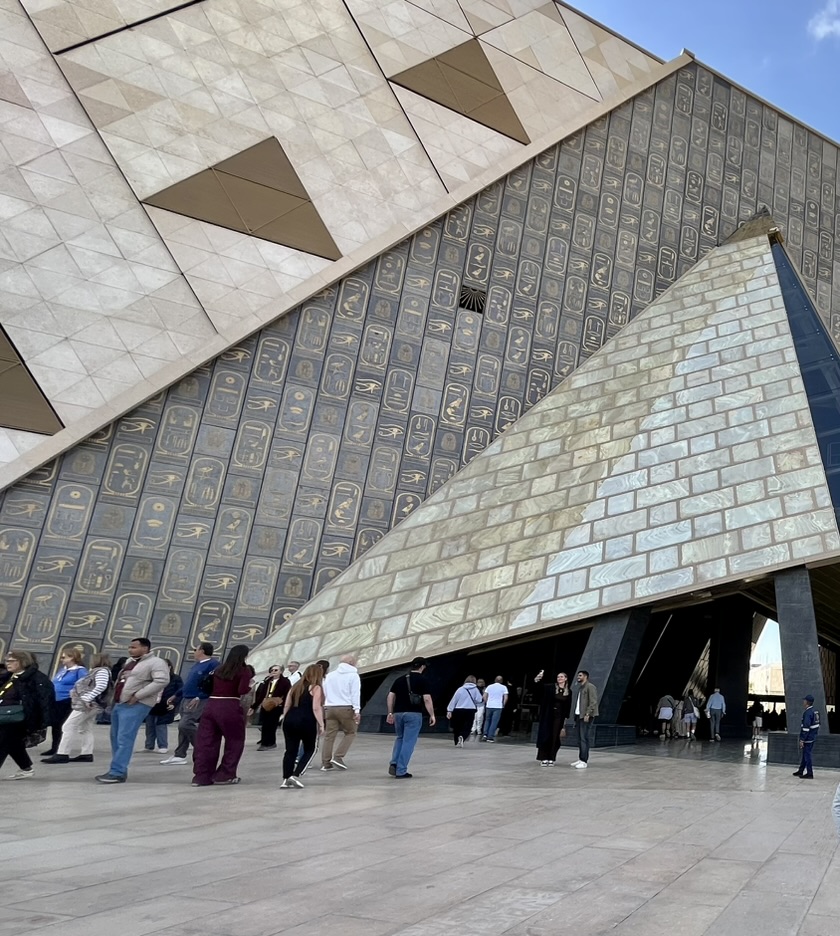
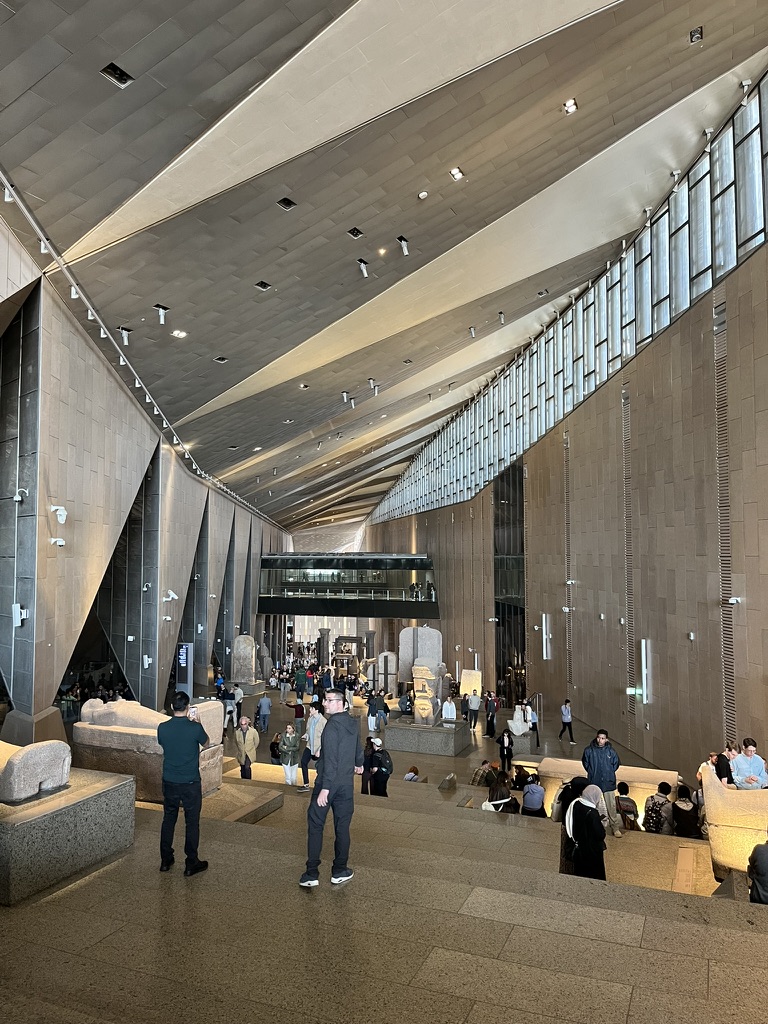
III. The Grand Atrium: Ramesses II and the Glass Wall
The Atrium is the first thing you encounter after the entrance plaza, and it sets the register for everything that follows. It is enormous — a cathedral-scale space of polished stone and structural glass — and at its centre stands the statue that has anchored the GEM’s identity since opening: the 83-tonne Ramesses II, relocated here from the Cairo train station where it stood for decades, now cleaned and restored and given the setting it always deserved.
The statue is 11 metres tall and carved from a single block of red granite. Even in a room built to accommodate it, it is overwhelming at close range. The detail on the headdress, the proportions, the calm authority of the expression — these are not the qualities of a monument designed to impress from a distance. They are the qualities of a sculptor who understood that Ramesses would still be standing here long after everything else was gone.
He was right. Ramesses II built more monuments to himself than any other pharaoh — Abu Simbel, the Great Hypostyle Hall at Karnak, the Ramesseum at Luxor. By the end of the trip, his face becomes familiar in a way that is almost companionable. The GEM is where you meet him properly for the first time.
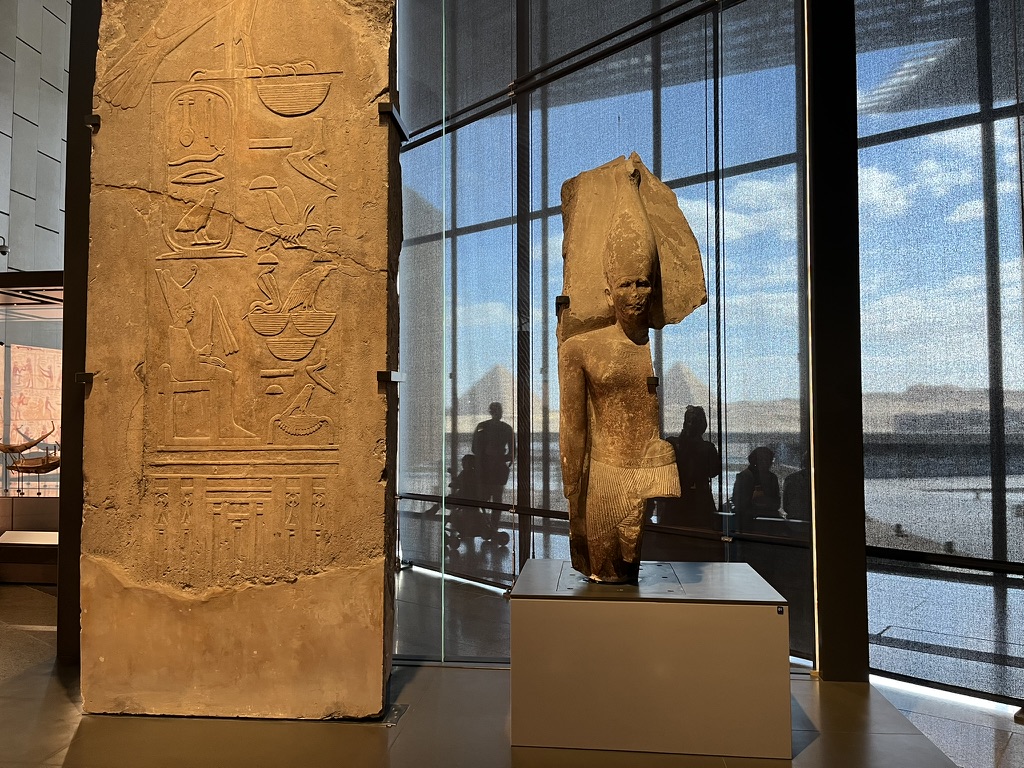
The glass façade behind the statue — floor to ceiling, spanning the full width of the Atrium — frames the Giza Plateau in the distance. On a clear day, all three pyramids are visible. The effect is intentional and genuinely extraordinary: a visual bridge between the artefacts inside and the monuments that produced them, 4,500 years compressed into a single sightline.
IV. The Grand Staircase: A Vertical Gallery of 60 Statues
The staircase that rises from the Atrium to the exhibition level is the most underrated part of the GEM, and also the most commonly rushed. Most visitors take the parallel moving walkway — a long, gently inclined escalator without steps that deposits you at the top in under two minutes. This is the efficient choice and the wrong one.
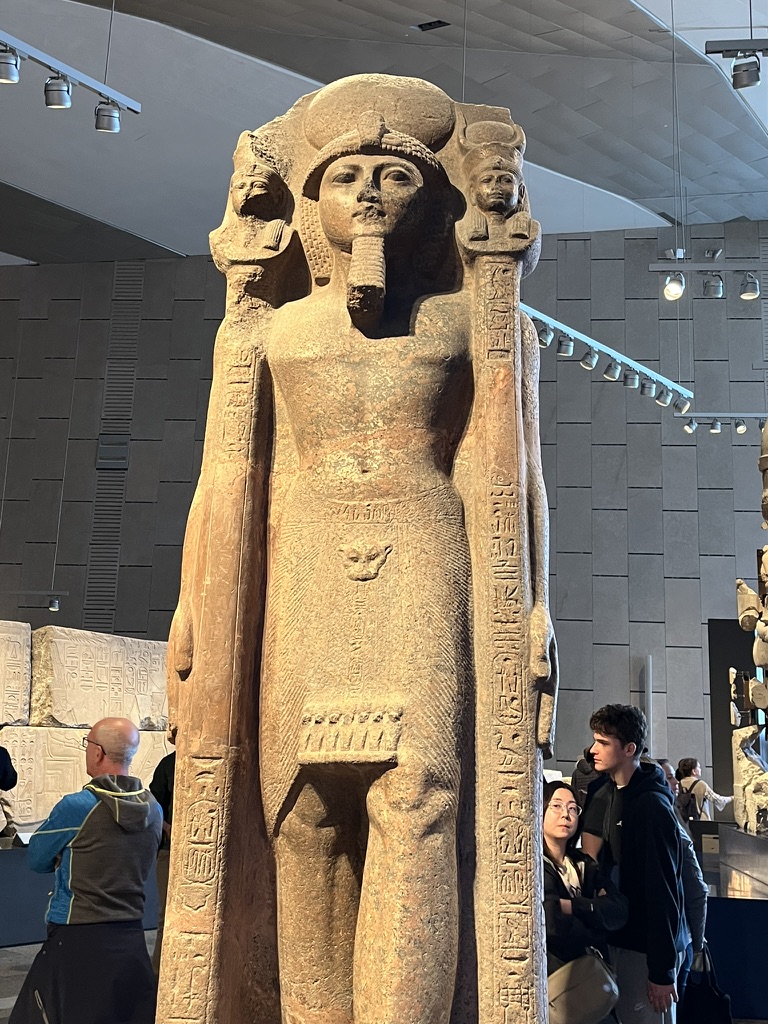
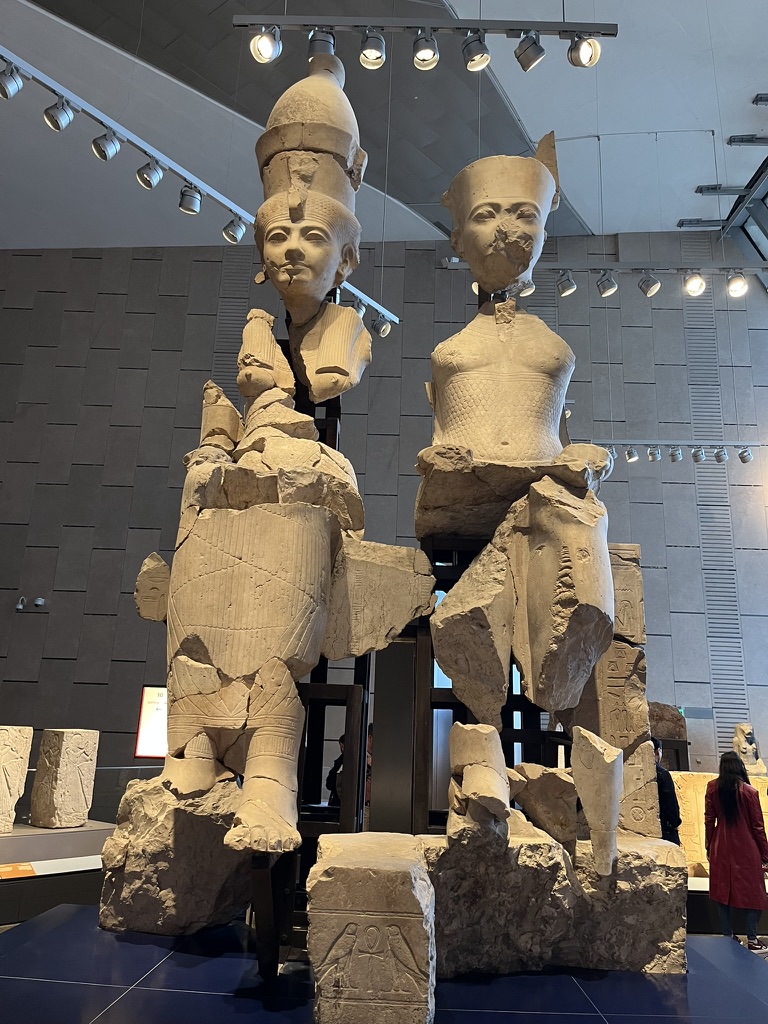
Walking the staircase means moving through a vertical gallery of 60 colossal statues, arranged in four thematic groups across four landings. The statues are not decorative — they are part of the chronological narrative, a who’s who of ancient Egyptian royalty spanning 3,000 years. Kings, queens, temple columns, and royal sarcophagi line the walls as you ascend, each landing revealing a different chapter before the galleries themselves begin.
The four groupings as you climb:
- Landing 1: Kings and queens of the Old and Middle Kingdoms — the earliest dynasties, the pyramid builders, faces that are idealised and formal.
- Landing 2: New Kingdom colossi — the era of empire, of Ramesses and Hatshepsut and Thutmose, where the statues become more confident, the expressions more commanding.
- Landing 3: Temple architectural elements — columns, lintels, and fragments that give a sense of the scale of the temples these figures once inhabited.
- Landing 4: Royal sarcophagi — the final threshold before the galleries, where the language shifts from life to death and afterlife.
V. The 12 Exhibition Halls: A Chronological Journey
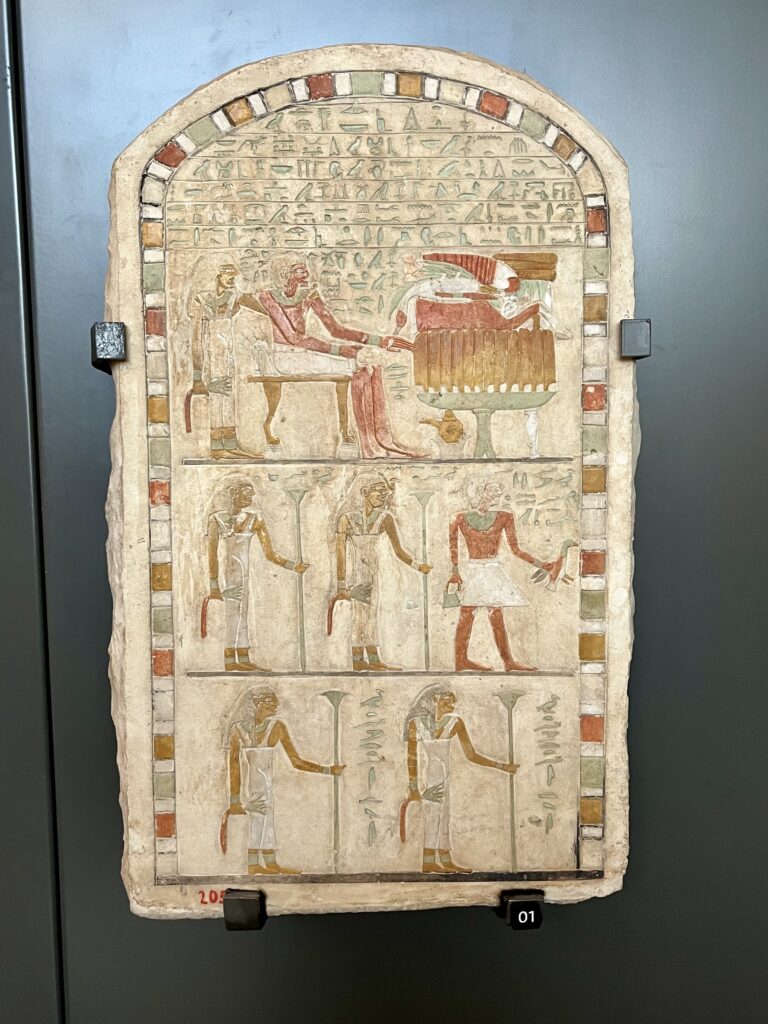
From the top of the staircase, the twelve exhibition halls radiate in a U-shaped flow. Following the hall numbers from 1 to 12 takes you on a chronological journey from prehistoric Egypt through the Greco-Roman period — roughly 7,000 years of human civilisation in a single afternoon.
The recommended approach is not to try to absorb everything equally. The GEM rewards selective depth over comprehensive coverage. Pick two or three halls that interest you most, slow down there, and move through the rest at a pace that keeps your energy for the Tutankhamun Galleries at the end.
| Halls | Era | Character | Must-See |
|---|---|---|---|
| 1–3 | Old Kingdom ~3100–2181 BCE | The age of the Pyramids — monumental, formal, mathematically precise | Narmer Palette (the world’s earliest political document), Statue of Khafre, Queen Hetepheres’ gilded bed |
| 4–6 | Middle Kingdom ~2055–1650 BCE | A more human era — the art becomes expressive, faces show weariness and individuality | Wooden models of daily life (boats, soldiers, farmers), the weary, realistic royal faces that mark this period’s style |
| 7–9 | New Kingdom ~1550–1069 BCE | The golden empire — this is Egypt at the peak of its power and artistic ambition | Statue of Akhenaten (the heretic king, his distinctive elongated features unmistakable), colossal Ramesses II, Hatshepsut statues |
| 10–12 | Late & Greco-Roman Period ~664 BCE–395 CE | A blended world — Egyptian iconography absorbing Persian, Greek, and Roman influences | The Fayum portraits (Roman-era mummy faces painted with extraordinary realism), hybrid Greco-Egyptian deity figures |
Grand Egyptian Museum Guide – Hall Highlights
Halls 1–3 (Old Kingdom) deserve more time than most visitors give them, because this is where the pyramids become comprehensible. The Narmer Palette — a 63 cm slate cosmetic palette carved around 3100 BCE — is the world’s earliest known political document, depicting the unification of Upper and Lower Egypt. It is a small object to be holding 5,000 years of history.
The Statue of Khafre, carved from diorite with absolute technical mastery, shows the pharaoh whose pyramid you saw that morning — sitting with perfect composure, the Horus falcon spreading its wings behind his head.
The gilded bed and canopy of Queen Hetepheres, Khufu’s mother, is one of the most complete pieces of Old Kingdom furniture in existence — gold-sheathed wood with a delicacy that contradicts every assumption about what 4,500-year-old furniture looks like.
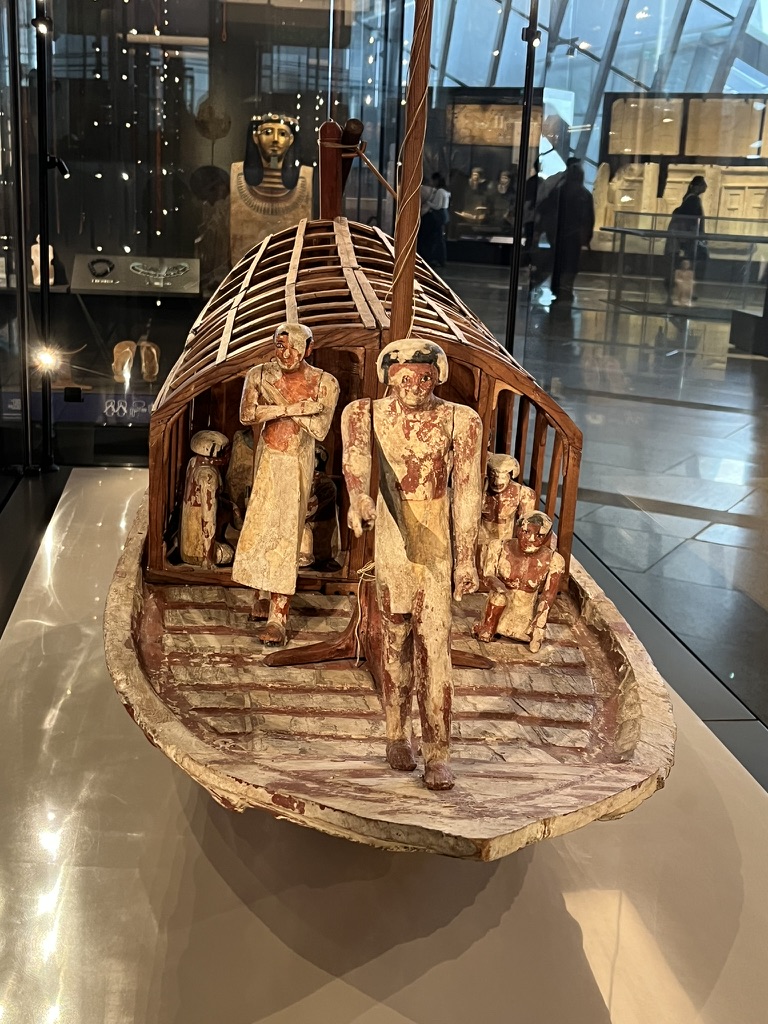
Halls 4–6 (Middle Kingdom) contain the wooden models that stop most visitors cold. These are small-scale dioramas — boats being rigged, soldiers marching, bakers at work, farmers ploughing — painted in vivid colour and preserved with astonishing completeness. They were placed in tombs to serve the deceased in the afterlife, which means they were made with absolute seriousness about their function. The result is an accidental record of exactly what everyday Egyptian life looked like 4,000 years ago, in miniature and in motion.
Halls 7–9 (New Kingdom) are where you find Akhenaten, the pharaoh who attempted to replace Egypt’s entire pantheon with the sole worship of the sun disc Aten, moved the capital, and was subsequently erased from official history by his successors. His statues are immediately identifiable: elongated skull, exaggerated jaw, almond-shaped eyes, a body rendered in a style so unlike anything before or after that it remains unexplained.
Standing in front of one, you understand why his reign is still called “the Amarna revolution.” The hall also contains the Hatshepsut statues — the female pharaoh who ruled for twenty years while technically presenting as male, depicted here in full royal regalia.
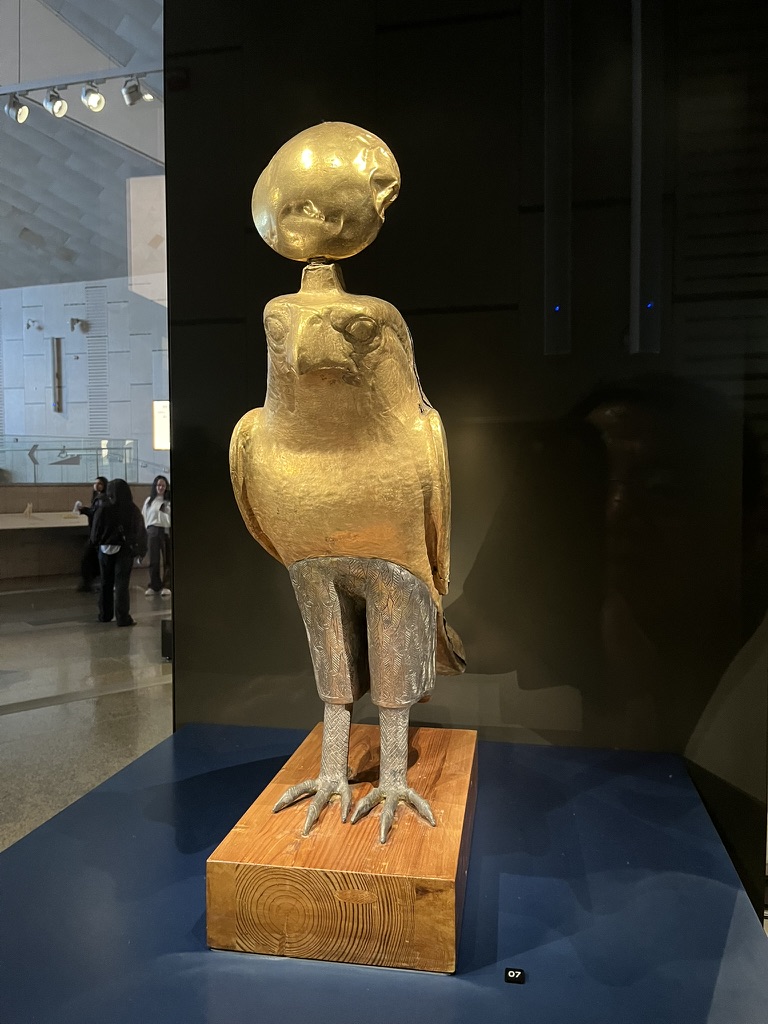
VI. The Tutankhamun Galleries: What to See and How
Two full halls. Over 5,000 artefacts. The complete contents of the most intact royal tomb ever discovered, moved from the old Egyptian Museum in Tahrir Square and presented here in a purpose-built space with lighting and curation that the old building, for all its Indiana Jones charm, could never provide.
Turn right at the top of the staircase. The queue will tell you where you are.
The Golden Mask
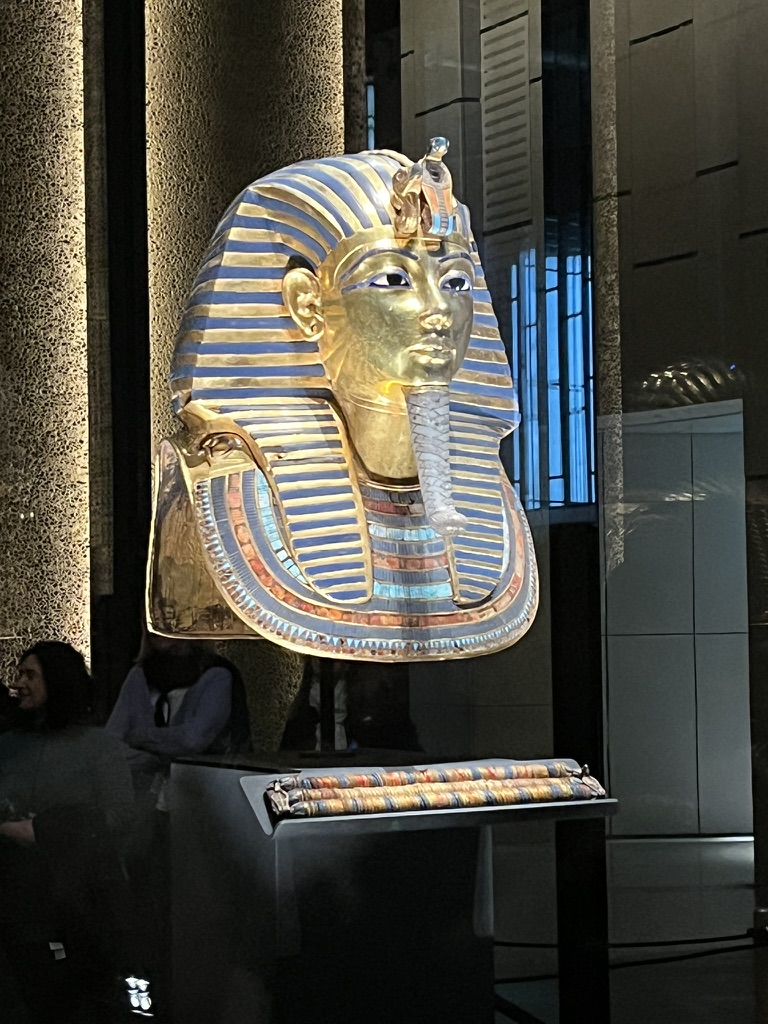
It is, without question, the must-see object in the museum — and one of the most famous artefacts in human history. The mask sits inside a glass case in the first Tutankhamun hall, closely guarded. Security keeps visitors moving; you will have approximately ten seconds of face time before being gestured forward.
Ten seconds is enough. The gold is not merely decorative — it has a quality of light that photographs don’t capture, a warmth and depth that makes the metal seem to glow from within rather than reflect. The lapis lazuli stripes, the inlaid eyes of obsidian and quartz, the vulture and cobra at the forehead — the mask weighs 11 kg and it reads as an object of extraordinary seriousness even at a glance. Be ready with your camera before you reach the case. Don’t fumble with it once you’re there.
The Five Objects Not to Miss
The most iconic artefact in Egypt. Solid gold with lapis lazuli, obsidian, and carnelian inlays. Even the ten seconds security allows is enough to understand why this object has transfixed the world since Howard Carter first held a candle to it in 1922.
Three nested coffins held Tutankhamun’s mummified body. The innermost — solid gold, 110 kg — is displayed nearby. The detail of the feathered rishi pattern covering the surface is extraordinary at close range.
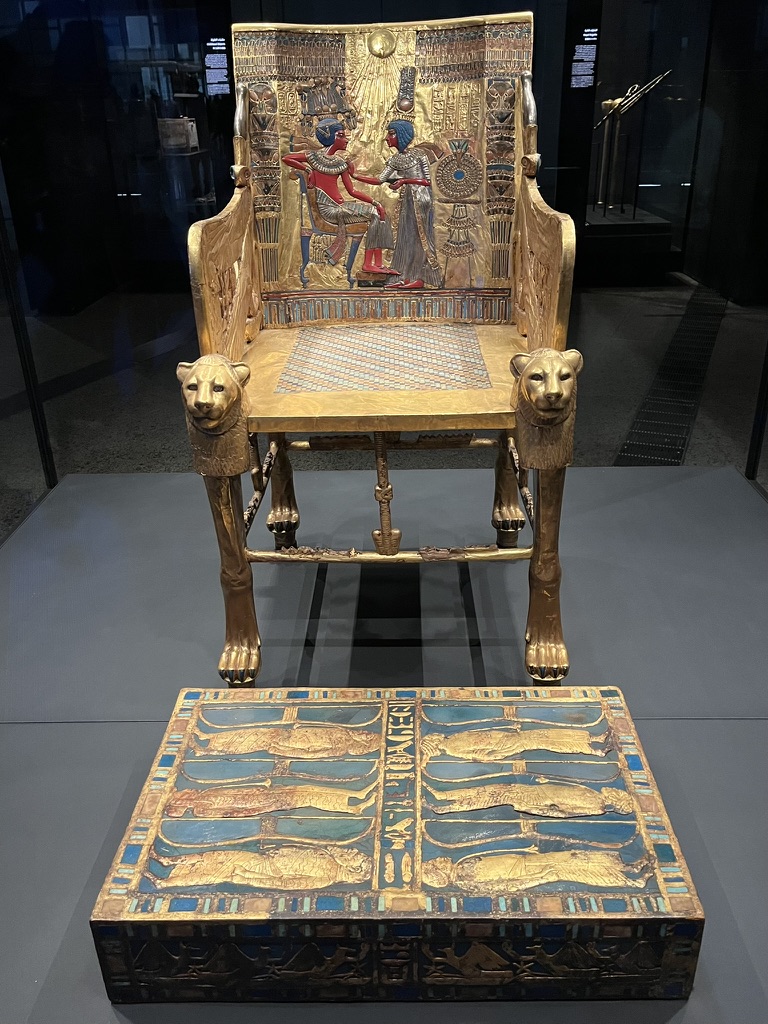
A wooden throne covered in gold sheet and inlaid with glass, faience, and semi-precious stones. The back panel depicts Tutankhamun seated on his throne while his wife Ankhesenamun reaches forward to anoint his shoulder with perfumed oil. An Egyptologist I heard on a podcast described this as showing rare tenderness and affection in royal art — a glimpse of the private person behind the royal persona. Standing in front of it, I understood exactly what he meant.
A dagger with a gold handle and an iron blade — iron that analysis has confirmed came from a meteorite. In an era before iron smelting, this blade was as precious as the gold surrounding it, and its cosmic origin was almost certainly understood by the people who made it.
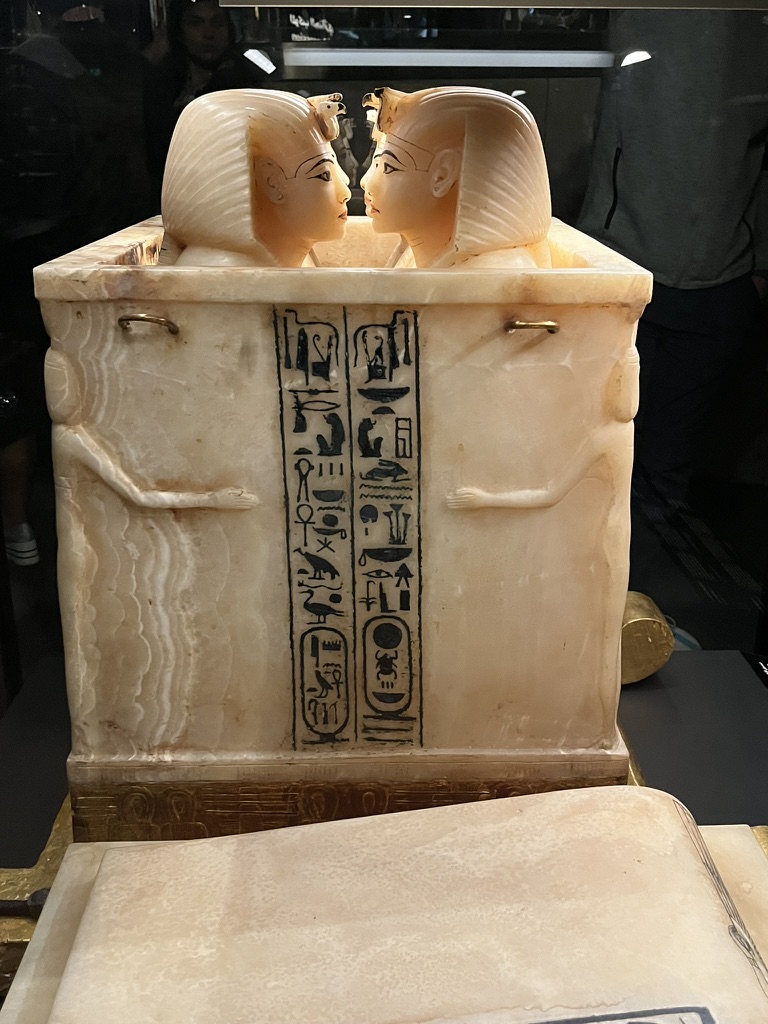
Four calcite jars containing Tutankhamun’s preserved organs, each protected by a stopper carved as the king’s face. They sit within a gilded wooden shrine guarded by four golden goddesses — Isis, Nephthys, Neith, and Selket — each with one arm extended outward in a protective gesture. The ensemble is one of the most complete ritual objects to survive from ancient Egypt.
💡 The Tutankhamun Gallery Tip
Most visitors spend so long at the Golden Mask that they underinvest in everything around it. The mask is the centrepiece, but the Golden Throne and the Meteoritic Dagger are the objects that prompt the most conversation once people get home. Give yourself time for all three. The Canopic Shrine in the second hall is also worth the detour — it’s the kind of object that takes a moment to process before its scale and completeness register properly.
VII. The Khufu Ships Museum: The Hidden Highlight
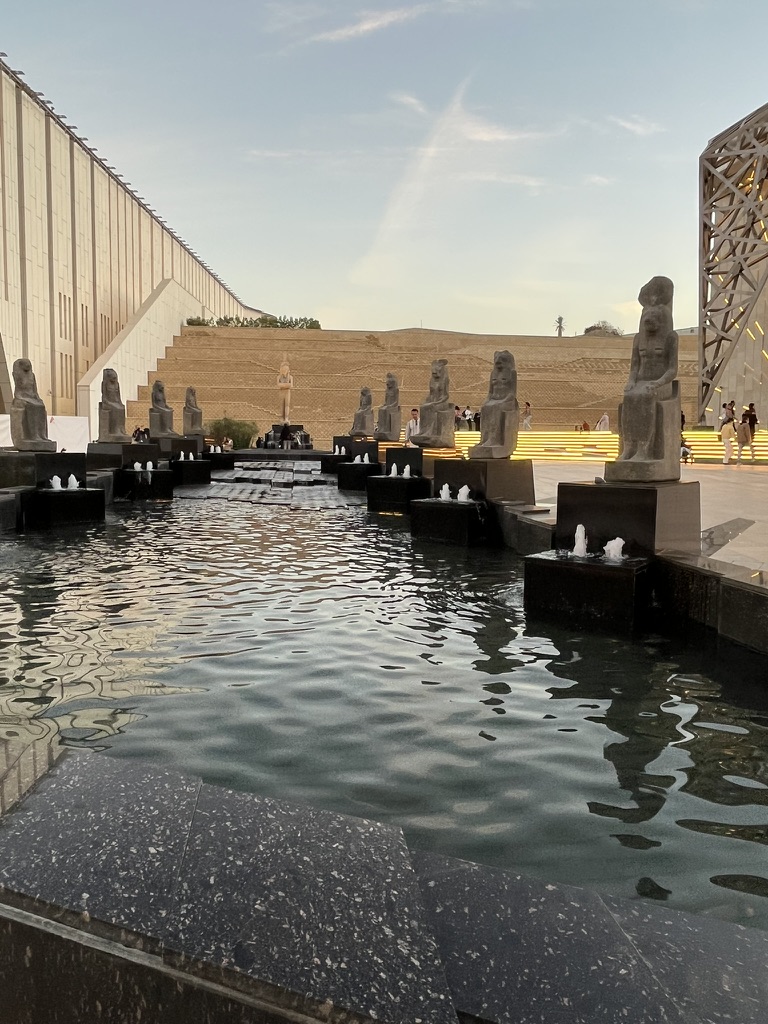
Across the plaza from the main GEM building, connected by the same ticket, is a separate museum that most visitors either don’t know about or reach only when their legs have already given out. This is a mistake. The Khufu Ships Museum contains one of the most extraordinary artefacts on earth, and it deserves the energy you’d give a major site rather than the afterthought it usually gets.
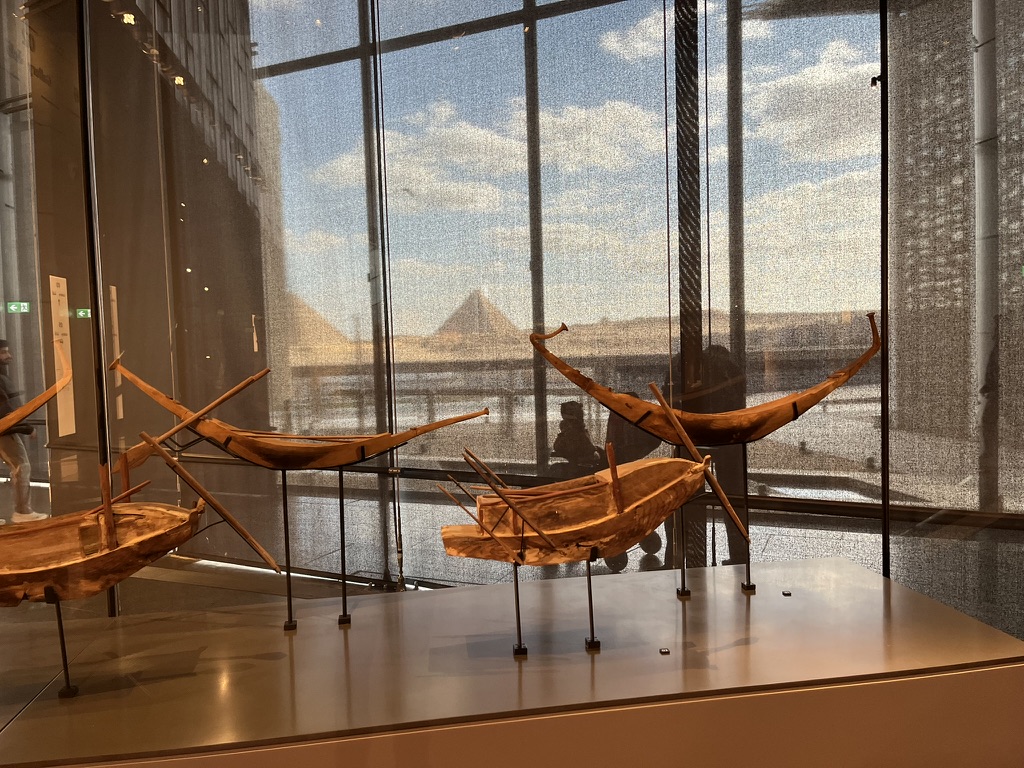
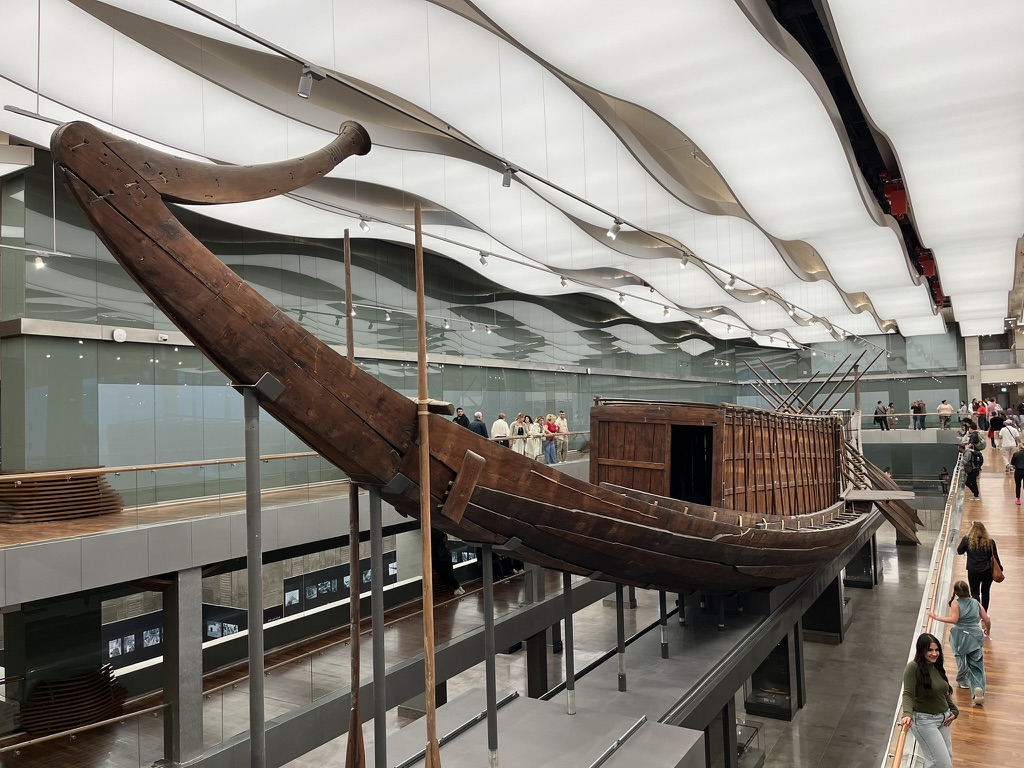
The building houses two ancient wooden solar boats — vessels buried beside the Great Pyramid of Khufu around 2500 BCE to carry the pharaoh alongside the sun god Ra in the afterlife. Across the sky by day, through the underworld by night, then reborn at dawn. The boats symbolised the eternal cycle of life — and were buried so completely, so carefully sealed, that they survived 4,500 years in near-perfect condition.
The first boat is the highlight: 43 metres long, assembled from 1,224 individual pieces of cedar wood, with every plank intact. When it was excavated in 1954, the wood was still fragrant. It sits in a climate-controlled chamber under careful lighting, and the preservation is so complete that it looks less like an ancient artefact than like a vessel that someone took out of the water last year. The engineering is astonishing — the planks are held together with rope passed through holes in a technique called “shell construction,” no iron nails anywhere. Standing beside it, the scale of what Egyptian craftsmanship achieved at the Old Kingdom’s peak becomes very concrete.
The second boat sits in an adjacent frame and is visibly supported by a modern metal skeleton — a Japanese-funded conservation project that, while technically necessary, does reduce the sense of authenticity somewhat. The number of Japanese visitors in this section on our visit was noticeably higher than elsewhere in the museum, which makes complete sense once you understand the connection.
💡 How to See the Khufu Ships Well
Take the elevator to the top floor of the Ships Museum rather than starting at the bottom. From above, you can see the full length of the first boat, its lines and proportions clear against the chamber below. Then walk down the ramps, which are designed to bring you progressively closer — passing the bow, then the midship, then the stern — so that by the time you reach the ground level, you’ve circled the entire vessel. It’s the best way to understand both the scale and the construction.
Ask the customer service desk inside the main GEM building for directions before you set off across the plaza — it’s easy to miss the entrance if you don’t know what you’re looking for.
VIII. Dining at the GEM: Where to Eat and When
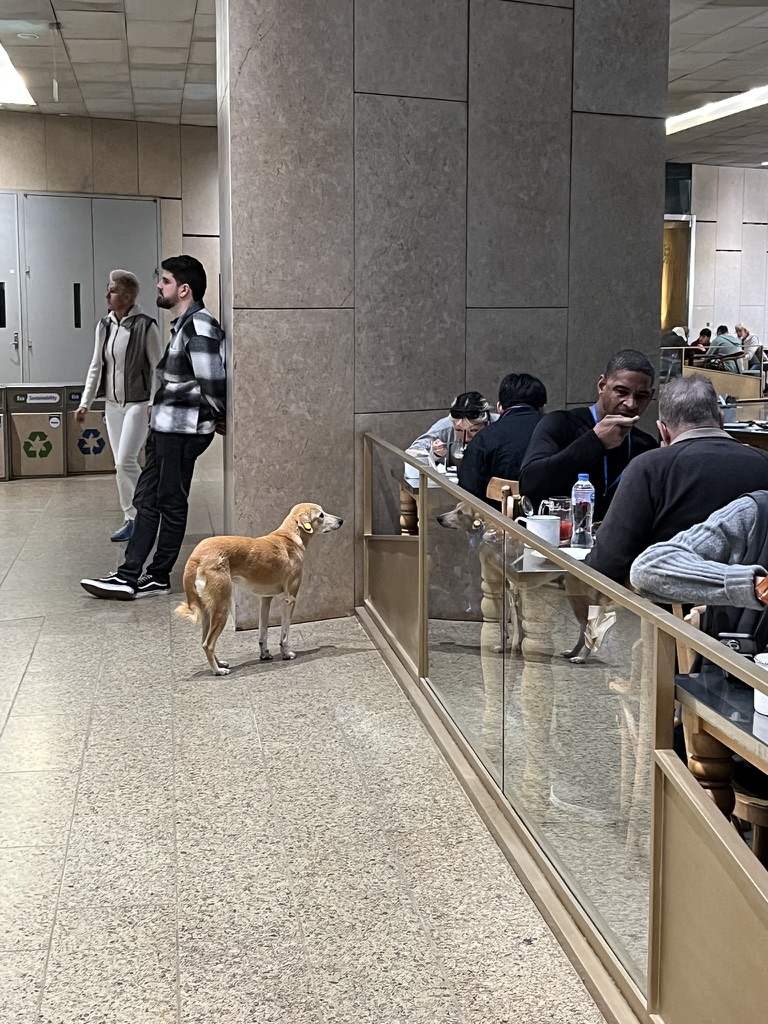
The GEM’s dining options are among the best at any museum in Egypt — which matters on a visit that can easily run eight or nine hours. You don’t need to leave the complex for food, and the restaurants here are genuinely good rather than merely convenient.
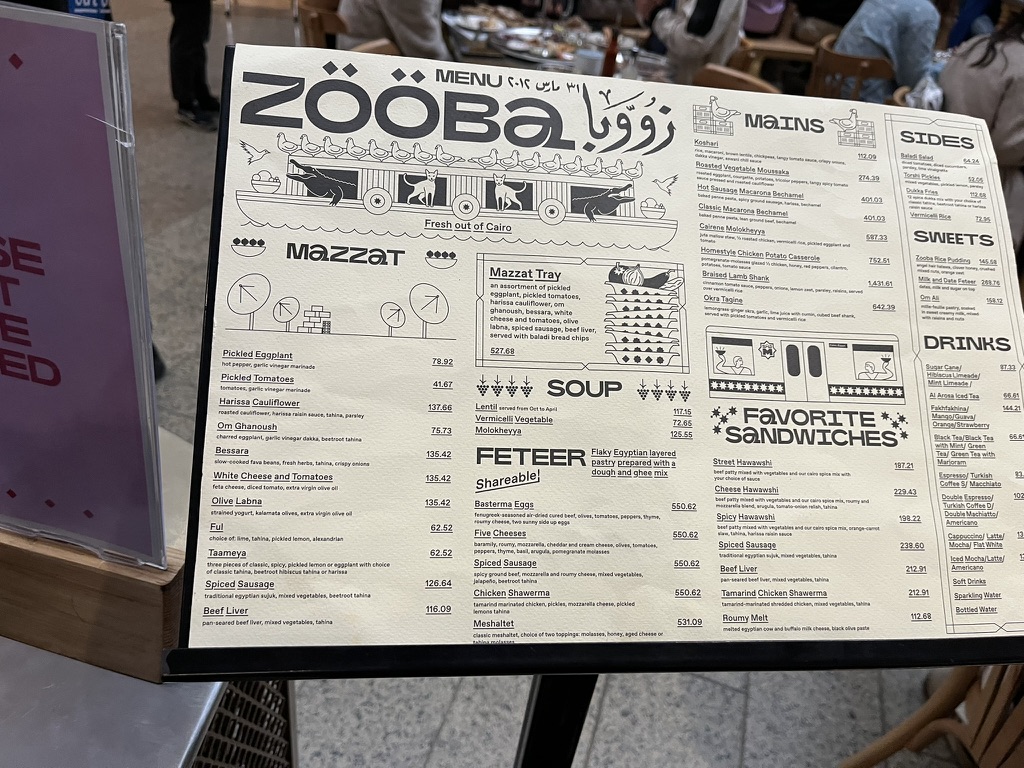
Zooba
Located near the main entrance in the Atrium area. Egyptian street food — koshari, chicken and beef sandwiches in the kofta style, ful medames — refined just enough for the museum setting without losing what makes it taste Egyptian. On our visit, the place was packed at lunchtime: no small tables available, a waiter asked if we’d mind sharing a large round table with two strangers. We didn’t hesitate. Our tablemates ordered the massive sampler platters and appeared to have come to the GEM specifically for Zooba rather than for the Tutankhamun collection. Given the quality of the food, this seemed defensible.
The chicken and beef sandwiches are the right order. The flavours are familiar and comforting — real Egyptian food, not a tourist approximation. Budget around 150–250 EGP per person for a full meal.
BitterSweet Café
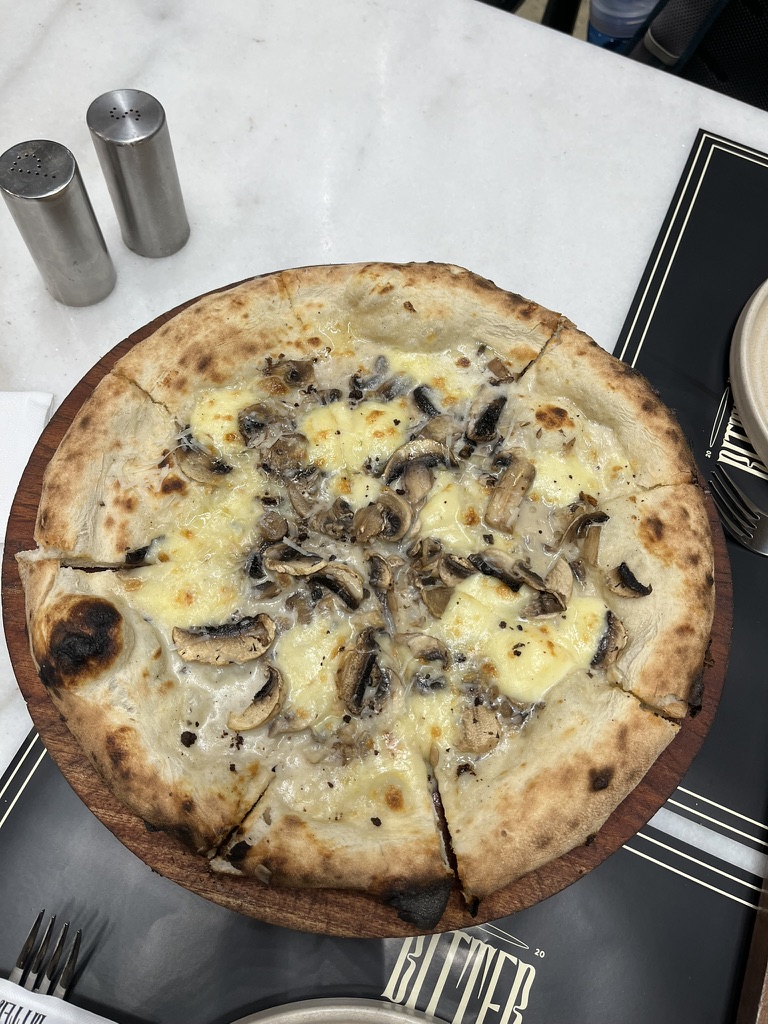
On the upper level, quieter than Zooba, with a menu that leans toward pizza, pasta, and café food. This is the place to recover on rather than to eat Egyptian. We came back for dinner after the Khufu Ships Museum — a mushroom pizza and a coffee in air-conditioned quiet after nine hours of walking through 7,000 years of history. It was exactly right. Budget around 200–350 EGP per person.
Mandarine Koueider
A legendary Cairo institution since 1928, with a branch inside the GEM complex. Baklava, kunafa, and Egyptian sweets in the traditional style. Worth a stop between the main galleries and the Ships Museum — the sugar helps.
💡 The Practical Dining Strategy
Eat at Zooba before entering the galleries — lunch crowds at the entrance thin out once the galleries absorb visitors. Coming back to BitterSweet for dinner when your legs are done is one of the better endings to a long museum day. Skip eating near the Pyramid gates entirely: the tourist-facing vendors around the Sphinx and main entrance are significantly worse and more expensive than anything inside the GEM.
IX. Tickets, Hours, and Timing (2026)
Ticket Prices
| Ticket Type | Price (EGP) | Notes |
|---|---|---|
| Adult foreigner — Admission only | 1,450 EGP | Includes Khufu Ships Museum |
| Adult foreigner — Guided | 1,950 EGP | With official museum guide |
| Child (6–12) / Student | 730 EGP | Half price; valid student ID required |
| Children’s Museum add-on | +750 EGP | Separate interactive wing for young visitors |
Operating Hours (2026)
| Area | Standard Days | Saturday & Wednesday | Ramadan |
|---|---|---|---|
| Complex (cafes, shops, plaza) | 8:30 AM – 7:00 PM | 8:30 AM – 10:00 PM | 8:30 AM – 4:00 PM |
| Exhibition Galleries | 9:00 AM – 6:00 PM | 9:00 AM – 9:00 PM | Shorter — check ahead |
Saturday is the best day to visit if you want the extended evening hours — galleries stay open until 9 p.m., and the atmosphere in the late afternoon and evening, when the crowd has thinned and the light through the glass façade is low and golden, is noticeably different from the midday rush.
Booking Tickets
Buy online at visit-gem.com for the safest experience, especially on weekends when the museum reaches capacity. We didn’t know our exact timing before arriving, so we bought tickets on our phones just outside the gate — it worked fine on a Saturday, though the website moved slowly. On-site purchase windows exist for those without smartphones or with payment issues, and staff are available to assist.
Entry is by timed slot. The slots are 8:30–11:00, 11:00–13:00, 13:00–15:00, 15:00–17:00, and 17:00–19:00. The timed entry applies to the galleries, not the complex — you can arrive, eat at Zooba, and use the atrium before your gallery slot begins.
💡 How Much Time to Budget
The honest answer: five to nine hours for a thorough visit. You can see the Tutankhamun Galleries in two hours if you move efficiently. Add the Grand Staircase, the remaining eleven halls, and the Khufu Ships Museum and you’re at a full day. We stayed noon to 9 p.m. and used every minute of it. If you only have half a day, prioritise the Grand Staircase, Tutankhamun Galleries, and the Khufu Ships Museum in that order.
X. Getting There: Transport, the Uber Trap, and the Walkway
The Official Connecting Walkway
A 1.45 km pedestrian walkway connects the Giza Plateau to the GEM entrance. To use it, you need valid tickets for both sites. The walk takes about 20 minutes and runs through a landscaped corridor after completion. However, at the time of our visit, it was in a semi open state only, with motorway crossing required. To get to GEM, we exited the Pyramid complex through the Sphinx Gate and took an Uber instead — about $4 for a ride that avoids the sun and delivers you to the GEM entrance directly. Both are valid options; the walkway is worth considering if you’re not in a hurry and the midday heat hasn’t set in.
Uber from the Pyramids to GEM
Use the destination string “GEM – Grand Egyptian Museum” in the app. Uber from the Sphinx Gate to the GEM entrance is typically around $3–5 and takes five minutes. This leg of the journey, going to GEM, is generally fine. The problems concentrate on the return.
The Giza Uber Trap: A Complete Breakdown
The area around the GEM and Giza Plateau exits is the only place in Egypt where we consistently encountered transport fraud. Understanding exactly how it works makes it entirely manageable.
The in-app message scam. A driver accepts your ride and immediately sends a message inside the Uber app. The message might be friendly (“Hello, where are you going?”) or direct (“Road is closed, need 500 EGP extra”). Either way, it’s the opening move of a price renegotiation. The driver is testing whether you’ll engage. The correct response: don’t reply. Cancel the ride immediately and request a new one. Report the driver for “requesting payment outside the app.”
The “walk to me” redirect. Some drivers ask you to walk 50–100 metres from the official GEM or Sphinx Gate exit to meet them. This is almost always an attempt to get you away from security cameras and into a less observable position before beginning the negotiation. Stay at the official pickup point. A legitimate driver will come to your pin.
The “in-car” demand. This is what happened to us on our second Giza exit. We got into a car, the driver drove a short distance, then turned and demanded a higher price. The script that works: “I only pay the price shown in the app. If that’s a problem, please stop here.” Say it once, calmly, without arguing. Most drivers back down immediately. If the car keeps moving, repeat it. We got out, canceled, and found a taxi.
⚠️ The Reality of GEM Exit Transport
After a full day at the GEM on a Saturday, getting a legitimate Uber back to Cairo required four attempts. The same fraudulent driver appeared in our app twice after being canceled. This is not rare — it is a consistent pattern at Giza.
The working approach: walk about 50 metres from the GEM entrance before opening the app (this changes which drivers can see your request). If three cancellations in a row produce fraudulent drivers, switch to a marked white taxi with official signage. Agree on the price and currency before getting in. The going rate from Giza to central Cairo is $10–15 — more than double the Uber price, but far less than what fraudulent drivers demand. A real taxi driver won’t mind you tracking the route on Google Maps.
Reading Egyptian Licence Plates
Egyptian licence plates use Eastern Arabic numerals, which look different from the 0–9 system shown in your Uber app. Three numbers cause consistent confusion:
٥ = 5 ٧ = 7 ٨ = 8
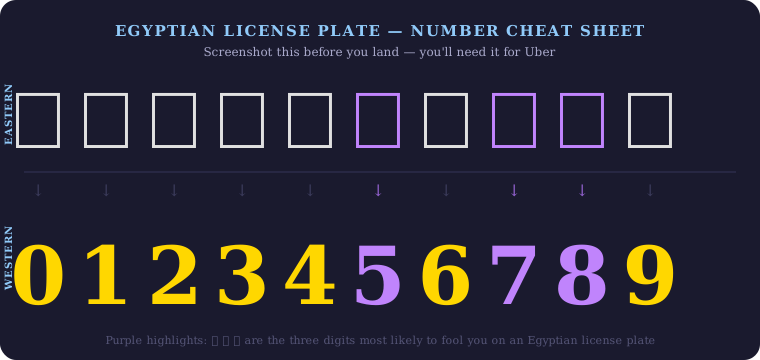
Save this on your phone before the trip. In the chaos of a busy GEM exit, being able to read the plate on a car in the Uber app against the actual car in front of you is the difference between confident identification and standing in a crowd of cars not knowing which one is yours.
XI. Frequently Asked Questions
Can I buy GEM tickets at the gate if I didn’t book online?
Yes — we did exactly this on a busy Saturday. The official recommendation is to book online at visit-gem.com, particularly for weekends when the museum can reach capacity. But on-site purchase windows are available at the gate, and staff will assist with the digital payment process if the website is sluggish. Keep the option open and buy online if you can confirm your arrival time in advance.
Is a guide worth it for the GEM?
For the Tutankhamun Galleries, yes — the guided ticket adds significant depth. The context around individual objects (the significance of the meteoritic dagger, the specific scene on the Golden Throne, the symbolism of the Canopic jars) is not fully captured by the labels, and an Egyptologist who knows these objects well transforms the experience.
For the rest of the museum, the labelling throughout is in English and comprehensive enough for self-guided exploration. A guide for the Tutankhamun section specifically, even informally arranged through the museum, is worth considering.
How is the GEM different from the old Egyptian Museum in Tahrir?
The old Egyptian Museum at Tahrir Square retains its own extraordinary value — densely packed galleries, a building that has stood since 1901, and a feeling of private archive rather than public exhibition. Many artifacts have migrated to the GEM, but the Tahrir museum is not empty. Think of them as complementary rather than redundant.
The GEM presents Egypt’s greatest objects in ideal conditions with modern curation. The Tahrir museum offers the feeling of what museum-keeping looked like before modern curation existed, and that texture is worth experiencing. Visit both if you have the time; if you must choose, the GEM offers the more complete collection.
What’s the best time to visit?
Midweek afternoons for the quietest experience. Saturday evenings for the extended gallery hours and the best atmosphere — the crowds thin after 6 p.m. and the low light through the façade at dusk is remarkable. Avoid midday on weekends. If visiting during Ramadan, check the GEM website for adjusted hours before booking.
How do I get to the Children’s Museum?
The Children’s Museum is a separate wing requiring an add-on ticket of 750 EGP. It’s an interactive space designed specifically for young visitors and is physically separate from the main gallery flow. If you’re visiting with children who won’t engage easily with the main galleries, it’s worth the extra ticket. If you’re visiting without children, skip it entirely — the ticket price covers the main galleries and the Khufu Ships Museum, which is more than enough.
Is the GEM accessible for visitors with mobility limitations?
Yes — thoroughly so. Escalators and moving walkways serve every floor, lifts reach every level, and the wide corridors and flat gallery floors are navigable by wheelchair throughout. The Khufu Ships Museum has elevator access to every level including the top viewing floor. The GEM was designed from the beginning with accessibility as a priority, and the infrastructure matches that intention.
📋 GEM Visit Quick Reference — Screenshot This
| Item | Key Information |
|---|---|
| Tickets | 1,450 EGP (admission) / 1,950 EGP (guided) — buy at visit-gem.com or at the gate |
| Gallery hours | 9 AM – 6 PM standard; until 9 PM on Sat & Wed |
| Best day to go | Saturday — extended hours, best evening atmosphere |
| Time to budget | 5–9 hours for full visit; 3 hours minimum for Tutankhamun + Staircase only |
| First move inside | Stand at Staircase base and look back through Atrium glass — all 3 pyramids visible |
| Don’t rush | Walk the Grand Staircase — moving walkway skips 60 colossal statues |
| Tutankhamun Gallery | Turn right at top of staircase — camera ready before reaching the mask case |
| 5 objects to find | Golden Mask, Inner Coffin, Golden Throne, Meteoritic Dagger, Canopic Jars |
| Khufu Ships Museum | Separate building across the plaza — same ticket — take elevator, walk down ramps |
| Lunch | Zooba (Egyptian street food, chicken/beef sandwiches) — eat before entering galleries |
| Dinner | BitterSweet Café (pizza, pasta) — ideal recovery after a long visit |
| Uber to GEM | Search “GEM – Grand Egyptian Museum” — ~$4 from Sphinx Gate, usually fine |
| Uber from GEM | Walk 50m from entrance before opening app; cancel any driver who messages first |
| Taxi fallback | Marked white taxi — agree price first — $10–15 to downtown Cairo |
| Licence plate hack | ٥ = 5, ٧ = 7, ٨ = 8 — save the cheat sheet on your phone |
📍 Related Guides in This Series
- My 12-Day Egypt Diary (Part 1) — the full story of our Giza and GEM day, including how the Uber scam unfolded in real time and what the golden mask actually looks like from three feet away.
- Cairo Transport & Safety Survival Guide — the complete Uber breakdown, the Giza trap in detail, ATMs, flights, and the full cheat sheet.
- 12-Day Egypt Master Guide — the self-guided blueprint for the full Egypt trip, including how to pair Giza and GEM in a single day.
- 3-7-9 Day Itinerary Library — how to fit the GEM into shorter itineraries.

Hi, I’m Frank J – Egypt Self-Guided Travel. I explore Egypt solo and share tips, stories, and practical advice to help you plan your own adventures safely and enjoyably.