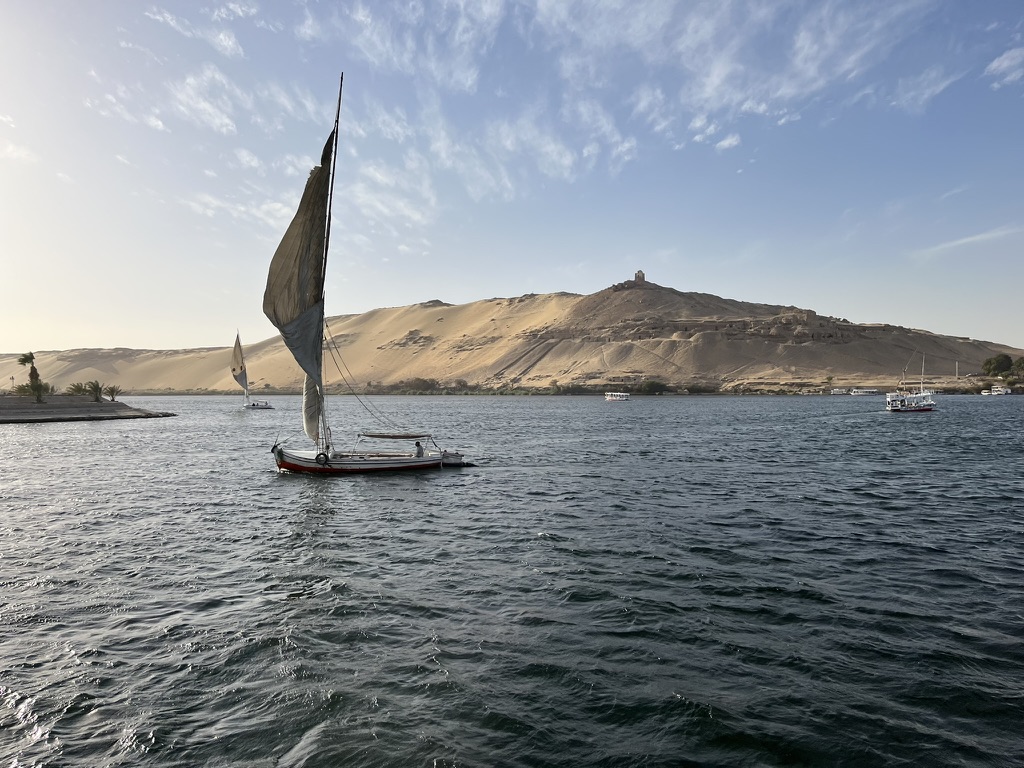
💡 Read the Full 12-Day Egypt Diary Series:
Looking for the exact logistics, hotel links, and Uber tips? Head over to my [12-Day Master Planning Guide].
After three days of Cairo pyramids travel experience, being absorbed by Cairo’s chaos, history, and hidden corners, our Aswan Abu Simbel travel experience began with a flight south to Aswan — a completely different Egypt. Slower, quieter, greener along the banks, and ancient in a way that felt more intimate than monumental. What followed were four days that would become the unexpected highlight of the whole trip.
📋 In This Post
The Aswan Abu Simbel Travel Experience Begins: Why We Didn’t Go It Alone
After flying from Cairo, we knew the journey would take us through Aswan and Luxor — but the question was how to connect them. We briefly considered hiring a private driver and stopping at Kom Ombo and Edfu along the way, moving entirely at our own pace. That’s usually our style.
But the more we thought about it, the more the Nile pulled at us. Seeing those temples from a car window, stopping at a car park, photographing from a fence — that felt like the wrong way to experience a river that has been the pulse of Egypt for thousands of years. The road couldn’t compete with the water.
Booking a private cabin, however, turned out to be either very expensive or very difficult to arrange. So we made a practical compromise: join a tour group, treat the cruise as transportation rather than a guided experience, and reclaim our independence the moment we reached Luxor.
After some research, we booked a TripAdvisor package — fully aware that most tours assign whatever ship happens to be available that day. It wasn’t glamorous. But it was going to get us down the Nile, past the temples, and into Luxor without a highway in sight. That was enough.
Arriving Aswan: Night Taxis and a Nile-View Cabin
We landed in Aswan around 8 p.m. — dark, a little disoriented, and immediately aware that Uber doesn’t operate here. I tried InDrive instead. The driver asked me to meet him outside the airport perimeter, and something about that felt off. We passed. A regular taxi was waiting right there, and after showing the driver the InDrive price on my phone, we negotiated something fair without any drama.
The hotel was modest — nothing fancy, but perfectly suited for a single overnight stop before the cruise began. The next morning at 8 a.m., the cruise driver was already in the lobby.
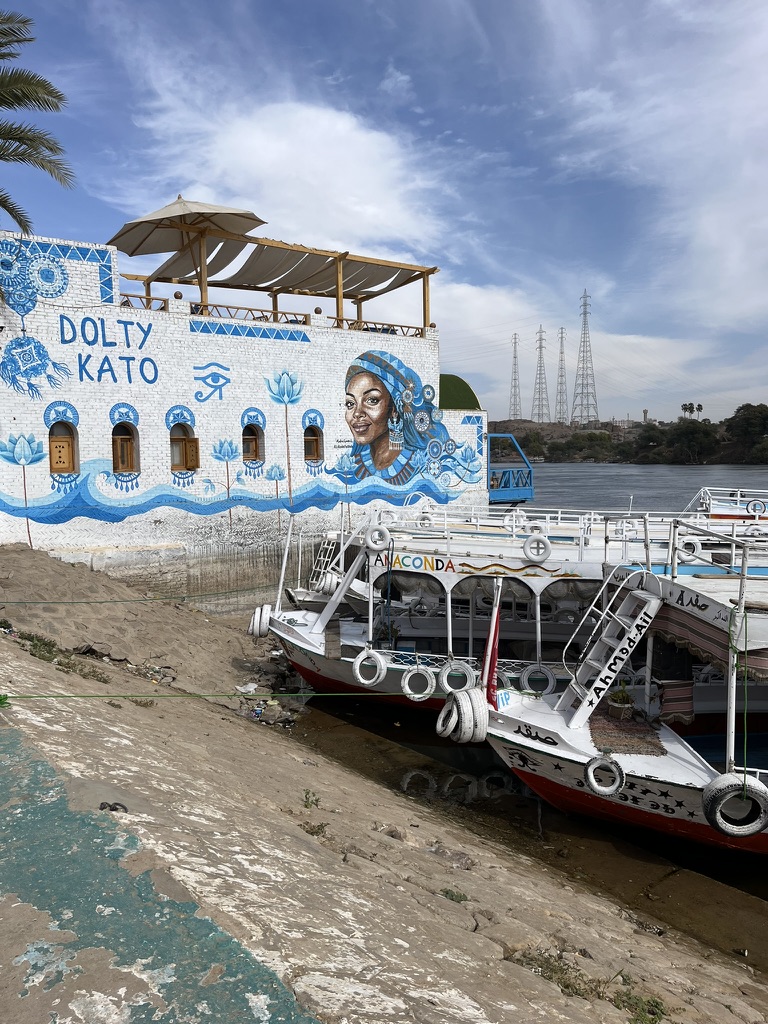
At the dock, three or four boats were lined up side by side. To reach ours, we had to walk through the others — a slightly surreal experience of passing through someone else’s floating hotel. Our guide was waiting on deck: a funny, sharp Egyptian with a PhD in Egyptology who introduced himself and then immediately started making the group laugh.
The group itself was a good mix — about twenty people in total, including a large family from Australia, couples from Italy and Mexico, a few from New Zealand. The kind of international assembly that makes shared meals and long boat conversations surprisingly good.
💡 Practical Note: Getting Around Aswan
Uber does not operate in Aswan. InDrive is available but drivers sometimes ask you to meet them away from official taxi zones — trust your instincts. Regular taxis are easy to find and drivers are generally willing to negotiate if you show them a reference price from an app.
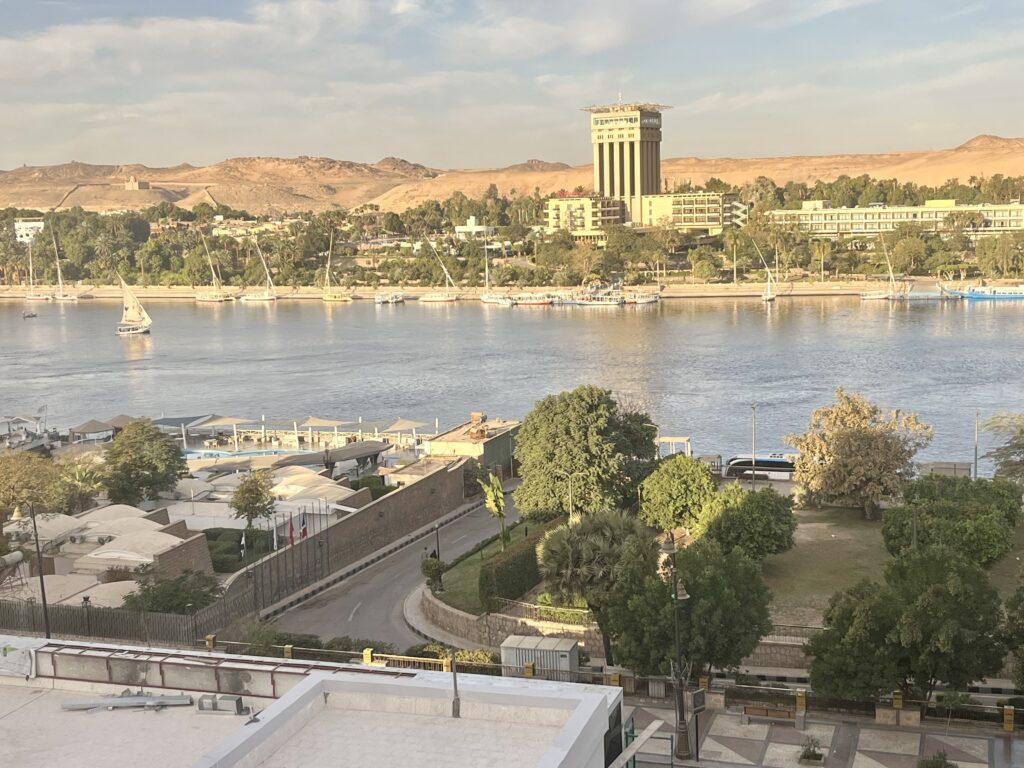
The Nubian Village — and a Baby Crocodile
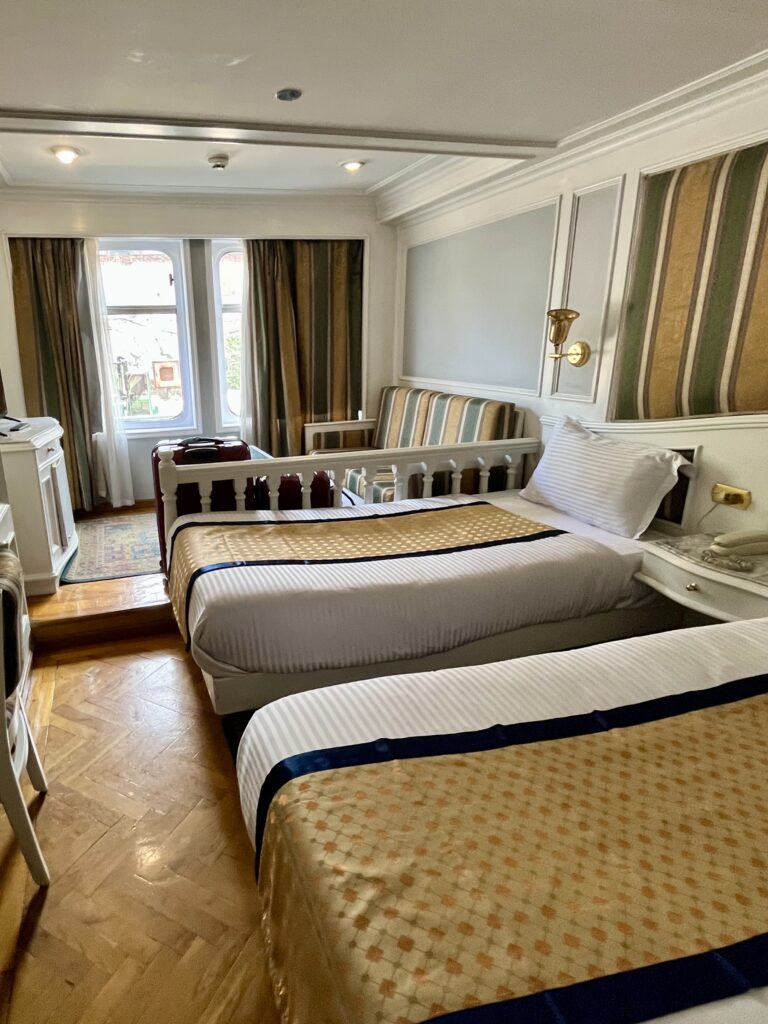
Since we arrived at the boat early, the guide found us a free cabin right away — two beds, a sitting area, and a wide window looking straight out over the Nile. Then he leaned in with a question: did anyone want to visit a Nubian village? Optional excursion, not in the itinerary. We said yes immediately.
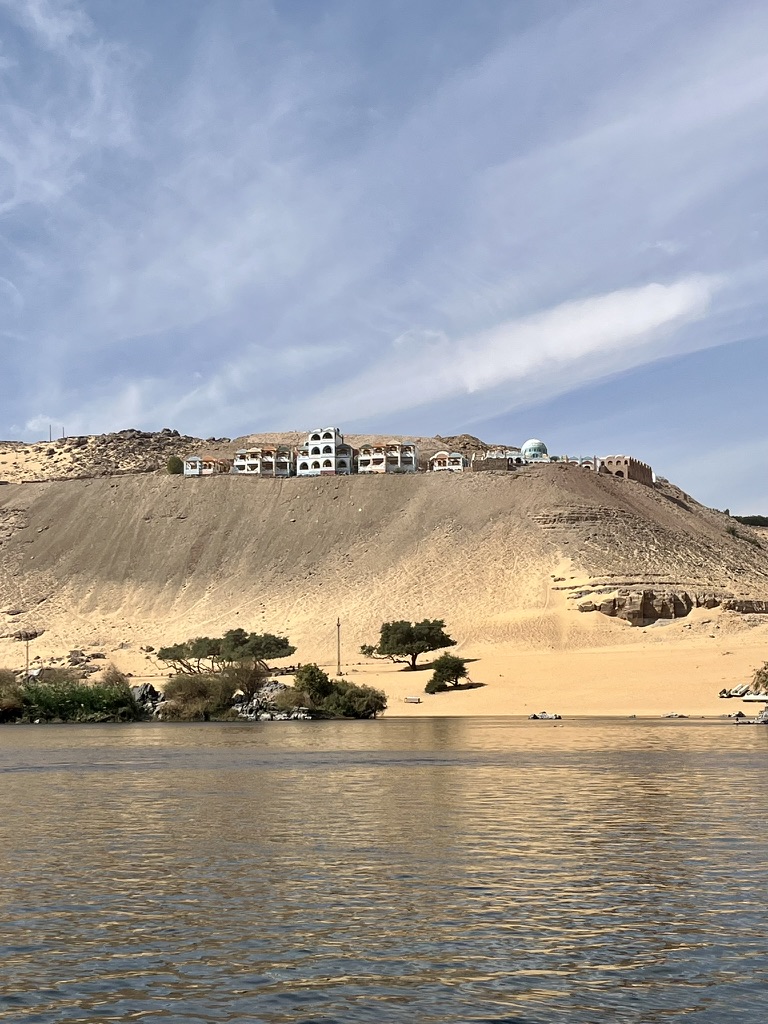
We boarded a small boat and set off along what turned out to be one of the most beautiful stretches of the Nile I’d seen — tombs carved into desert cliffs on one side, palms and green banks on the other, the river a deep, calm blue in between. At one point, the guide gave us the green light to jump in.
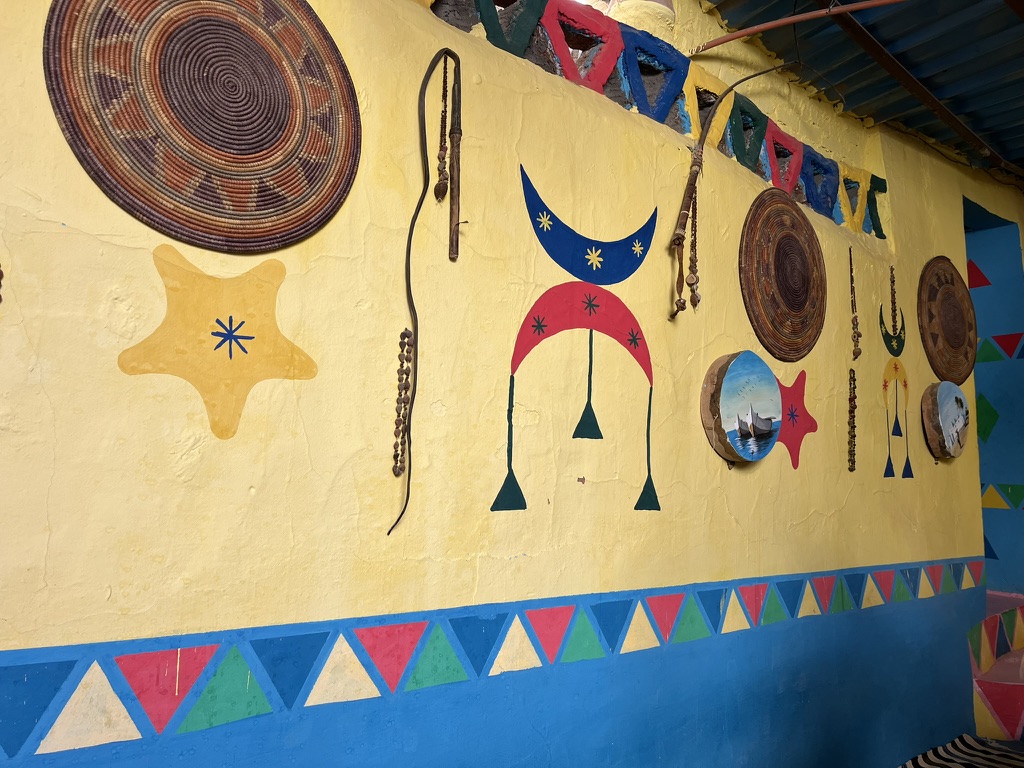
The Nubian village itself was, yes, a little touristy — but genuinely fun. A buggy ride to the highest point gave us sweeping views of the river and Aswan’s east bank. Then we visited a Nubian family who kept a crocodile. A real one. We held a baby crocodile — which was equal parts cute and alarming — and our guide, who has been leading tours for years, told us he had never once seen what happened next: the baby left a souvenir on my shirt.
He couldn’t stop laughing. Neither could the group.
Philae Temple: The Island That Floats
After lunch back on the boat, the rest of the group joined us and we set off for Philae Temple. Our guide had already steered us away from the High Dam — mostly concrete, he shrugged, not particularly exciting. A quick look at photos confirmed it. We admired the old dam from a distance and headed straight to the water.
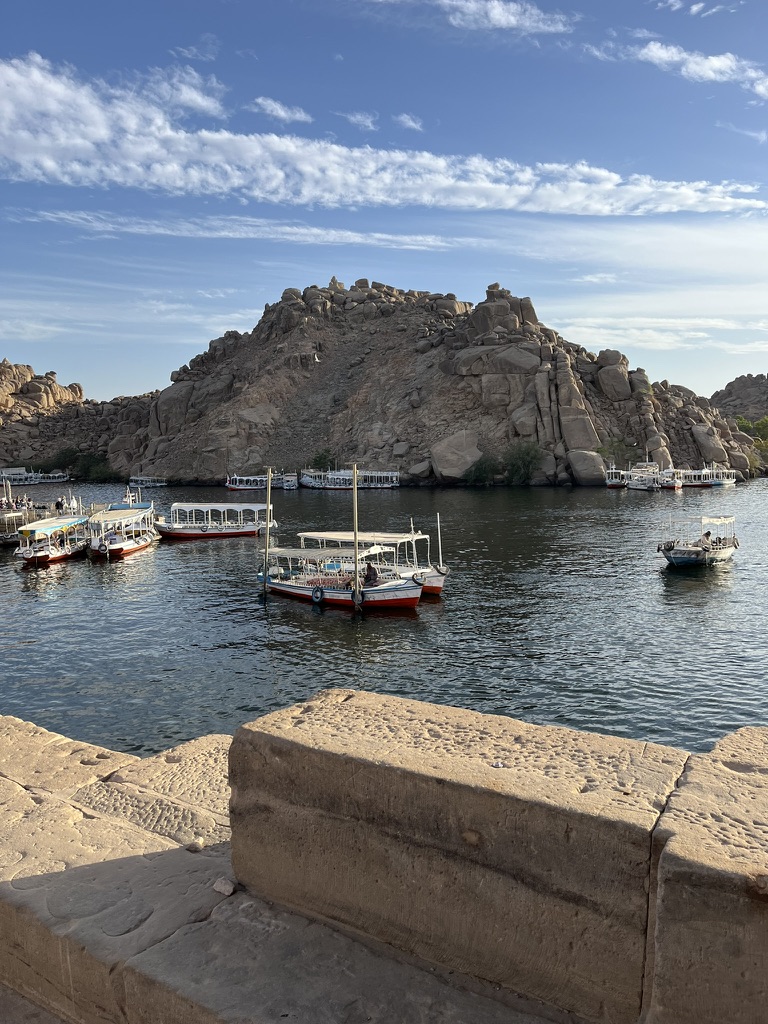
To reach Philae, you board a small boat for a ten-minute crossing. The ride alone is worth it — sunlight sparkling on the gentle ripples, a river breeze carrying the faint scent of water plants, palm trees swaying on the distant banks. Then the island comes into view.
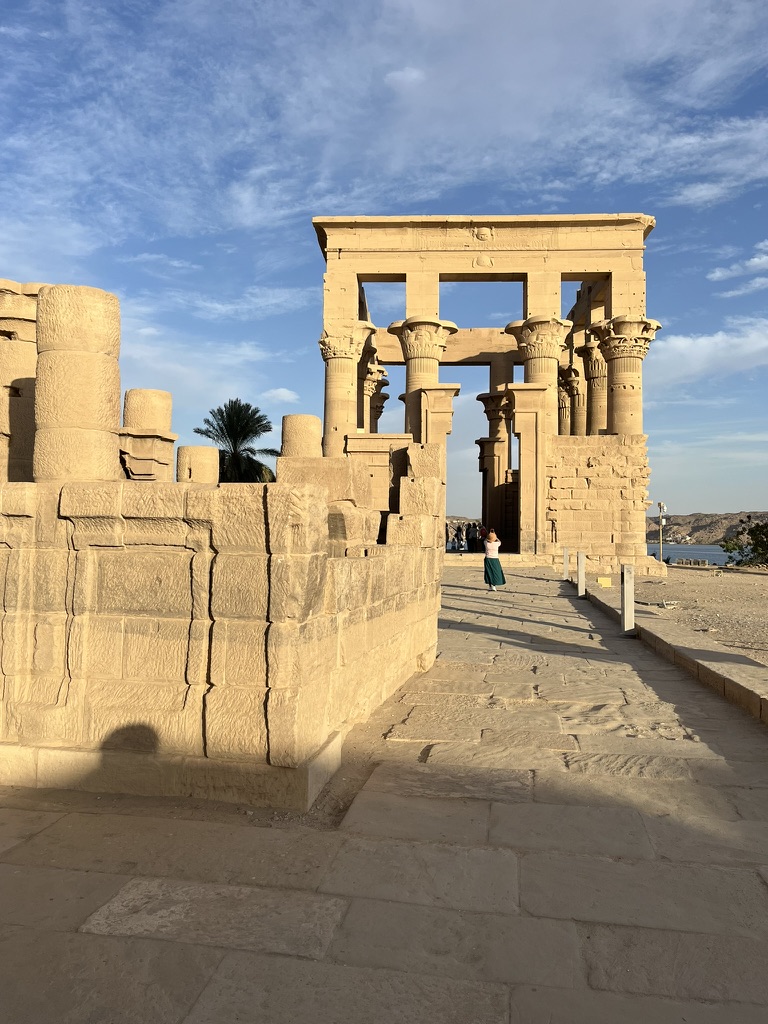
Philae sits on Agilkia Island, and the effect of seeing it from the water is unlike any other approach to an Egyptian temple. The blue-green Nile wraps around the island, and the temple’s red sandstone walls glow warmly in the afternoon sun. It appears, genuinely, to float.
What makes Philae even more extraordinary is its story. The original island was submerged after the Aswan High Dam was built. UNESCO preservation project spent years carefully dismantling the entire temple complex, stone by stone in the 1970s from the submerged Philae Island to the higher Agilkia Island, and reassembling it on higher ground — a feat of preservation as remarkable as anything the ancient Egyptians achieved in the first place.
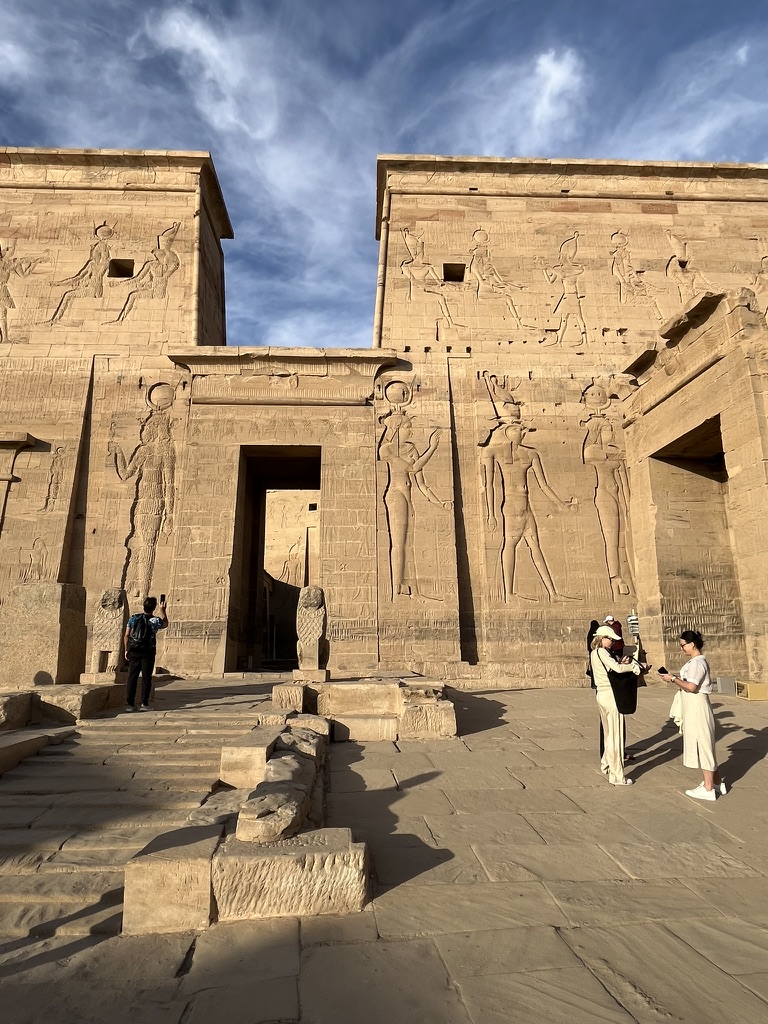
Inside, the temple is dedicated primarily to the goddess Isis, with additional shrines to Osiris, Hathor, and other deities — and visible traces of Roman influence layered on top of the older Egyptian work. The hieroglyphs are astonishingly detailed. Our guide moved through the complex slowly, explaining how the temple remained an active centre of worship well into the Roman period, long after most Egyptian temples had fallen silent.
We returned to the boat as the light softened. Dinner was a standard buffet on board, the boat docked quietly under a sky full of stars. We went to sleep early. The alarm for Abu Simbel was set for 4 a.m.
Abu Simbel: An Aswan Abu Simbel Travel Experience That Commands Awe
The 4 a.m. Bus and the Desert Convoy
The alarm went off while it was still fully dark. Our guide appeared in the lobby remarkably relaxed, wearing slippers, and informed us that a local guide would meet us at Abu Simbel instead — the agency needed to give local guides a share of the work. It was a pity. Our guide’s storytelling had been excellent, and we knew a local substitute wouldn’t carry the same depth.
We climbed onto the bus in darkness. Shortly after leaving Aswan, we hit a massive line of vehicles — hundreds of them, stretching far back into the desert. Our driver, however, seemed to know someone. A car on the side of the road suddenly pulled forward, creating just enough space for us to slip in. Connections, apparently, matter everywhere.
Curious, I asked why everyone else was waiting. The answer was simple but surprising: the road is open to Egyptians around the clock, but foreigners are not permitted through until around 5 a.m. When the gate finally opened, the convoy surged forward across the desert as the sun began to rise — soft light spreading across the sand, turning the emptiness into something quietly beautiful.
The Moment of Arrival
After three and a half hours, we were close to the Sudanese border. Abu Simbel came into view — or rather, it didn’t, at first. You see almost nothing: a rocky hillside, unassuming and silent. Lake Nasser appears on the right, the water trying to pull your attention. You know something is hiding behind the sandstone cliff on the left, but the road curves slowly, and the cliff gives nothing away.
Then, in a single step forward, everything changes.
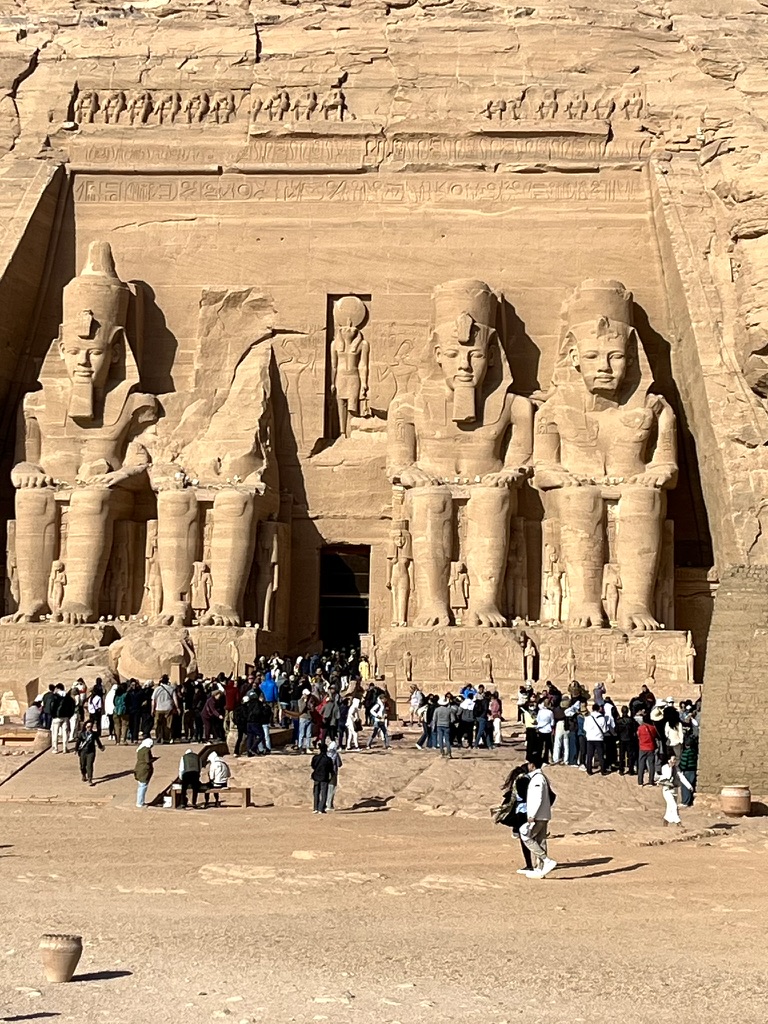
Four colossal figures of Ramesses II emerged from the rock — perfectly still, impossibly large, their faces calm and eternal. They sit in absolute silence, gazing out across the desert as they have for more than three thousand years. The scale is disorienting. What had been a distant wall of stone moments before now feels like a living presence, towering overhead and dwarfing every person standing below.
Our local guide broke the silence with a dry smile: “You see, all four statues here are of the same person — Ramesses II himself. He must have loved himself too much.” The group laughed. The statues didn’t react.
Inside the Great Temple
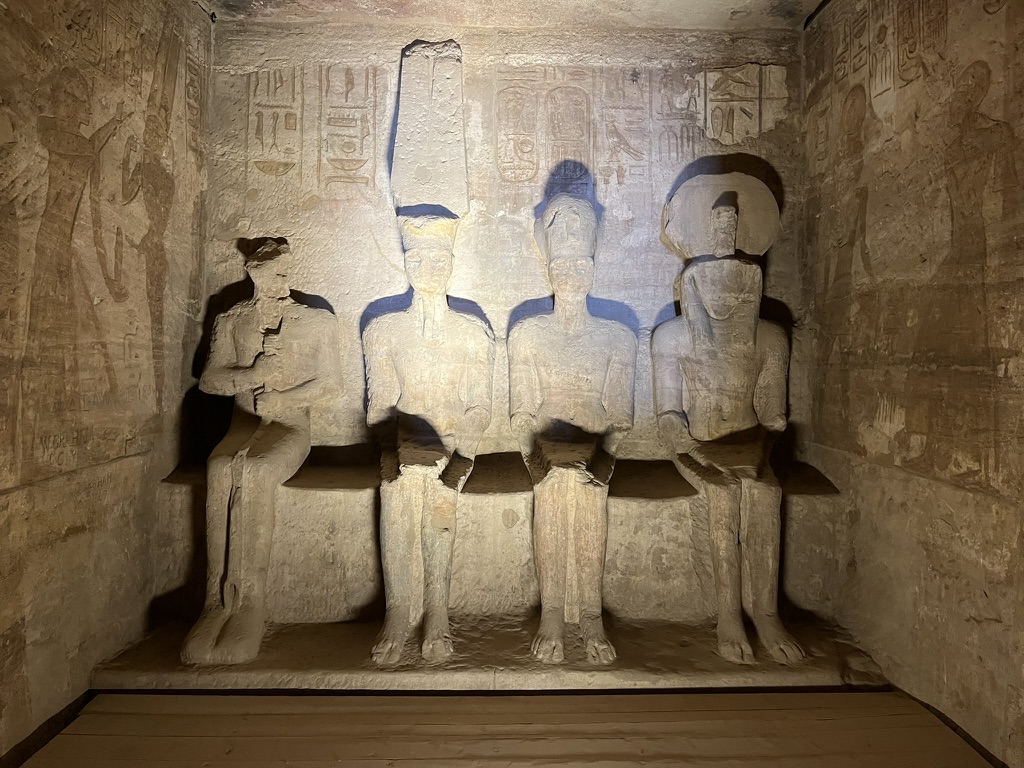
The Great Temple is dominated by those four seated figures of Ramesses II, each more than 20 metres high — depicting him from the age of 18 to 80, left to right. Inside, four statues stand in the inner sanctuary: Ra-Horakhty, Amun, Ptah, and Ramesses himself, projecting divine power and royal authority into the rock.
Twice a year — on February 22nd and October 22nd — sunlight penetrates the entire length of the temple to illuminate three of the four statues. Ptah, the god of the underworld, remains in darkness. The ancient Egyptians calculated this alignment with precision that still baffles researchers today. The exact mechanism, the exact intent — still not fully understood.
The Small Temple: Built for His Wife (Mostly)
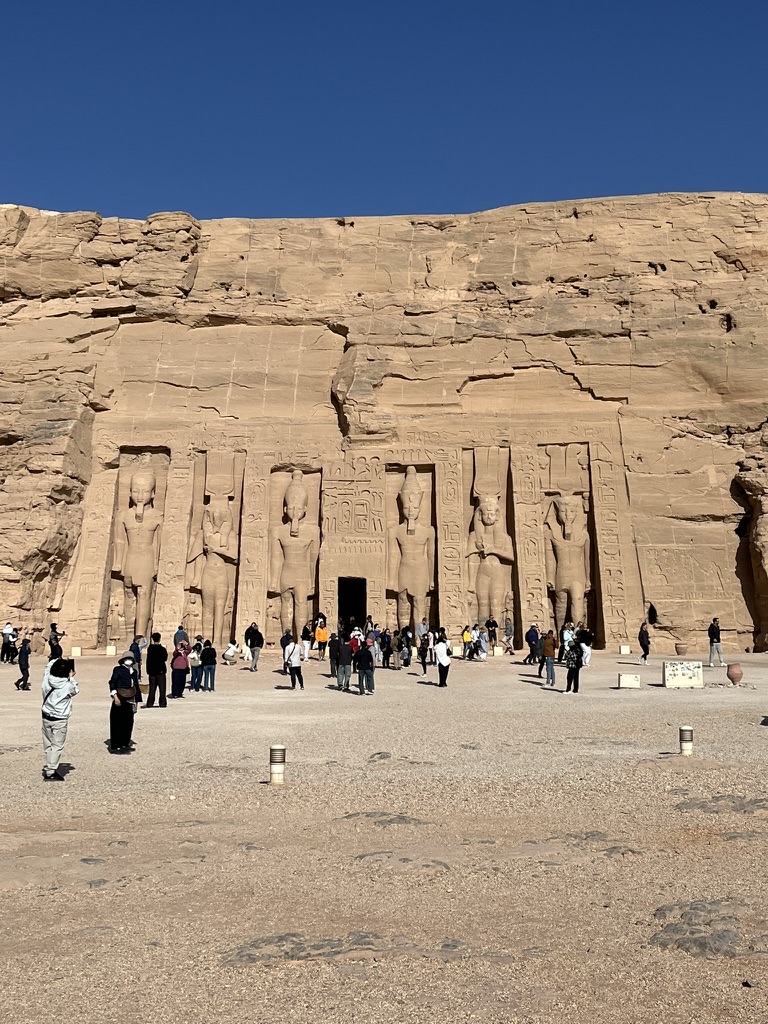
Beside the Great Temple stands the Small Temple of Abu Simbel, dedicated to the goddess Hathor and to Queen Nefertari, Ramesses II’s favoured wife. Unusually for ancient Egypt, Nefertari’s statues are carved at the same height as the pharaoh’s — a mark of exceptional status in a culture where such equality was almost never depicted.
The façade features six statues: four of Ramesses II and two of Nefertari. Our guide noted this with a perfectly timed pause: “Look — even for the temple he built for his wife, he put four statues of himself and two of her.” Everyone laughed again. Ramesses II, it was becoming clear, loved himself approximately twice as much as he loved anyone else.
The Wind, the Sand, and the Crowds
The moment we stepped outside, a sudden gust swept across the desert, kicking up fine sand from the shores of Lake Nasser. I raised my hand to shield my eyes, squinting against the grit, and through the haze I noticed the first line of visitors beginning to form.
In that moment, I longed to be there alone — just the cliff, the monumental statues, the shimmering lake, and the wind brushing across the sand. No chatter, no tour groups, just the raw power of the place. And yet, even as people trickled in, none of that detracted from what I had already felt. Abu Simbel is one of those rare sites that doesn’t just demand attention — it commands awe. It’s not something you merely visit. It’s something you feel, and it etches itself into memory long after you leave.
💡 Visiting Abu Simbel: What to Know
The convoy from Aswan departs very early — around 4–5 a.m. — because foreigners cannot travel the road independently before dawn and the cruise schedule requires returning by early afternoon. If you’re visiting independently, a later visit (mid-morning to early afternoon, after the convoy crowds clear) is possible but requires arranging your own transport and staying overnight in Abu Simbel.
The two solar alignment dates — February 22 and October 22 — draw large crowds. If your trip overlaps, book accommodation well in advance.
See more in Aswan and Abu Simbel Travel Guide.
Kom Ombo: Mango Juice and the Crocodile God
We returned to the boat around 1 p.m., had lunch, and waited for the other boats ahead of us to depart. By about 3 p.m., we finally started moving. Watching the Nile from our cabin window as Aswan receded behind us — the cozy space with its wide river view, the afternoon light on the water — was pure peace. We had made the right call.
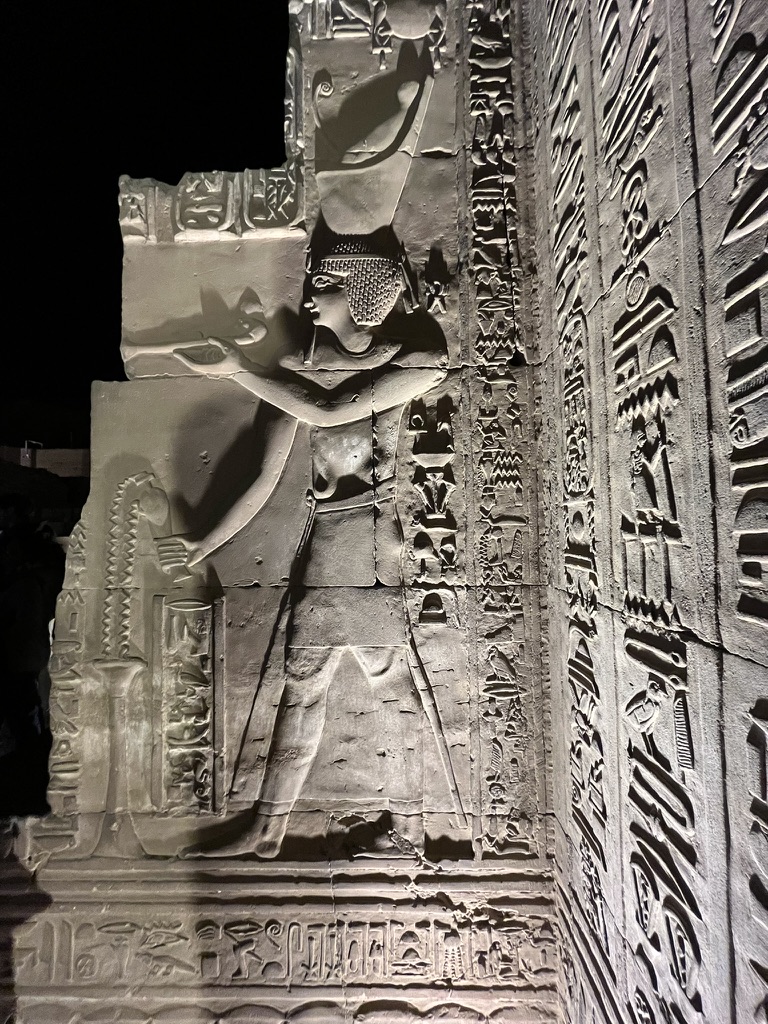
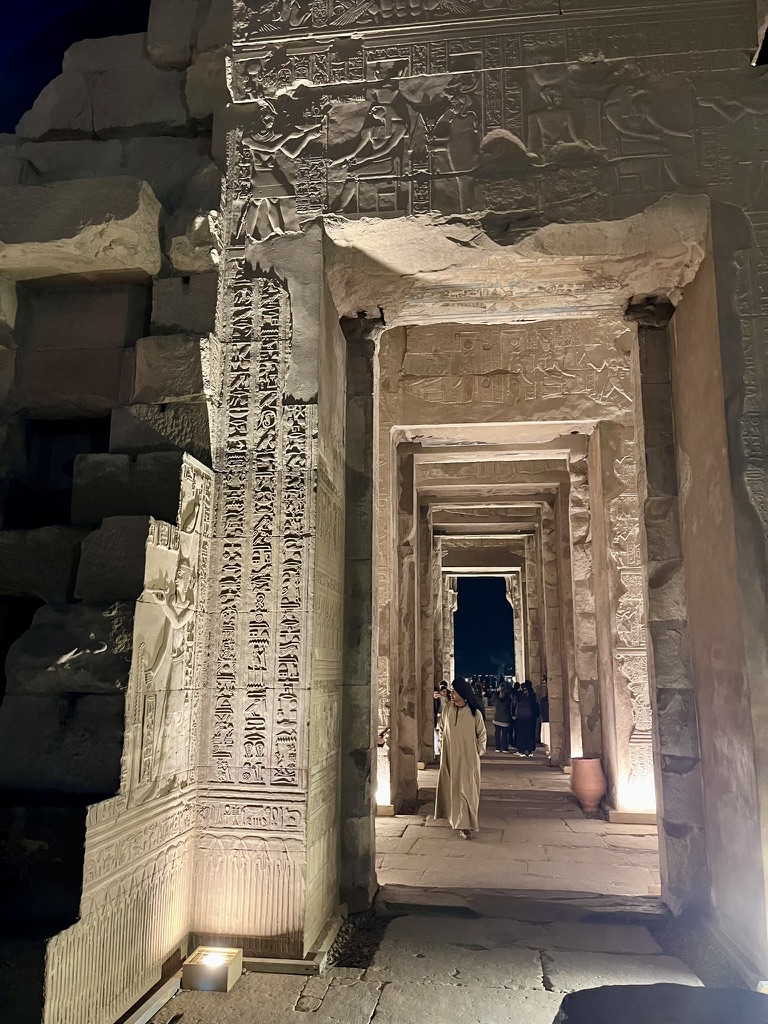
Our first temple stop after leaving Aswan was Kom Ombo, arriving at dusk. The setting alone was striking — the temple rising directly above the Nile bank, its columns lit against the darkening sky. We handed in our boarding cards for safety and followed the guide inside.
Kom Ombo is unusual in Egyptian architecture: it’s a dual temple, built symmetrically and dedicated to two gods simultaneously — Sobek, the crocodile god, on one side, and Horus, the falcon god, on the other. The guide walked us through the myth behind the design: Horus was the rightful ruler, but Sobek, envious, dismembered him and scattered the pieces across Egypt. Horus’s wife gathered them all — except one. Unable to restore him fully, Horus transformed into a falcon, forever incomplete but still powerful.
“Myth or not,” our guide said, “it definitely adds a layer of drama.”
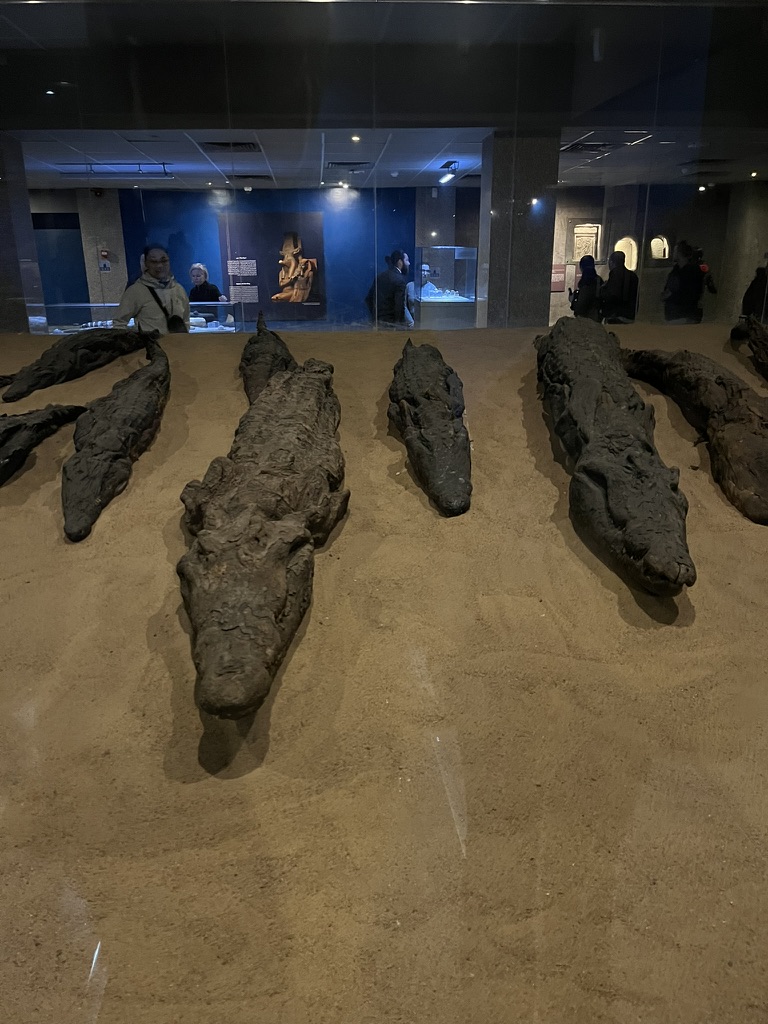
The attached crocodile museum — housing dozens of mummified crocodiles unearthed near the temple — was a strange, fascinating detour. Crocodiles were sacred to Sobek, kept in pools near the temple, venerated in death.
After the tour, the guide steered us to the temple cafeteria and insisted on the mango juice. He was right. It was phenomenal — fresh, pure, vibrantly real. Pricier by Egyptian standards, but not something to skip.
He also offered a try of the water pipe — fruit-based, not tobacco. The bubbling water, the sweet scent of the smoke, the warm evening air by the Nile. Not something I’d seek out again, but a genuine cultural moment worth sharing at least once.
We slept that night while the boat was moving — gently rocking, the river sounds outside the window. It’s one of the most effortlessly soothing ways to sleep I’ve ever experienced.
Edfu Temple at Dawn
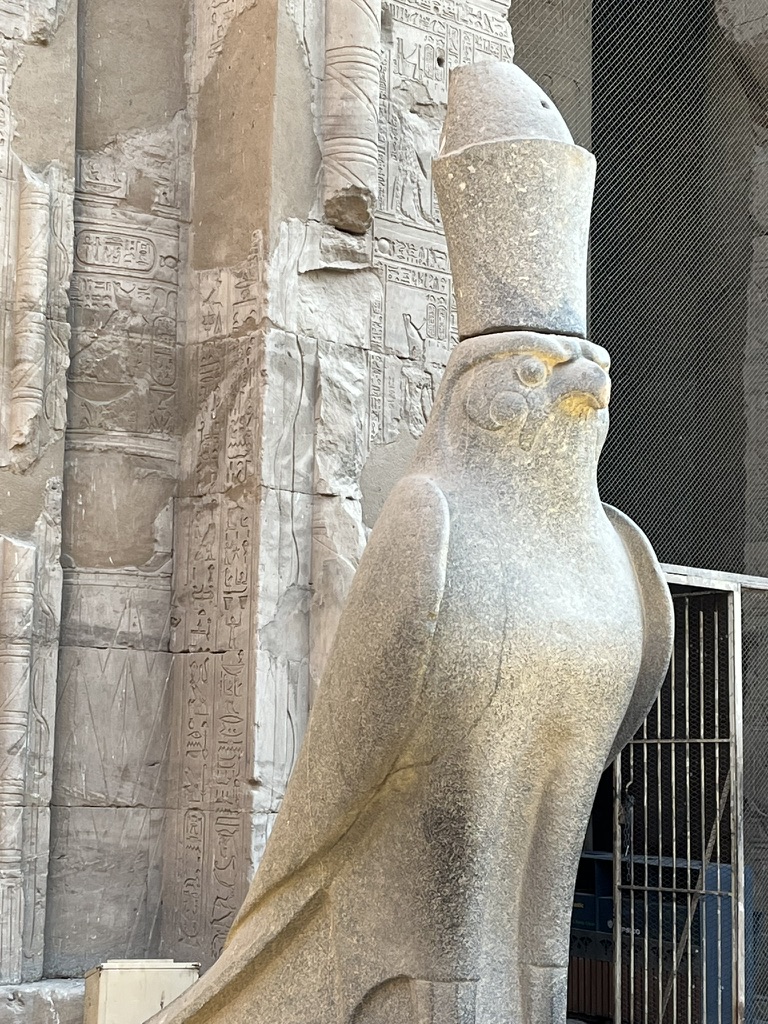
The alarm went off again before sunrise. The boat had to reach Luxor on schedule, which meant an early departure from Edfu. We stepped off the boat while the sky was still dark, into the sound of horses — clip-clop everywhere, as carriages waited to take visitors to the temple. It’s a considerable distance. We chose a van to get ahead of the crowd.
The morning air was genuinely cold. We arrived in layers and joined a line that was already long — tour groups everywhere, the site filling quickly even at that hour. But once inside, the crowds faded from the foreground.
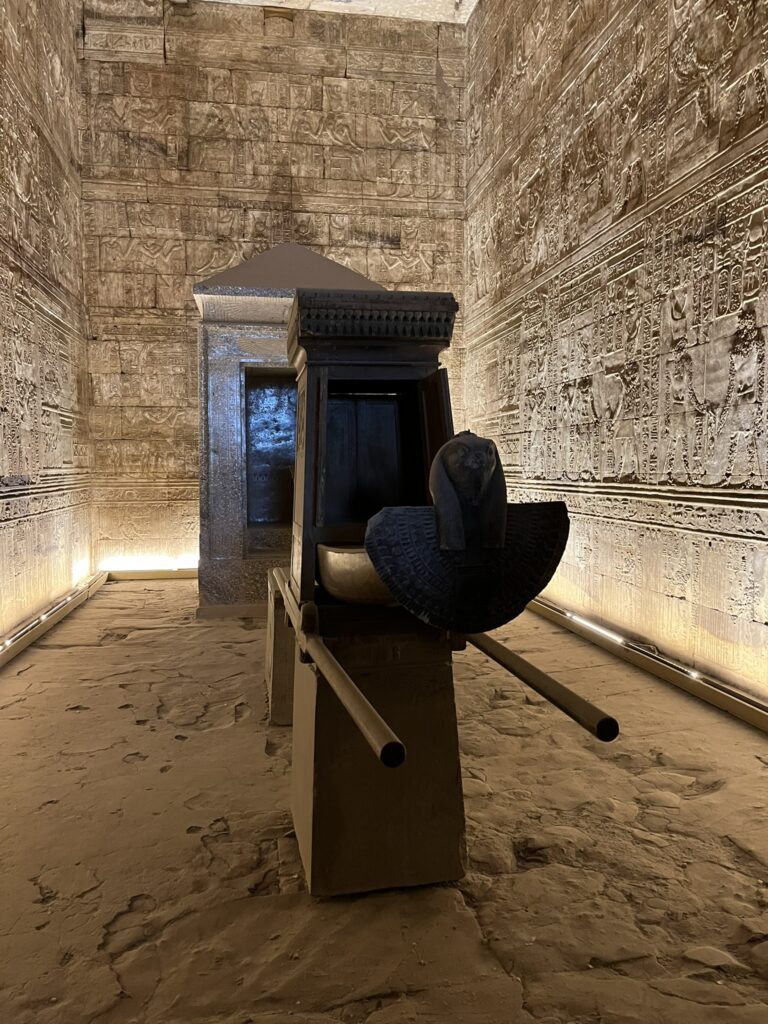
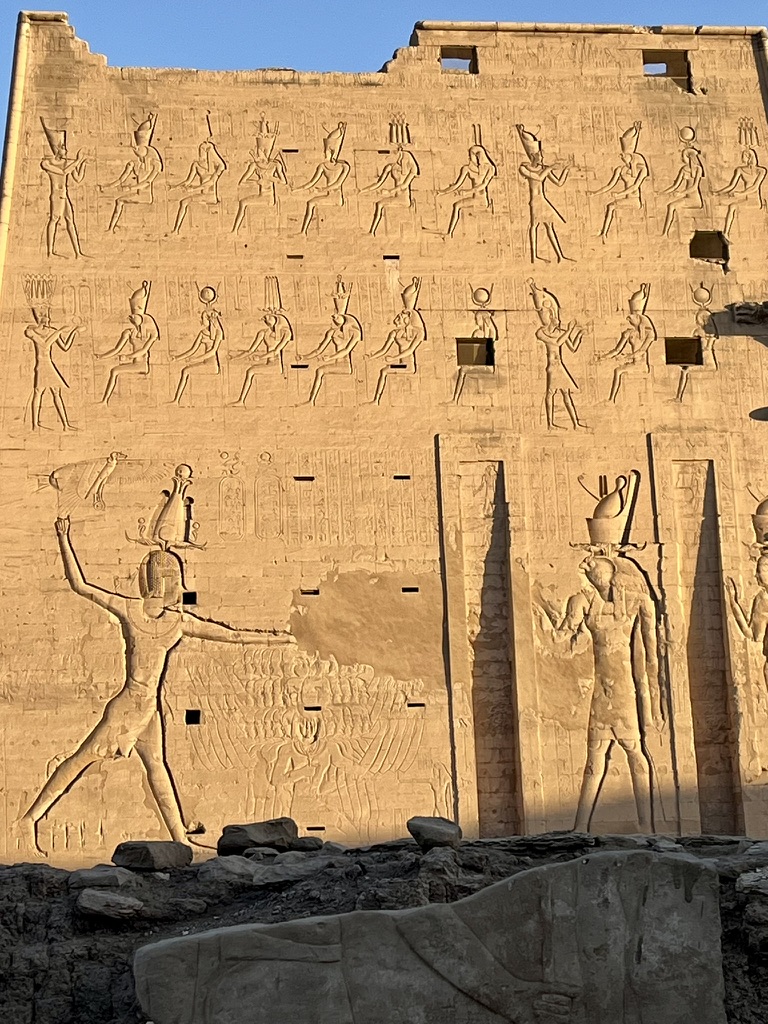
Edfu is one of the best-preserved temples in all of Egypt. The reliefs are deep, intricate, almost three-dimensional — as if the stone has been carved more recently than logic suggests. The scale of the front pylon is staggering: the entire wall is carved with Horus in battle against a hippopotamus representing chaos. You can almost feel the collision.
Inside, the courtyard opens into a vast, sacred space — columns, sanctuaries, inner chambers, everything intact. Where Karnak impresses with its size and Philae with its setting, Edfu impresses with its completeness. Walking through it, you understand more clearly than anywhere else what an active Egyptian temple would have looked and felt like.
We returned to the boat for breakfast — omelets, a standard Western-and-Egyptian spread, nothing spectacular — and then the rest of the morning was simply the Nile.
A Day Sailing: The Esna Lock and the Open River
The middle stretch of the cruise day — after Edfu, before Luxor — turned out to be one of the parts I remembered most clearly.
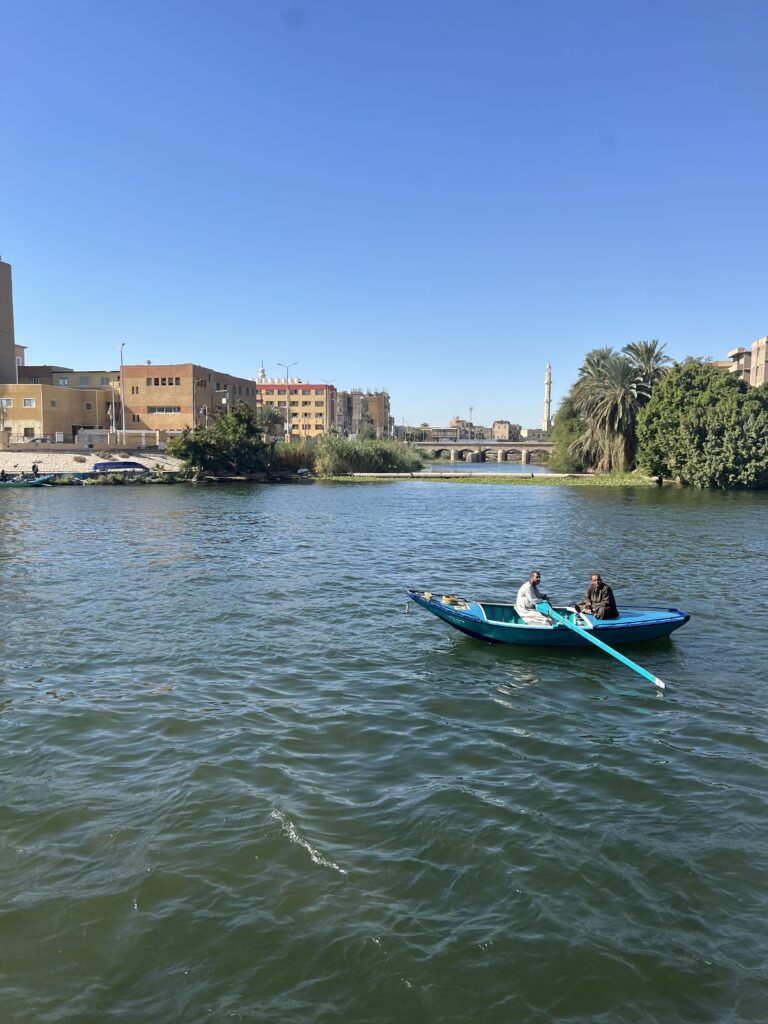
Sometimes we stayed in our cabin, watching the riverbanks drift past through the window: palm trees, small farms, men in robes on motorbikes along dusty paths, children waving from the banks. Other times we went up to the second level, where a piano and a small drinks area created an oddly civilised atmosphere on a floating boat in the Egyptian desert. But the best spot was the sun deck on the third level — fully open-air, with uninterrupted views in every direction.
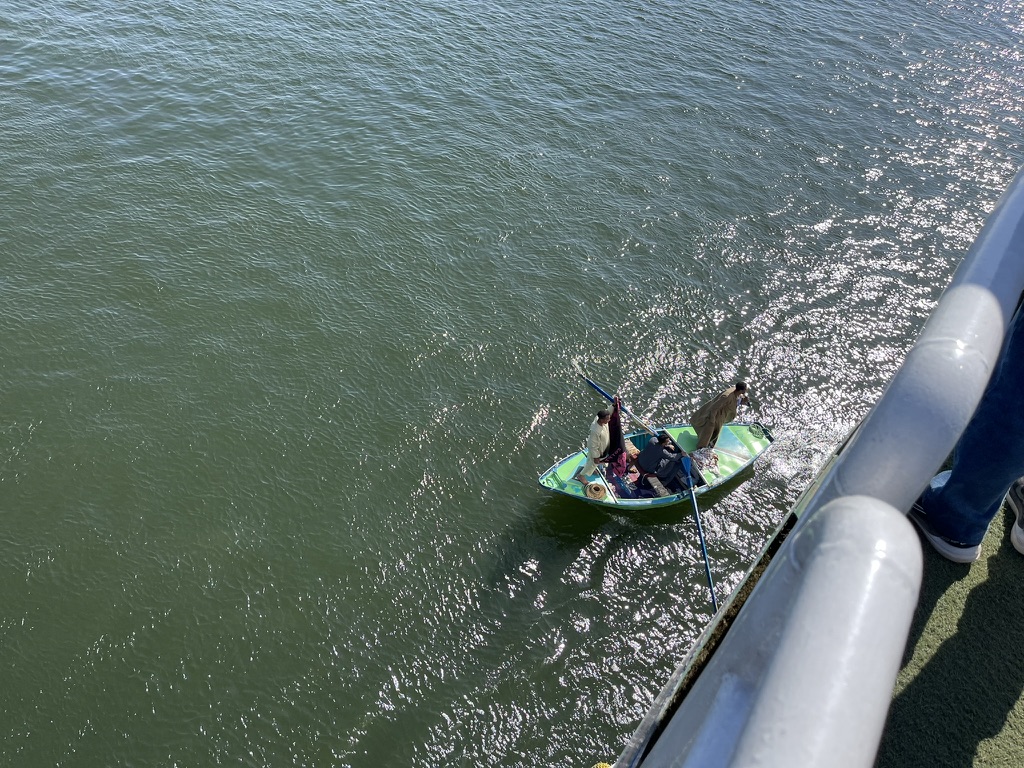
From up there, we waved back at Egyptians in small fishing boats, watched egrets perched on the bank, and let the slow rhythm of the river do its work. There’s a particular kind of peace in moving through landscape without effort, without navigation, without decisions to make. The Nile teaches you to slow down.
The Esna Lock
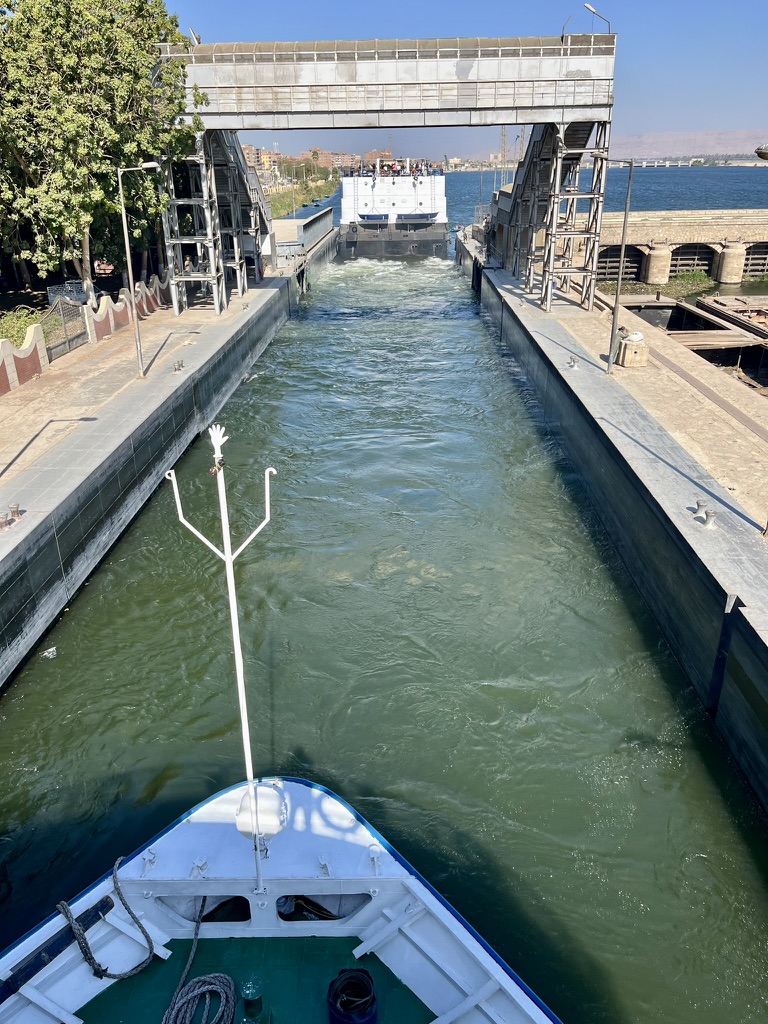
After lunch, I noticed small boats pulling alongside ours — men standing in them, holding up blankets and scarves, calling out prices. That was the first sign: we were approaching the Esna Lock.
We went up to the sun deck to watch. The lock is a dam structure with two levels — the upper Nile sits about ten metres higher than the lower — and our boat had to be lowered through it. We entered second, slowly, and over about ten minutes the water level dropped around us, the stone walls of the lock rising higher on either side as we descended. The floating vendors stayed alongside the whole time, products held aloft, prices shouted up at the sun deck.
Arriving Luxor by River
A couple of hours after the Esna Lock, the boat eased toward shore.
Due to new regulations, cruise boats now dock several miles from Luxor’s city centre — you can’t see the temples or the town from the mooring. We’d expected to arrive around 6 or 7 p.m., which would have meant an evening visit to Luxor Temple in its famous after-dark lighting. But we arrived between 3 and 4 instead, and our guide pivoted immediately: why not visit both Luxor Temple and Karnak right now, while it’s still afternoon?
We had planned to do both independently the next day. But since the boat would stay docked in Luxor overnight — meaning we could sleep on board instead of checking into a hotel — it made sense to join the group for one more afternoon.
As the boat pulled in and Luxor appeared in the distance, I thought about the four days that had just passed: the baby crocodile, the 4 a.m. desert convoy, the four colossal faces of Ramesses emerging from rock, the mango juice, sleeping on a moving river, the Esna Lock vendors, and the long, unhurried hours on the sun deck watching Egypt drift by.
Luxor was waiting. And we had three full days to explore it on our own terms.
📍 Coming Up
Three days in Luxor on our own — the Valley of the Kings, Hatshepsut’s mortuary temple, the Tombs of the Nobles, Medinet Habu, a felucca on the Nile at sunset, and why Luxor rewards those who slow down and stay longer than any tour group ever does.Insert additional text here

Hi, I’m Frank J – Egypt Self-Guided Travel. I explore Egypt solo and share tips, stories, and practical advice to help you plan your own adventures safely and enjoyably.