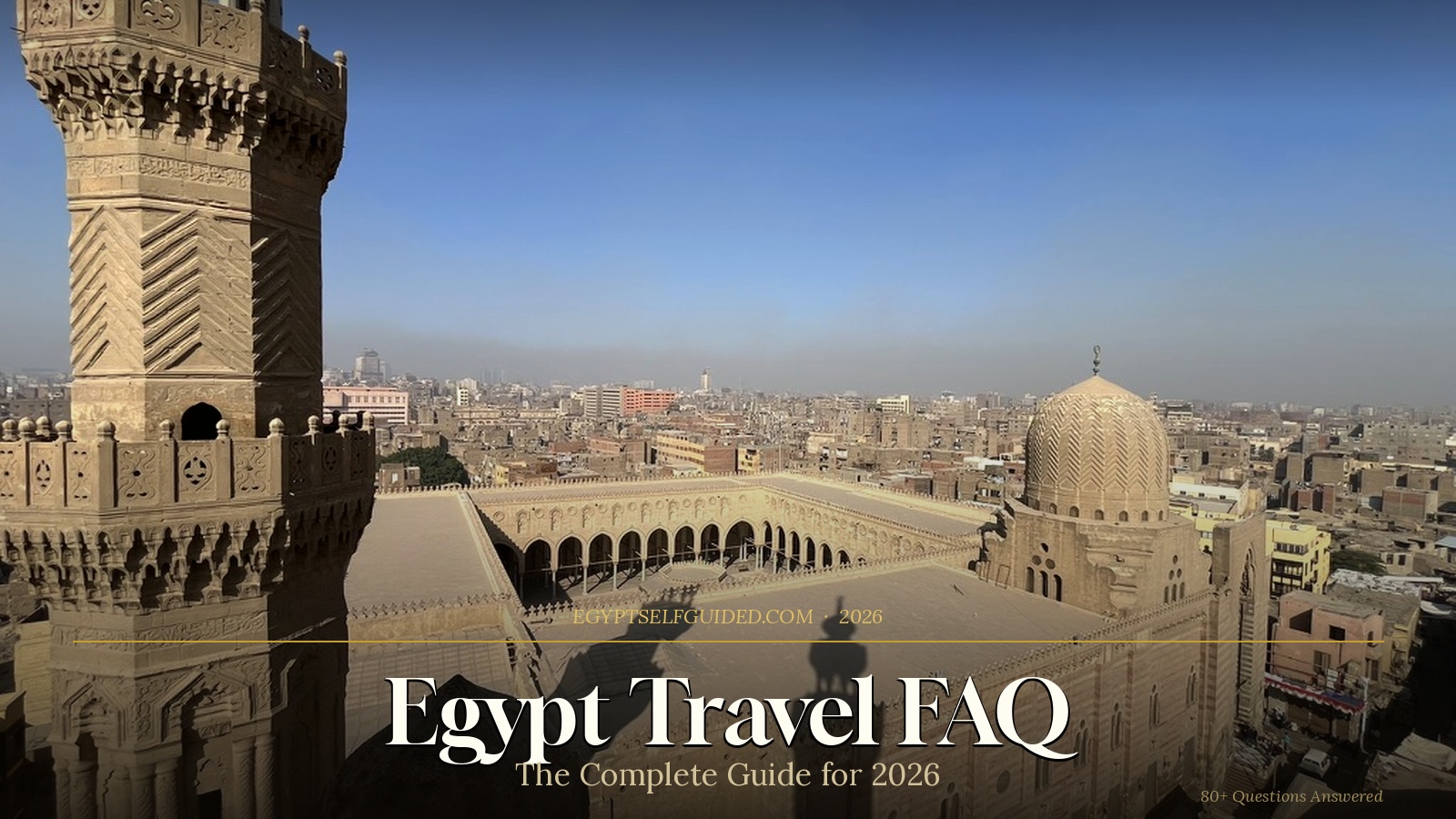
Every Egypt trip starts with the same list of unanswered questions. Is there really a GEM walkway to the Pyramids — and how does it work? How do you spend 3 days in Cairo without wasting them? What actually happens with Uber at Giza, and what do you do when it goes wrong? How do you plan a safe night out in Egypt — transport, scams, etiquette — without the anxiety? Is 9 days in Egypt enough, or do you need 12?
This Egypt Travel FAQ answers all of it. It draws on every guide in this series — the GEM, Cairo transport, Cairo culture, the Nile cruise, Aswan, Abu Simbel, Luxor, the hidden West Bank, and the itinerary library — organised by the questions travelers actually search for. The most-searched topics appear first. Every answer links to the full guide where the subject is covered in depth.
If you’re planning a self-guided Egypt trip in 2026, start here.
✍️ How to Use This Guide
This is a reference guide, not a read-through. Use the Table of Contents to jump to the section most relevant to your planning stage. Each answer is self-contained — you don’t need to have read any other guide first. Where a topic goes deeper than a single FAQ can cover, the answer links to the full dedicated guide in this series.
If you’re building an itinerary from scratch, the 12-Day Egypt Master Itinerary and the 3, 7 & 9-Day Itinerary Library are the right starting points. The Egypt Transport & Safety Survival Guide and the Cultural Guide cover the practical and experiential layer underneath every destination.
📋 Table of Contents
I. The GEM Walkway & The Giza Plateau
The GEM walkway to the Pyramids is one of the most-searched questions about Egypt — and the answer is more useful once you understand exactly how it works and what you need to use it. Below are the key questions about the walkway, the Giza Plateau logistics, and how the GEM and Pyramids fit together as a combined visit.
What is the GEM walkway to the Pyramids — is it completed yet?
Still not fully completed yet, the GEM walkway is a dedicated 1.45 km pedestrian path that connects the Grand Egyptian Museum entrance to the Giza Plateau. To use it, you need valid tickets for both sites — you cannot walk the path with a GEM-only or Pyramids-only ticket. The walk takes roughly 20 minutes through a landscaped corridor.
However, at the time of our visit, it was in a semi open state only, with motorway crossing required (for latest news, check the GEM official site). A better option for now is take an Uber from the Sphinx Gate to the GEM entrance takes about five minutes and costs $3–5. For the full GEM layout and how to coordinate the walkway into your day, see The Grand Egyptian Museum (GEM): The Complete Self-Guided Visitor’s Guide.
Which entrance should I use at the Giza Plateau if I’m heading to the GEM afterward?
Plan your route through the plateau so you exit from a different gate than you entered — this avoids retracing your steps and puts you closer to the GEM on the way out. There are two ways to do this:
Option A — Enter via the main Pyramids Visitor Centre, exit via the Sphinx Gate. Walk the plateau from the main entrance toward the Sphinx, exit at the Sphinx Gate, then take an Uber or taxi to the GEM from there.
Option B — Enter via the Sphinx Gate, exit via the main Pyramids Visitor Centre. Start at the Sphinx and work your way toward the pyramids, exit at the main Visitor Centre, then Uber or taxi to the GEM.
Either route covers the full plateau without backtracking. Note: the old entrance near the Marriott Mena House hotel is permanently closed and does not appear reliably on older maps — do not use it as a reference point. For the full GEM transport strategy including the Uber rules on the return to Cairo, see The Grand Egyptian Museum (GEM): The Complete Self-Guided Visitor’s Guide.
Should I visit the Pyramids first or the GEM first?
Pyramids first, GEM second — and ideally on separate days if your schedule allows. The Pyramids are best experienced in the early morning before tour group convoys arrive (by 7 a.m. if possible). The GEM is a full-day destination in its own right — we arrived at noon and left at nearly 9 p.m.
If you’re combining them in one day: Pyramids at opening, then cross to the GEM by midday via Uber and stay until closing. But if your schedule gives you the choice, treat each as its own full-day experience. Both deserve it. Sequencing guidance in The Grand Egyptian Museum (GEM): The Complete Self-Guided Visitor’s Guide and the 12-Day Egypt Itinerary: Master Guide.
What is the best way to get from the Giza Plateau to the GEM?
Uber — but with a specific strategy. Set the destination as “GEM – Grand Egyptian Museum” in the app. The ride from the Sphinx Gate to the GEM entrance takes about five minutes and costs $3–5. This leg (Pyramids to GEM) is generally fine.
The problems concentrate on the return journey — GEM or Sphinx Gate back to Cairo is where the Uber fraud pattern is consistent. Always walk about 50 meters from the exit before opening the app on the return leg, and cancel immediately if a driver sends you any message before pickup. The full Giza Uber strategy is in Cairo: Getting Around, Staying Safe & Practical Essentials.
Is the Giza Plateau well-organised in 2026, or is it still chaotic?
Considerably more organised than its reputation suggests. The free internal shuttle buses run frequently across the plateau, connecting each pyramid and viewpoint. Most visitors are funnelled along the same routes, which means wandering even slightly off the main path — a few steps to the side, a slightly different angle — produces photographs with almost no one in them.
The shuttle system has genuinely changed the experience for the better. Vendor presence is real but manageable with the “La, Shukran” method (say it once, keep walking, no eye contact).
The biggest source of stress is not inside the plateau — it is transport leaving the area. Budget for the taxi fallback ($10–15 to central Cairo in a marked white taxi) and carry the cash before you go in.
The full on-the-ground 2026 Giza experience is covered in The “Wish I Knew” Cultural Guide to Egypt.
II. Visiting the Grand Egyptian Museum (GEM)
The GEM opened as the world’s largest archaeological museum and immediately became the most misunderstood site in Egypt. Most visitors plan it as a half-day follow-up to the Pyramids. Almost all of them wish they’d given it a full day. Here is everything you need to plan it properly.
How much time is needed for visiting the Grand Egyptian Museum?
Budget 5 to 9 hours for a thorough visit covering the Grand Staircase (60 colossal statues), the Tutankhamun Galleries, the 12 Exhibition Halls, and the Khufu Ships Museum. If you only have half a day, prioritise the Grand Staircase, Tutankhamun Galleries, and Khufu Ships Museum in that order.
We arrived at noon on a Saturday and left at nearly 9 p.m. — and didn’t feel we’d exhausted it. For a full breakdown of what to see and how to sequence it, refer to The Grand Egyptian Museum (GEM): The Complete Self-Guided Visitor’s Guide.
What are the must-see objects in the Tutankhamun Galleries at the GEM?
Five objects are worth prioritizing above everything else:
The Golden Mask (11 kg of solid gold with lapis lazuli inlays — have your camera ready before you reach the case, you’ll have roughly ten seconds);
The Inner Coffin (110 kg, solid gold, with extraordinary feathered rishi patterning);
The Golden Throne (the back panel shows Tutankhamun and his wife in a rare scene of royal tenderness);
The Meteoritic Dagger (iron blade confirmed to have come from a meteorite — in an era before iron smelting, this was as precious as the gold surrounding it);
The Canopic Shrine (four golden goddesses with arms extended in protection).
Most visitors invest all their time at the Golden Mask and underinvest in the Throne and the Dagger — don’t make that mistake. Full gallery guidance in The Grand Egyptian Museum (GEM): The Complete Self-Guided Visitor’s Guide.
Should I walk the Grand Staircase or take the moving walkway?
Walk it.
The moving walkway gets you to the top in two minutes — and skips 60 colossal statues arranged across four thematic landings spanning 3,000 years of Egyptian royalty. At each landing, turn around and look back through the Atrium glass: the building is designed so that all three Giza pyramids are framed in the center of the view as you ascend, the alignment shifting as you gain height.
This is one of the most carefully engineered sightlines in any museum in the world. Almost no one stops to look. Full staircase guidance in The Grand Egyptian Museum (GEM): The Complete Self-Guided Visitor’s Guide.
What is the Khufu Ships Museum and is it included with the GEM ticket?
Yes — included in the standard GEM admission (1,450 EGP). It is a separate building across the plaza from the main entrance, and this is why most visitors either miss it or arrive when their legs are already gone. Note its location at the start of the day and visit it before your energy runs out.
The museum houses a 43-meter cedar solar boat buried beside Khufu’s pyramid around 2500 BCE — assembled from 1,224 pieces of wood, held together with rope and no nails, preserved so completely that when it was excavated in 1954, the wood was still fragrant. Take the elevator to the top floor first, then walk the ramps down to see it from above and then alongside. Full details in The Grand Egyptian Museum (GEM): The Complete Self-Guided Visitor’s Guide.
Should I book GEM tickets online or at the gate?
Online booking at visit-gem.com is recommended for weekends, when the museum can reach capacity. That said, we bought tickets on our phones just outside the gate on a busy Saturday and it worked fine — the website was slow but functional.
Entry is by timed slot (8:30–11:00, 11:00–13:00, 13:00–15:00, 15:00–17:00, 17:00–19:00). This applies to the galleries only — you can arrive early, eat at Zooba in the atrium, and use the complex before your gallery slot begins. Full ticket and timing details in The Grand Egyptian Museum (GEM): The Complete Self-Guided Visitor’s Guide.
What is the best day and time to visit the GEM?
Saturday is the best day if you want extended evening hours — galleries stay open until 9 p.m. (Wednesday also has extended hours). The atmosphere in the late afternoon, when the crowd has thinned and the low light through the glass façade turns golden, is noticeably better than the midday rush.
For the quietest experience, visit midweek in the afternoon. Avoid midday on weekends. If visiting during Ramadan, check the GEM website for adjusted hours. Full timing guidance in The Grand Egyptian Museum (GEM): The Complete Self-Guided Visitor’s Guide.
How is the GEM different from the old Egyptian Museum in Tahrir Square?
They are complementary experiences, not duplicates. The GEM presents Egypt’s greatest objects — including the complete Tutankhamun collection — in a purpose-built space with ideal lighting and modern curation. The Tahrir museum, open since 1901, feels more like a private archive overflowing with things of incalculable importance: some rooms have priceless artifacts lined up almost apologetically because there isn’t space to give each one its due.
Go to the GEM for the famous objects; go to Tahrir for the texture of what museum-keeping looked like before modern curation — and for collections that haven’t moved to Giza yet. Arrive at Tahrir after 10 a.m. to let the morning tour groups clear. Both are covered in The Grand Egyptian Museum (GEM): The Complete Self-Guided Visitor’s Guide and Cairo: Cultural Attractions & Hidden Gems.
Where should I eat at the GEM?
Two genuinely good options inside the complex. Zooba (near the main entrance) serves Egyptian street food refined for the museum setting: koshari, chicken and beef sandwiches, ful medames. Eat here before entering the galleries — lunch crowds thin out once visitors are absorbed into the halls. Budget 150–250 EGP per person. BitterSweet Café (upper level) serves pizza, pasta and coffee — ideal for recovery at the end of a long day. Budget 200–350 EGP.
There is also a branch of Mandarine Koueider (a Cairo institution since 1928) for baklava and Egyptian sweets. Skip eating near the Pyramid gates entirely. Full dining guidance in The Grand Egyptian Museum (GEM): The Complete Self-Guided Visitor’s Guide.
📋 GEM Quick Reference — Screenshot This
| Item | Key Information |
|---|---|
| Tickets | 1,450 EGP (admission) / 1,950 EGP (guided) — buy at visit-gem.com or at the gate |
| Gallery hours | 9 AM – 6 PM standard; until 9 PM on Sat & Wed |
| Best day | Saturday — extended hours, best evening atmosphere |
| Time to budget | 5–9 hours for full visit; 3 hours minimum for Tutankhamun + Staircase only |
| GEM walkway | 1.45 km path to Giza Plateau — needs valid tickets for BOTH sites |
| First move inside | Stand at Staircase base, look back through Atrium glass — all 3 pyramids visible |
| Walk the staircase | Don’t take the moving walkway — it skips 60 colossal statues across 4 landings |
| Tutankhamun tip | Camera ready before the mask case. Turn right at top of staircase. |
| 5 objects to find | Golden Mask · Inner Coffin · Golden Throne · Meteoritic Dagger · Canopic Shrine |
| Khufu Ships Museum | Separate building across the plaza — same ticket — take elevator, walk down ramps |
| Lunch | Zooba (Egyptian street food) — eat before entering galleries |
| Dinner | BitterSweet Café (pizza, pasta) — ideal after a long visit |
| Uber TO GEM | “GEM – Grand Egyptian Museum” — ~$4 from Sphinx Gate, usually fine |
| Uber FROM GEM | Walk 50m from entrance before opening app; cancel any driver who messages first |
| Taxi fallback | Marked white taxi — agree price first — $10–15 to downtown Cairo |
| Licence plate hack | ٥ = 5 · ٧ = 7 · ٨ = 8 — save the cheat sheet in The Grand Egyptian Museum (GEM): The Complete Self-Guided Visitor’s Guide on your phone |
III. Cairo Itinerary — How Many Days & What to Do
Cairo is the question most travelers underestimate at the planning stage. The instinct is to treat it as a gateway — two days on the way to Luxor. The reality is that Cairo alone contains two of the most extraordinary sites in the world (the GEM and the Giza Plateau), an Islamic old city that takes days to absorb, one of the oldest Christian neighbourhoods on earth, and a food scene that rewards every detour. Here is how to structure your time.
How many days do I need in Cairo?
Three days is the minimum to experience Cairo properly — and three days is the number we recommend most strongly.
Here is why the 3-Day Cairo Rule matters: the Giza Plateau and GEM together justify a full day; Islamic Cairo (the Citadel, Bab Zuweila, Al-Azhar, Khan el-Khalili) justifies a full day; and Coptic Cairo plus the original Egyptian Museum at Tahrir Square justifies at least a half-day.
Trying to compress all of this into two days means rushing past things you’ll wish you’d lingered over — and Cairo specifically punishes rushing. Two days gives you a good trip. Three days gives you Cairo. Four days, if you have them, is the version where the city starts to feel like yours. The full 3-day Cairo structure is in the 12-Day Egypt Itinerary: Master Guide to Independent Travel.
What is the best 3-day Cairo itinerary?
The sequence that works best:
Day 1 — Islamic Cairo and the Citadel. Start at the Saladin Citadel and Muhammad Ali Mosque for the panoramic view (on a clear morning you can see the Pyramids on the western horizon). Move down to Islamic Cairo: Al-Azhar Mosque, Bab Zuweila and the minaret climb, and an unhurried walk along Al-Muizz Street. End the day with the walk from Bab al-Futuh south into Khan el-Khalili at dusk.
Day 2 — Coptic Cairo and the Tahrir Museum. Metro to Coptic Cairo in the morning — St. Barbara’s Church, Abu Serga, and the Hanging Church. Afternoon at the original Egyptian Museum on Tahrir Square (arrive after 10 a.m. to let tour groups clear).
Day 3 — Giza Plateau and the GEM. Pyramids at opening, then cross to the GEM by midday via the walkway or Uber and stay until closing. This order builds well — the Islamic and Coptic heritage makes a strong first impression, the Tahrir museum provides historical context, and the Pyramids and GEM serve as a climax.
Full day-by-day breakdown in Cairo: Cultural Attractions & Hidden Gems.
Where should I stay in Cairo?
Stay in central Cairo — downtown near Tahrir Square, Garden City, or Zamalek. Do not stay in Giza.
A Giza hotel puts you close to one attraction and far from everything else: better food, walkable streets with evening energy, the metro, and the kind of city atmosphere that makes a trip feel lived-in rather than visited.
Our first Cairo hotel had a rooftop jazz breakfast with city views. Our second had a 1940s-era manual elevator that worked perfectly. Neither was in Giza. The full neighbourhood comparison — and what central Cairo has that Giza doesn’t — is in Cairo: Getting Around, Staying Safe & Practical Essentials.
IV. Cairo Arrival Guide — Airport, Uber & Getting Around
Cairo Airport has a handful of specific procedures that most first-time visitors don’t know in advance — the parking lot rule, the Arabic numeral plate issue, the SIM card desk location. Getting these right on arrival sets the tone for the whole trip. Here is everything you need before you land.
What do I need to know before arriving at Cairo Airport?
Four things to do immediately after landing, in this order:
(1) Visa on arrival — for most nationalities (USA, UK, EU, Australia), the bank kiosks are in the arrivals hall before passport control. $25 USD, single entry, takes about 20 seconds. Bring new, crisp bills — tellers regularly reject worn notes.
(2) SIM card — Vodafone and Orange desks are in the luggage hall. Buy a 30GB physical SIM for ~$10 before you leave the building. Don’t wait until the city.
(3) Currency — don’t exchange at the airport counters. Rates are poor. Use NBE or Banque Misr ATMs once you’re in Cairo.
(4) Transport — your three options are a hotel transfer (~$15–20, best for late arrivals), Uber from the parking lot (see below), or the official airport taxi counter inside arrivals.
The complete Cairo arrival playbook is in Cairo: Getting Around, Staying Safe & Practical Essentials.
How do I get an Uber from Cairo Airport? Why can’t drivers find me?
This is the single most important thing to know about Cairo Airport: Uber cannot pick up at the arrivals curbside. That lane is reserved for taxis. If you open Uber while standing outside arrivals and wonder why drivers keep messaging that they can’t find you — this is why.
The correct process: exit arrivals → find the outdoor elevators → take them down to the parking lot (Section B5) → stay inside the terminal until your driver confirms they are actually in the lot → approach the car only then.
The moment you step outside arrivals, taxi touts will approach. Matching the car to the number plate before you move is essential (see license plate FAQ below).
For late-night arrivals after midnight, a pre-booked hotel transfer at ~$15 is worth the peace of mind. Full airport arrival guide in Cairo: Getting Around, Staying Safe & Practical Essentials.
How do I read Egyptian licence plates to match my Uber driver?
Egyptian license plates use Eastern Arabic numerals, which look different from the 0–9 system shown in your Uber app. Three numbers cause consistent confusion: ٥ = 5 (looks like a backwards “o”), ٧ = 7 (looks like a “V”), ٨ = 8 (looks like a backwards “7”).
In the chaos of the GEM exit or the airport parking lot, being able to match the plate in the app to the actual car in front of you is the difference between confident identification and standing in a crowd of identical vehicles with no idea which one is yours.
Screenshot the Egyptian numeral mapping and save them to your camera roll before the trip. Covered in both the Egypt Transport & Safety Survival Guide and Cairo: Getting Around, Staying Safe & Practical Essentials.
Is Uber reliable in Cairo?
Yes — Uber is the single most useful app in Cairo and the right tool for the vast majority of journeys. Most rides cost $2–5, the price is fixed, and it eliminates the energy drain of constant price negotiation.
One rule makes it work significantly better: if a driver messages you before pickup asking for cash, a higher fare, or asking you to meet somewhere other than the pin — cancel immediately, no exceptions.
A legitimate driver has no reason to contact you before pickup. The only consistently problematic area is the Giza Plateau and GEM exit, which has its own dedicated section below. All Uber rules for Cairo are in Cairo: Getting Around, Staying Safe & Practical Essentials.
Is the Cairo Metro worth using?
Yes — at least once, and particularly for Coptic Cairo. The metro stop is close to the neighbourhood entrance and bypasses the surface traffic entirely. It’s clean, cheap (a few EGP per ride), and a genuine slice of local life.
On our first attempt, several locals spontaneously guided us through buying a ticket and finding the right platform without being asked — it set the tone for our whole understanding of Cairo. Women-only cars are clearly marked. The metro is most useful for Coptic Cairo and for bypassing traffic between Tahrir and the southern neighborhoods.
Full metro guidance in Cairo: Getting Around, Staying Safe & Practical Essentials.
Where is the best Uber drop-off for Khan el-Khalili bazaar?
Set your destination to Bab al-Futuh — the historic medieval gate, a 10–15 minute walk north of the bazaar — not to Khan el-Khalili itself.
Dropping directly into the market means arriving in gridlocked alleys. Walking south from Bab al-Futuh gives you beautifully lit historic streets first: old city gates illuminated, mosque minarets glowing, locals pausing for evening prayer. By the time you reach the bazaar, you’re already in the right state of mind for what it is.
This approach and the best timing (dusk) are covered in Cairo: Getting Around, Staying Safe & Practical Essentials and Cairo: Cultural Attractions & Hidden Gems.
V. The Uber Giza Trap — What It Is & How to Handle It
The Giza Plateau and GEM exit is the only place in Egypt where transport fraud is a consistent, predictable pattern — not an occasional bad experience but a reliable scheme that operates at both exits. Understanding exactly how it works makes it entirely manageable. We encountered it on both our Giza visits. Here is the complete breakdown.
What is the Uber Giza trap, and how does it work?
The Uber Giza trap is a consistent transport scam that operates at the exits of the Giza Plateau and Grand Egyptian Museum. It works like this: a driver accepts your Uber request, then immediately sends an in-app message. The message is usually friendly (“Good morning! Where are you going?”) or direct (“Road is closed, need extra cash”). Either is the opening move of a price renegotiation — the driver is testing whether you’ll engage before pickup.
The correct response: don’t reply. Cancel the ride immediately and request a new one. Report the driver for “requesting payment outside the app.” The message itself — whatever it says — is the red flag. A legitimate driver has no reason to contact you before pickup.
On our second Giza exit, getting a legitimate Uber required four attempts. The same fraudulent driver appeared twice after being cancelled. This is not an isolated bad experience — it is a consistent pattern at this specific location.
Full breakdown in Cairo: Getting Around, Staying Safe & Practical Essentials and the Egypt Transport & Safety Survival Guide.
What do I do if I’m already in the car and the Uber Giza driver demands more money?
This happened to us. The script that works: say calmly, “I only pay the price shown in the app. If that’s a problem, please stop here.” Say it once, without arguing or explaining further. Most drivers back down immediately when they realize you won’t negotiate. If the car keeps moving, repeat it.
We were moving slowly enough in Giza traffic that getting out was straightforward — we simply got out, cancelled the ride, and found a taxi. The experience was unpleasant for about four minutes and then completely over. The key is not to engage with the logic of their demand (“the road is long,” “I’ll return empty,” “traffic surcharge”) — engaging turns it into a negotiation. One calm statement, then the door.
Full account in Cairo: Getting Around, Staying Safe & Practical Essentials.
What is the full strategy for getting a legitimate Uber from Giza?
Four steps that work:
(1) Walk away from the exit first. Walk about 50 metres from the GEM or Sphinx Gate entrance before opening the Uber app — this changes which drivers can see your request and filters out some of the fraudulent ones positioned closest to the exit.
(2) Cancel without reply. If the first driver messages you, cancel immediately without responding. Request a new one. Repeat as needed.
(3) Know when to switch. If three cancellations in a row produce fraudulent drivers, stop trying Uber at that moment and switch to a marked white taxi.
(4) Carry the taxi cash before you go in. The going rate from Giza to central Cairo in a marked taxi is $10–15. Agree the price and currency before getting in. Carry this amount in cash specifically before visiting Giza — having the fallback available before you need it removes all the stress.
The complete Giza transport strategy is in Cairo: Getting Around, Staying Safe & Practical Essentials.
Is the Uber Giza problem the same at the Sphinx Gate and at the GEM exit?
The two exits have different patterns and different levels of severity.
At the Sphinx Gate — typically midday when heading from the Pyramids to the GEM — the fraudulent driver pattern is present but manageable. Multiple cancellations and retries usually produce a legitimate driver within a few attempts. It is an inconvenience, not a crisis.
At the GEM exit — typically in the evening when heading back to Cairo — the problem is considerably more serious. Legitimate Ubers are very hard to come by here, and multiple retries are unlikely to resolve it.
Don’t rely on Uber for the GEM evening exit. Plan from the start to negotiate with a taxi. Walk away from the entrance, find a clearly marked taxi, and agree the price and currency before getting in. The going rate to central Cairo is $10–15. Carrying this amount in cash before you enter the GEM is not optional — it is the exit strategy.
For the full Uber cancellation and taxi negotiation approach, see Cairo: Getting Around, Staying Safe & Practical Essentials.
VI. Cairo — Cultural Sites & Hidden Gems
Cairo does not reveal itself on a schedule. Its best moments arrive when you turn the wrong corner and find something no travel guide described. The questions below cover both the famous sites and the ones most itineraries leave out.
What is the best view of Islamic Cairo — Bab Zuweila or the Cairo Tower?
Both have nice views, but Bab Zuweila’s view is more authentic Cairo.
Bab Zuweila is one of only three surviving gates from Cairo’s original 11th-century city walls. From the minaret balcony, Islamic Cairo spreads in every direction: minarets, unfinished rooftops, narrow lanes, the mosque courtyard directly below.
The Cairo Tower, by comparison, is an elevator ride to an observation deck. Bab Zuweila puts you in the middle of the city’s history, not above it.
Worth knowing: there is no signage separating Bab Zuweila from the adjacent Mosque of Sultan al-Mu’ayyad — getting “lost” between the two is built into the visit. If someone opens a decorated door and invites you in, say yes. We did, and were shown a private domed chamber with twelve decorated windows that most visitors never see.
Full guide in Cairo: Cultural Attractions & Hidden Gems.
Is Al-Azhar Park worth visiting in Cairo?
Yes — and it is dramatically underused by visitors. Al-Azhar Park is Cairo’s best elevated viewpoint outside the Citadel: a beautifully landscaped public garden on a hill above Islamic Cairo, with palm-lined paths, fountains, and sweeping views including the Muhammad Ali Mosque on the horizon.
On our weekday morning visit, it was nearly empty. The contrast with the crowds of Islamic Cairo, ten minutes’ walk away, was dramatic. It pairs naturally at the end of a Bab Zuweila and Al-Azhar Mosque morning — walk or Uber there after Al-Azhar (five minutes), spend an hour for the views, then Uber to Bab al-Futuh for the evening walk into Khan el-Khalili.
Full guide in Cairo: Cultural Attractions & Hidden Gems.
How do I approach Khan el-Khalili bazaar without being overwhelmed?
Two things make the difference. Go at dusk, not midday — the bazaar lights up in warm tones as evening arrives, the atmosphere is exceptional, and the walk from Bab al-Futuh is one of Cairo’s finest evening experiences.
Set your Uber to Bab al-Futuh (the medieval gate, a 10–15 minute walk north of the market) and walk south from there through beautifully lit historic streets before the bazaar begins.
Allow 90 minutes maximum inside — the sensory saturation is real and a shorter focused visit beats hours of exhaustion. For vendor interactions, “La, Shukran” applies here more than anywhere: walk faster, avoid eye contact.
Full guide in Cairo: Cultural Attractions & Hidden Gems.
Is Coptic Cairo safe to visit, and how do I get there?
Yes — Coptic Cairo is one of the safest and most serene neighborhoods in all of Cairo. Military checkpoints at vehicle barriers mean your Uber stops at the perimeter and you walk in (show no nervousness and you’re through in seconds).
Once inside, the city recedes. Narrow alleys wind between ancient churches, chapels, and small markets. The three churches worth prioritizing:
St. Barbara’s Church (extraordinary iconostasis and wall paintings);
Church of St. Sergius (Abu Serga) (believed to stand where the Holy Family rested during the flight into Egypt — descend the stairs into the crypt);
The Hanging Church (built atop the gatehouse of a Roman fortress, literally suspended above the street below).
Best transport: Cairo Metro, Line 1, Coptic Cairo station — close to the entrance and traffic-free. Allow 2–3 hours. Full guide in Cairo: Cultural Attractions & Hidden Gems.
VII. How to Plan a Safe Night Out in Egypt (Transport, Scams & Etiquette)
This is one of the most-searched Egypt travel questions — and the answer is more reassuring than most people expect. Egypt’s cities are evening cities. Cairo is alive well past midnight. Luxor’s Corniche comes alive as the light changes over the Nile. Knowing the specific transport rules, vendor dynamics, and social signals for after dark makes the difference between an anxious evening and a genuinely memorable one.
How do you plan a safe night out in Egypt — transport, scams, and etiquette in 2026?
The most important reframe before any Egyptian evening: physical safety is high. Egypt is intense, not dangerous.
Walking at night in downtown Cairo and tourist areas felt completely comfortable throughout our 12-day trip. The “risks” are not physical — they are commercial: persistent vendor approaches and transport dynamics that work differently after dark.
Here is the practical framework for a safe and enjoyable Egyptian night out.
Transport: Use Uber — it is available 24 hours in Cairo and is the right tool for night travel. The same rules apply after dark as during the day: cancel immediately if a driver messages before pickup. For very early morning departures (3–4 a.m.), allow an extra 5–10 minutes of buffer and have a fallback plan.
In Luxor, there is no Uber — arrange through your hotel.
In Aswan, use InDrive or negotiate with a taxi using the InDrive price as a baseline.
Scams: Vendor pressure is real but works the same way at night as during the day — say “La, Shukran” once, keep walking, no eye contact. The bazaar areas (Khan el-Khalili) are actually less chaotic at dusk than midday because the crowd is active but not claustrophobic.
Etiquette: Egypt is an evening culture. Restaurants, rooftops, and the areas around major temples (Luxor Temple is open until 9 p.m.) are all genuinely welcoming to visitors after dark. Dress modestly near mosques even in the evening.
The full night-out strategy is in The “Wish I Knew” Cultural Guide to Egypt and Egypt Transport & Safety Survival Guide.
Is it safe to take an Uber late at night in Cairo?
Yes — Uber is available and reliable 24 hours in Cairo. The front desk at our hotel, when asked if Uber at 3 a.m. would be a problem, said simply: “Cairo never sleeps.” The same driver behaviour rules apply at night as during the day.
On our 3 a.m. pre-flight departure, the first driver immediately sent a message asking for 30 euros cash “because he’d return empty.” We cancelled. A second driver arrived three minutes later with no messages and no drama.
The system works — some individual drivers test it, always at night as at day. Cancel and rebook without hesitation. Full late-night transport guidance in Cairo: Getting Around, Staying Safe & Practical Essentials.
What is the best evening experience in Cairo for first-time visitors?
The sequence that consistently produces the best Cairo evening: Uber to Bab al-Futuh in the late afternoon → walk south along Al-Muizz Street as the mosque lighting comes up → enter Khan el-Khalili at dusk → 90 minutes in the bazaar → dinner in one of the rooftop or courtyard restaurants one block off the main tourist path.
More evening highlights for both Cairo is in The “Wish I Knew” Cultural Guide to Egypt.
How do you handle vendor pressure during an evening out in Egypt?
The same way you handle it during the day — and with more confidence, because after a day or two in Egypt, the pattern becomes entirely readable. “La, Shukran” (No, thank you) delivered calmly, without breaking stride, without eye contact, without explanation.
The moment you engage with a reason (“I already have one,” “I’m not interested”), the conversation becomes a negotiation. Forward movement ends it. In the bazaar specifically: walk at a slightly faster pace, don’t make eye contact with display items you’re not genuinely considering, and let the crowd carry you through the densest sections.
The social contract in Khan el-Khalili is understood by everyone — vendors call out, travelers decline or engage, and no one takes it personally. The “La, Shukran” method and full cultural vendor guidance are in Egypt Transport & Safety Survival Guide and The “Wish I Knew” Cultural Guide to Egypt.
VIII. Safety, Scams & Cultural Etiquette — Egypt Travel FAQ
Is Egypt safe for independent travelers?
Yes. We walked Cairo, Luxor, and Aswan for 12 days — including at night — entirely self-guided and never once felt physically threatened. Egypt has a strong tourist infrastructure, visible security presence at major sites, and a culture of genuine hospitality toward visitors. The important distinction: the “dangers” you’ll read about online are almost always persistent commercial pressure — vendors and commission-seekers who open with elaborate friendliness. These people are not threatening. They want a sale.
Understanding that distinction before you arrive makes the country immediately more manageable. The practical toolkit — and why Egypt rewards the traveler who stops fighting its rhythm — is in Egypt Transport & Safety Survival Guide and The “Wish I Knew” Cultural Guide to Egypt.
What is the “La, Shukran” method and why does it matter?
Two Arabic words handle the majority of unwanted vendor interactions across the entire trip: “La, Shukran” — No, thank you. Say it calmly, without breaking stride, without making eye contact, without stopping to explain your reasoning. The moment you engage with a reason, the conversation becomes a negotiation. Eye contact invites follow-up. Forward movement ends it. It takes a day or two to stop feeling rude about this. Once it becomes instinct, Egypt becomes considerably more relaxed. The full vendor interaction guide is in the Egypt Transport & Safety Survival Guide.
How do you cross the street safely in Cairo?
Cairo traffic does not stop for pedestrians — crosswalk signals are largely decorative. The technique that works: walk at a steady, unhesitating pace. Drivers calculate their path around your current speed. Stopping suddenly or hesitating breaks their calculation — that’s where problems happen. Don’t run and don’t freeze. If you’re nervous on your first day, find a local crossing at the same moment and match their pace.
By Day 3 it becomes automatic. A Luxor cyclist later passed us without turning his head: “Wow, you walk like an Egyptian.” — the trip’s unofficial graduation. Full street-crossing guidance in the Egypt Transport & Safety Survival Guide.
What should I know about tipping (baksheesh) in Egypt?
Tipping is woven into Egyptian daily life and genuinely expected in more situations than most Western travelers are used to. Approach it with openness — it is how many people in the service industry supplement modest wages. As a rough guide: bathroom attendants (2–5 EGP), hotel porters (10–20 EGP per bag), local restaurants (~10% in cash), museum or site attendants who open a door or illuminate a scene (20–50 EGP), Nile cruise staff (~$10 per day per person for both staff and guide).
Always carry a stock of small notes (5s and 10s) specifically for this — ATMs dispense 200 EGP notes that are nearly impossible to break at small transactions. Full tipping guidance in Cairo: Getting Around, Staying Safe & Practical Essentials.
How should I dress when visiting mosques and religious sites?
Shoulders and knees should be covered when entering mosques and religious sites. Many mosques provide coverings for women at the entrance, but bringing your own lightweight layer is simpler and more comfortable in the heat. Always remove shoes before entering. If you arrive while prayer is beginning, move quietly to the side, sit unobtrusively, and wait — watching worshippers from the side is acceptable and can be genuinely moving.
Tips are customary in smaller mosques when a caretaker has given you private access or spent time explaining the history. Cultural etiquette for mosque visits is covered in The “Wish I Knew” Cultural Guide to Egypt.
IX. Money, ATMs & Practical Logistics
Do I really need cash in Egypt, or will my card work?
Cash is essential — more than most first-time visitors expect. Hotels and upscale restaurants accept cards reliably. Everything else — local restaurants, street food, taxis, tips, bathroom attendants, smaller shops — runs on cash.
Assuming your card will cover most situations is the most common financial mistake visitors make. Before sitting down at any local restaurant, ask “Do you accept credit cards?” — many will say no, or “only if the machine is working today.”
Carry a working mix of denominations at all times, with plenty of small notes. Full cash strategy in the Egypt Transport & Safety Survival Guide.
Which ATMs are safe and reliable in Egypt?
Stick to two banks: National Bank of Egypt (NBE) and Banque Misr. Their ATMs work consistently with foreign cards, are easy to find throughout Cairo, Luxor, and Aswan, and always dispense cash.
Smaller bank ATMs caused repeated problems on our trip — some rejected foreign cards without explanation, one appeared to work but dispensed nothing. After a few failed attempts, we stopped trying anything other than NBE and Banque Misr entirely.
Covered in the Egypt Transport & Safety Survival Guide.
What is the small note problem, and how do I solve it?
ATMs in Egypt almost always dispense 200 EGP notes. These are very difficult to break at small shops, street food stalls, public toilets, and taxis. The solution: every time you’re at an ATM or receiving change at a larger establishment, actively seek out 5, 10, and 20 EGP notes.
Keep a separate pocket for them. Replenish at every opportunity. Running out of small bills is a more common practical problem across the day than running out of cash entirely. Details in the Egypt Transport & Safety Survival Guide.
What is the best debit card to bring to Egypt?
A Charles Schwab debit card is the standout option for US-based travelers — it automatically refunds all international ATM fees and charges zero foreign transaction fees. It worked at every ATM we tried across three cities. If switching cards isn’t practical before the trip, prioritize fewer, larger ATM withdrawals to minimize per-transaction fees.
Some smaller cash-only restaurants also accept USD or EUR when EGP runs short, usually at a fair rate — useful as a genuine backup. Details in the Egypt Transport & Safety Survival Guide.
X. Flights, SIM Cards & Pre-Trip Essentials
What is the EgyptAir currency hack for cheaper domestic flights?
When booking on the EgyptAir website, change the booking currency to EGP (Egyptian Pounds) before searching for flights. The site defaults to a higher “international” rate in USD or EUR. Switching to EGP before selecting your flight regularly produces a noticeably lower fare — sometimes the equivalent of a full night’s hotel.
This applies to Cairo–Aswan, Cairo–Luxor, and any domestic EgyptAir route. Covered in Aswan & Abu Simbel: The Complete Self-Guided Explorer’s Guide and the Egypt Transport & Safety Survival Guide.
Will EgyptAir notify me if my flight time changes?
They may not — and this is critical.
EgyptAir changed our flight times twice without sending any email notification either time. Check your booking directly on the EgyptAir website manually — every few days in the weeks before the trip, and daily in the final 48 hours. Do not rely on email alerts. This is especially important if you have tight connections or an early departure with an Abu Simbel convoy day on the other end.
Always allow at least four hours between a domestic Cairo arrival and your international departure. Covered in the Egypt Transport & Safety Survival Guide.
Should I buy a physical SIM card or use an eSIM in Egypt?
Buy a physical SIM card at Cairo Airport — in the luggage hall, before you leave the building. Vodafone and Orange both have desks there. A 30GB SIM costs around $10 and will last a 12-day trip comfortably.
Skip the eSIM unless your phone has no physical SIM slot: inside the thick stone walls of Luxor’s temples and Aswan’s rock-cut tombs, physical SIM cards maintain signal noticeably better than most eSIMs.
Having data before you reach the taxi queue is worth a five-minute stop. Covered in the Egypt Transport & Safety Survival Guide.
Is a visa on arrival the best option for Egypt?
For most nationalities (USA, UK, EU, Australia), yes. The visa on arrival ($25 USD) is available at bank kiosks in the arrivals hall before passport control — the process takes about 20 seconds at the counter.
Bring new, crisp $20 and $5 bills — tellers routinely reject worn notes. The e-visa option exists, but the on-arrival stamp is typically faster and avoids any pre-trip portal issues. Covered in the 12-Day Egypt Itinerary: Master Guide to Independent Travel.
XI. The Nile Cruise — Aswan to Luxor
We didn’t want to do a Nile cruise. By the end of it, we would do it again without hesitation. Below are the questions we now get asked most about what it’s actually like — and how to use it on your own terms.
What is the Nile cruise Aswan to Luxor actually like?
The Nile cruise from Aswan to Luxor is not what most brochures make it look like. It is not a luxury liner. It is a riverboat — typically 20–40 passengers — that travels 200 km over four days, stopping at Kom Ombo and Edfu temples, navigating the Esna Lock, and arriving in Luxor.
The cabins are functional, the food is buffet, the schedule is fixed. What the brochures don’t convey: watching the Nile pass from a sun deck as palm trees give way to desert cliffs, the light spreading across slow water — this is its own argument.
Arriving in Luxor by river, seeing the East Bank temples materialize from the water after three days of desert and river, remains one of the highlights of the entire trip.
The full honest account is in The Nile Cruise Aswan to Luxor: What It’s Actually Like.
Which direction should I book — Aswan to Luxor or Luxor to Aswan?
Strongly recommedn book Aswan to Luxor (downstream). The Nile flows north, making Aswan-to-Luxor a downstream cruise that takes four days and three nights. The reverse runs against the current and takes five days.
Fly Cairo to Aswan first, cruise downstream to Luxor, then fly back from Luxor to Cairo at the end. This direction is more efficient, follows the natural progression of Egyptian architectural history, and is the route every experienced guide recommends. Covered in The Nile Cruise Aswan to Luxor: What It’s Actually Like.
How should I book the Egypt Nile cruise — independently or through a tour package?
The uncomfortable truth most travel sites don’t state plainly: booking a cabin independently is significantly more expensive than joining a group tour package, and the on-board experience is largely the same either way.
Tour groups access cabin rates roughly half the price of independent bookings. For self-guided travelers who resist group travel, the most cost-effective way to cruise on your own terms is to book through a group package — then use the cruise however you choose once aboard.
We booked via a TripAdvisor package, prioritizing operator reviews over price tier.
There is also a walk-in option: arrive in Aswan, walk to the docking area, and negotiate for unsold cabins — better rates are possible but availability is not guaranteed.
Full booking strategy in The Nile Cruise Aswan to Luxor: What It’s Actually Like.
How much should I budget for tipping on the Nile cruise?
Budget approximately $10 per day per person for boat staff and another $10 per day per person for the guide. Our guide communicated this directly on the first day — it is the standard expectation. On a 4-day cruise, that is roughly $80 per person total.
Build it into your budget before you board. Full practical cruise details in The Nile Cruise Aswan to Luxor: What It’s Actually Like.
What is the Esna Lock, and is it worth watching?
The Esna Lock manages the 10-metre water-level difference between the upper and lower sections of the Nile. Every Aswan-to-Luxor cruise passes through it. It sounds like infrastructure. It is one of the most memorable experiences on the cruise.
As the boat enters the lock chamber and the massive gates close behind you, the water drops and the stone walls rise on both sides. Outside, floating vendors pull alongside and conduct an improvised commerce entirely vertically — lobbing packaged goods up to the deck and receiving payment thrown back down.
The whole sequence takes ten minutes. We talked about it for days. Watch from the open sun deck. Full account in The Nile Cruise Aswan to Luxor: What It’s Actually Like.
My boat seems to have disappeared at the dock — what happened?
It hasn’t gone anywhere. At every dock along the Nile cruise route, ships moor side-by-side, three or four deep. If you return to the dock and your boat doesn’t appear to be there, it is simply behind another ship.
Walk through the lobby of one or two adjacent boats — this is entirely standard, expected by all staff on all boats, and mildly surreal the first time.
Full practical cruise details in The Nile Cruise Aswan to Luxor: What It’s Actually Like.
Can I use a Nile cruise as a self-guided traveler without joining all the group tours?
Yes — and this is exactly how we used it. The temple stops (Kom Ombo, Edfu) are fixed points — the boat docks, everyone visits the temple, you return.
These stops are genuinely worth doing with the group. Everything else — sun deck versus cabin, whether you follow the guide commentary, evening entertainment — is entirely your choice.
When the cruise reached Luxor, we requested an early hotel transfer and spent the following days at the Valley of the Kings and West Bank sites on our own schedule. The self-guided cruise approach is covered in The Nile Cruise Aswan to Luxor: What It’s Actually Like.
XII. Aswan & Abu Simbel
Is the Aswan High Dam worth visiting?
Not really. An impressive engineering achievement, but in person it is mostly concrete. Our guide shrugged when it came up on the itinerary. We skipped it and had no regrets — spending the time at Philae Temple and Elephantine Island instead. Don’t build a half-day around it. The better alternatives are covered in Aswan & Abu Simbel: The Complete Self-Guided Explorer’s Guide.
How does transport work in Aswan — can I use Uber?
Uber does not operate in Aswan. The app to know is InDrive. The catch: InDrive drivers are often not permitted inside the airport perimeter.
Our recommended approach: open InDrive before reaching the taxi queue, note the price it shows, then use that figure as your baseline when negotiating with a regular taxi.
Expect to pay 20–50% above the InDrive price to get out of the airport — this is normal. Full Aswan transport details in Aswan & Abu Simbel: The Complete Self-Guided Explorer’s Guide.
Why does the Abu Simbel trip require a 4:30 a.m. departure?
Abu Simbel is 280 km south of Aswan — a 3.5-hour drive each way. If you’re on a Nile cruise, the boat departs Aswan in the early afternoon, making the pre-dawn alarm non-negotiable.
There is also a security convoy system: foreigners are not permitted through until approximately 5 a.m., when all foreign-registered vehicles travel together.
The sunrise over the desert during that convoy drive is, in itself, worth the alarm. If you’re not on a cruise, you can also fly from Aswan — EgyptAir operates a short flight that eliminates the convoy and delivers you around noon when the morning crowds have cleared.
Full logistics in Aswan & Abu Simbel: The Complete Self-Guided Explorer’s Guide.
What makes Abu Simbel worth the early alarm and long drive?
The approach is designed — whether intentionally or by the accident of geography — to be exactly as dramatic as it turns out to be. You drive along the shore of Lake Nasser. The road curves around a cliff that looks unassuming. Then, in a single step forward, four colossal figures of Ramesses II emerge from the rock face — perfectly still, impossibly large. Nobody in our group spoke for a moment. Our guide broke the silence: “All four statues here are of the same person. He must have loved himself too much.”
Inside: twice a year sunlight penetrates the entire inner corridor and illuminates three of the four statues — the fourth remains in permanent darkness by ancient design.
Skipping Abu Simbel to avoid the early alarm is a decision most travelers regret. Full guide in Aswan & Abu Simbel: The Complete Self-Guided Explorer’s Guide.
What is Philae Temple, and how do I get there?
Philae Temple is dedicated to the goddess Isis and sits on Agilkia Island, reached by a short boat crossing (~10 minutes) from a dock near the Aswan dam. The temple appears to float — its red sandstone walls reflected in the calm Nile water as you approach.
What you’re seeing is not where Philae originally stood: when the Aswan High Dam raised water levels, UNESCO dismantled the entire complex stone by stone and reassembled it on higher ground, completed in 1980.
Walk all the way around the exterior as well as through the interior — the best reliefs are sometimes on the outer walls facing the water, where the light is different.
If visiting independently, negotiate the boat price before boarding and go in a group of at least two — solo rates are higher. Full guide in Aswan & Abu Simbel: The Complete Self-Guided Explorer’s Guide.
XIII. Luxor — East Bank (Karnak, Avenue of Sphinxes, Luxor Temple)
How do I get around Luxor — is there Uber?
There is no Uber in Luxor. The city runs on taxis and privately arranged drivers. For any multi-stop day — especially on the West Bank — arrange your car through your hotel rather than flagging someone at the roadside.
Hotel staff speak English, will brief the driver on your full itinerary, and set a fair price. We arranged our entire West Bank day through the hotel hostess for $20 — pickup, waiting at both sites, and return with a Colossi stop.
Ask about bundled packages when you check in. Always agree price, route, and payment before moving. Full transport guidance in Luxor: Valley of the Kings & Beyond — The Complete Self-Guided Guide.
What is the best time to visit Karnak Temple?
Heaviest crowds are 8–11 a.m. with cruise ship convoys. Meaningfully thinner from 2–3 p.m. onward. The Great Hypostyle Hall — 134 columns, the tallest nearly 24 metres high, some still with original polychrome decoration — is the centrepiece.
Beyond the main hall, the outer courts and side sanctuaries away from the central axis are often almost empty even when the hypostyle hall is crowded.
Full guide in Luxor: Valley of the Kings & Beyond — The Complete Self-Guided Guide.
Should I walk the Avenue of Sphinxes between Karnak and Luxor Temple?
Yes if you are physically able and it is not too hot. Most group tours skip it entirely, which is a genuine loss. The 2.7 km processional avenue connecting Karnak to Luxor Temple is lined with hundreds of sphinx statues and takes 45–60 minutes to walk.
Best sequence: walk south from Karnak in the late afternoon, arriving at Luxor Temple as the floodlights come up — one of the finest single experiences in Luxor. Full details in Luxor: Valley of the Kings & Beyond — The Complete Self-Guided Guide.
What is the best time to visit Luxor Temple?
Dusk and after dark. Open until 9 p.m. — one of the latest closing times of any major site in Egypt — and the evening floodlighting transforms it completely. The stone takes on a warmth that daytime photography never captures.
Best sequence: West Bank by day, Luxor Temple in the evening. Covered in Luxor: Valley of the Kings & Beyond — The Complete Self-Guided Guide.
XIV. Luxor — Valley of the Kings & Temple of Hatshepsut
What is the one thing everyone regrets at the Valley of the Kings?
Two things.
First: not buying the add-on ticket for KV9 — the tomb of Ramesses V and VI. The separate ticket price keeps it nearly empty; long corridors, multiple chambers, and the most elaborate astronomical ceiling in the valley — the body of the sky goddess Nut arching over a midnight-blue field of figures — in a space you can often have almost to yourself. Buy the add-on.
Second: not bringing food. The on-site cafeteria offers little beyond overpriced snacks. Eat a full meal before you come.
The full guide — including the optimal tomb sequence — in Luxor: Valley of the Kings & Beyond — The Complete Self-Guided Guide.
What time should I arrive at the Valley of the Kings to avoid tour groups?
11 a.m. is the optimal arrival time. Most organised tour groups arrive between 7 and 10 a.m. and have dispersed by mid-morning.
Arriving at 11 a.m. sidesteps the convoy rush without sacrificing the experience — the tombs are underground and cool regardless of outside temperature, so the heat argument for going early doesn’t apply here.
The full crowd timing table for all major Egypt sites is in the Egypt Transport & Safety Survival Guide.
What time should I visit the Temple of Hatshepsut?
Around 11 a.m. — same logic as the Valley of the Kings. Hatshepsut’s temple gets very crowded with tour groups from 7–10 a.m.
Arriving at 11 a.m. gives you a meaningfully quieter experience of one of Egypt’s most architecturally striking monuments: three terraced levels of perfect horizontal symmetry rising against a sheer limestone cliff.
An electric tram runs from the car park to the temple entrance. Full West Bank timing in Luxor: Valley of the Kings & Beyond — The Complete Self-Guided Guide.
XV. Luxor — The Hidden West Bank (Deir el-Medina, Tombs of the Nobles, Medinet Habu)
What are the hidden West Bank sites that most visitors miss in Luxor?
Three sites:
Deir el-Medina (the village and tombs of the elite craftsmen who built the royal tombs — vivid paintings, intimate scale, and the most personal ancient art in Egypt);
Tombs of the Nobles (scenes of daily life, musicians, farming, and family moments that the royal tombs never show);
Medinet Habu (the mortuary temple of Ramesses III, comparable in scale to Karnak with some of the best-preserved original pigment anywhere in Egypt).
Most tour groups skip all three entirely. That is their mistake and your advantage. The full guide — including ticket logistics and the recommended visiting order — is in Luxor’s Hidden West Bank: The Tombs Most Visitors Never See.
Where do I buy tickets for Deir el-Medina, the Tombs of the Nobles, and Medinet Habu?
This is the single most important logistical fact: none of them sell tickets at their own entrances. All tickets must be purchased in advance at the Antiquities Ticket Office near the Colossi of Memnon (clearly marked on Google Maps).
Tell your driver the ticket office is the first stop. Come knowing exactly which tombs you want. Full logistics in Luxor’s Hidden West Bank: The Tombs Most Visitors Never See.
What is so special about Deir el-Medina, and which tombs should I see?
Deir el-Medina was the home of the elite craftsmen — the painters and sculptors — who spent their working lives creating the royal tombs in the Valley of the Kings, sealed in a remote valley to protect the burial secrets they carried.
Their own tombs are true paintings — harvest scenes, musicians, family celebrations — personal visions of the afterlife by people who made the magnificent tombs of others for a living. Complete guide in Luxor’s Hidden West Bank: The Tombs Most Visitors Never See.
What is the best visiting order for the hidden West Bank sites?
Deir el-Medina at dawn (6 a.m.) → Tombs of the Nobles mid-morning → Medinet Habu late morning.
This sequence — “Underworld to the Sun” — builds emotional and visual impact deliberately: from intimate artistry underground to the grand, sun-drenched courtyards of a triumphal temple. At 6 a.m., Deir el-Medina is profoundly silent. The painted walls were made to be contemplated. That contemplation requires quiet.
Full visiting strategy in Luxor’s Hidden West Bank: The Tombs Most Visitors Never See.
XVI. Food, Drink & Egyptian Culture
What should I eat in Egypt — what are the must-try dishes?
Koshari is Egypt’s national dish and the thing to try first: rice, lentils, chickpeas, pasta, and a tangy tomato sauce with crispy fried onions on top. Order it from a dedicated koshari restaurant, not a general tourist spot.
Most versions cost the equivalent of a dollar or two.
Shawarma in Egypt is noticeably better than exported versions.
Fresh juice is the great underrated pleasure of the trip: mango in season, sugarcane pressed to order, fresh guava, fresh-squeezed orange — try every variant. The mango juice at the Kom Ombo temple cafeteria was genuinely one of the best drinks of the entire 12-day trip.
Ful medames (slow-cooked fava beans with olive oil and spices) is the authentic Egyptian breakfast.
Full food guide in The “Wish I Knew” Cultural Guide to Egypt.
What should I eat near the Valley of the Kings?
Bring a packed lunch and water from your hotel. This is the one site in Egypt where advance food preparation genuinely matters. The on-site cafeteria is expensive and offers little beyond overpriced snacks.
After a full morning of underground tomb visits in the desert, arriving with food and water already prepared removes the only reliable source of frustration on an otherwise extraordinary day.
Covered in the Egypt Transport & Safety Survival Guide and Luxor: Valley of the Kings & Beyond.
Why does food take so long to arrive at Egyptian restaurants?
Egyptian restaurants take their time — sometimes meditatively so. This is not poor service; it is a different relationship with the meal. The quality almost always justifies the wait.
Building this expectation in before you sit down converts potential frustration into an actual experience. The slow kitchen is part of what Egypt is: a country with its own pace, and one that rewards the traveler who stops fighting that pace and starts moving with it.
Full cultural context in The “Wish I Knew” Cultural Guide to Egypt.
XVII. Egypt Itinerary Planning — Days, Routes & Structure
How many days do I need for Egypt?
12 days is the real sweet spot for a self-guided trip covering Cairo, Aswan, Abu Simbel, the Nile, and Luxor with room to breathe. Three things make it work: the 3-Day Cairo Rule (the GEM, Giza, Islamic Cairo, and Coptic Cairo each deserve real time — two days means rushing); the Luxor Surplus (a standard cruise drops you in Luxor with one group day — two extra self-guided days is what separates a good trip from a great one); and the Egypt Buffer (a 10-day itinerary has no margin for the beautiful chaos that Egypt reliably produces).
The full comparison — with honest warnings about pace and what gets cut at each length — is in the 12-Day Egypt Itinerary: Master Guide to Independent Travel and Egypt Short Itinerary Options: 3, 7 & 9 Days.
Is 9 days in Egypt enough to see the main sites?
Yes — 9 days is the real sweet spot for a compressed trip that keeps the full classic flow: Cairo, Aswan, Abu Simbel, the Nile Cruise, and Luxor.
What you give up relative to 12 days: the hidden West Bank sites in Luxor (Deir el-Medina, Tombs of the Nobles, Medinet Habu) and the extra breathing room in Cairo for Islamic and Coptic neighborhoods. Everything else — the GEM, the Pyramids, Abu Simbel, the Valley of the Kings — stays.
The pace is moderate to fast. The most common regret from 9-day travelers: not having a third Luxor day for the West Bank hidden gems. If you can extend from 9 to 12 days, the extra time goes entirely to Luxor and Cairo, and both reward it. The complete 9-day route — day by day, with transport and timing — is in Egypt Short Itinerary Options: 3, 7 & 9 Days.
What does a 12-day Egypt itinerary look like?
The 12-day structure that works best:
Days 1–3 in Cairo and Giza (arrival, GEM + Pyramids day, Islamic Cairo + Coptic Cairo day); evening flight to Aswan on Day 3;
Day 4 in Aswan (Philae, Nubian Village, board the cruise);
Day 5 Abu Simbel (4:30 a.m. convoy, return by afternoon as cruise departs);
Days 5–7 on the Nile (Kom Ombo, Edfu, Esna Lock);
Days 8–10 in Luxor (Karnak and Luxor Temple, Valley of the Kings and Hatshepsut, hidden West Bank sites);
Days 11–12 return to Cairo (flight back, original Egyptian Museum at Tahrir, Khan el-Khalili, departure).
This route follows the natural progression of Egyptian architectural history (Old Kingdom → New Kingdom) and gives every destination the time it deserves.
The complete day-by-day breakdown — with transport links, timing, and what to do if things go wrong — is in the 12-Day Egypt Itinerary: Master Guide to Independent Travel.
Should I start my Egypt trip in Cairo or Luxor?
Always start in Cairo. Moving from Cairo south to Aswan and then north to Luxor follows the natural progression of Egyptian architectural history — from Old Kingdom monuments at Giza toward the New Kingdom temples of Luxor. The historical narrative is far easier to absorb in this direction.
Traveling in reverse makes the chronology feel muddled. The natural route and the logic behind it is in the 12-Day Egypt Itinerary: Master Guide to Independent Travel.
Should I take the sleeper train or fly between Cairo and Aswan?
Fly.
Domestic flights cost roughly the same as the sleeper train — sometimes less — and save 10+ hours of travel time. The train booking process is also genuinely confusing online and not set up for international visitors.
Unless you want the overnight train experience specifically, there is no practical argument for the train.
Use the EgyptAir currency hack (switch to EGP before searching) to get the best fare. Covered in the Egypt Transport & Safety Survival Guide.
What is the best time of year to visit Egypt?
October through April offers the best weather — warm for long days of walking, cool enough in the evenings. February is close to perfect. May through September brings 40°C+ heat but genuinely empty temples and lower prices.
If heat doesn’t bother you and solitude at historic sites appeals, shoulder season is worth considering seriously — the Valley of the Kings with almost no one else in it is a fundamentally different experience.
Seasonal context in the 12-Day Egypt Itinerary: Master Guide to Independent Travel.
When should I hire a guide in Egypt, and when is it unnecessary?
You do not need a guide for logistics — Egypt’s infrastructure for independent travelers is genuinely good, signs are in English throughout, and Google Maps is accurate.
Where a guide adds real value is historical depth at temples: the difference between standing in front of a carved wall at Kom Ombo and actually understanding what you’re seeing is the difference between impressive stone and a story that lands. The practical recommendation: use a guide for the Nile cruise temple stops (Philae, Kom Ombo, Edfu, Abu Simbel). Navigate Cairo, Giza, and the GEM independently.
Check out the Visual Guides to Egyptian Gods series of this website to help you explores the statues, carvings, and symbols of Egyptian deities in temples and sites you are visiting.
📍 Related Guides in This Series
- The Grand Egyptian Museum (GEM): The Complete Self-Guided Visitor’s Guide (2026) — tickets, layout, every major gallery, the Tutankhamun collection, the Khufu Ships Museum, dining, and the full GEM walkway and Giza Uber breakdown.
- Cairo: Getting Around, Staying Safe & Practical Essentials (2026) — the complete Cairo arrival guide: airport Uber rules, the Giza trap in full detail, the Metro, ATMs, where to stay, and the Cairo cheat sheet.
- Cairo: Cultural Attractions & Hidden Gems (2026) — the Citadel, Coptic Cairo, Bab Zuweila, Al-Azhar, Khan el-Khalili, and the original Egyptian Museum at Tahrir Square.
- Egypt Transport & Safety Survival Guide — Uber logistics country-wide, the Giza scam breakdown, ATMs, domestic flights, Nile cruise logistics, crowd timing for every major site, and the full save-this cheat sheet.
- The “Wish I Knew” Cultural Guide to Egypt — hospitality, food, safe nights out, hidden gems in Cairo, Aswan, and Luxor, and what Egypt gives you beyond the monuments.
- The Nile Cruise Aswan to Luxor: What It’s Actually Like (2026) — the honest account of what an Egypt Nile cruise is (and isn’t), how to book it, Kom Ombo, Edfu, the Esna Lock, and how to use it as a self-guided traveler.
- Aswan & Abu Simbel: The Complete Self-Guided Explorer’s Guide (2026) — Philae, the Nubian Village, the Abu Simbel convoy, the Great Temple and Small Temple, and all transport and logistics for Upper Egypt.
- Luxor: Valley of the Kings & Beyond — The Complete Self-Guided Guide (2026) — Karnak, the Avenue of Sphinxes, Luxor Temple, Hatshepsut, the Valley of the Kings, and all practical Luxor logistics.
- Luxor’s Hidden West Bank: The Tombs Most Visitors Never See (2026) — Deir el-Medina, the Tombs of the Nobles, and Medinet Habu. The sites most tour groups never reach — and the most intimate ancient experience in Luxor.
- 12-Day Egypt Itinerary: Master Guide to Independent Travel (2026) — the complete self-guided blueprint: day-by-day structure, destination deep-dives, and the full framework for doing Egypt on your own terms.
- Egypt Short Itinerary Options: 3, 7 & 9 Days (2026) — compressed routes for travelers working with less time, with honest warnings about what gets cut at each length and whether 9 days in Egypt is enough.
- Visual Guide To Monumental Egyptian Gods (Part 1): Abu Simbel — breaking down the Egyptian history through pictures in Abu Simbel.
- Visual Guide To Enchanting Egyptian Gods (Part 2): Philae — breaking down the Egyptian history through pictures in Philae.

Hi, I’m Frank J – Egypt Self-Guided Travel. I explore Egypt solo and share tips, stories, and practical advice to help you plan your own adventures safely and enjoyably.