Philae is not the most famous temple in Egypt. It doesn’t have Ramesses’ face carved four times into a mountain. It doesn’t have a valley full of royal tombs behind it. What it has is something rarer: it is the last temple. The very last outpost where ancient Egyptian religion was practiced, surviving centuries after every other temple had gone silent — keeping its fires burning until 537 AD, when a Roman emperor finally ordered it shut.
🔍 Decipher Egyptian Gods Through Pictures — Full Series
This is Part 2 of a new series: DecipherEgyptian Gods Through Pictures. We’re breaking down the history of these sites through my own photography. Whether you’re a trivia buff prepping for Jeopardy or a parent trying to keep a 7-year-old engaged, these “Tini-Tiny Details” will help you “read” the walls like an expert.
In This Guide
Egyptian Gods Philae – Fast Facts Before You Look at the Pictures
Philae was built by a dynasty of Greek-speaking kings who wanted to win over a population they’d just conquered. The Ptolemies — successors of Alexander the Great — understood something important: if you want Egyptians to accept you as rulers, you build temples to their gods, you dress as pharaohs, and you do it beautifully. Philae is the masterpiece of that strategy.
Construction began around 370 BCE and kept going for centuries — Ptolemaic pharaohs, Roman emperors, Augustus, Tiberius, Trajan, Hadrian — all of them adding walls, gates, kiosks, and reliefs to the same island. The result is one of the most layered temple complexes in Egypt. And then, just as it had outlasted every other ancient religion in the country, a Roman emperor named Justinian finally closed it in 537 AD. The priests went quiet. The last hieroglyph had already been carved — right here, on Hadrian’s Gate — 143 years earlier.
The Basics
Detail
Built by
Ptolemy II Philadelphus, successor of Alexander the Great.
Date built
Begun ~285 BCE; expanded continuously through the Roman period. It is closed in 537 AD by Emperor Justinian I — the last functioning pagan temple in Egypt.
Location
Originally Philae Island; relocated to Agilkia Island during the 1970s UNESCO rescue.
What it is
Dedicated to Isis — primarily. Also Osiris, Horus, Hathor, and dozens of lesser deities
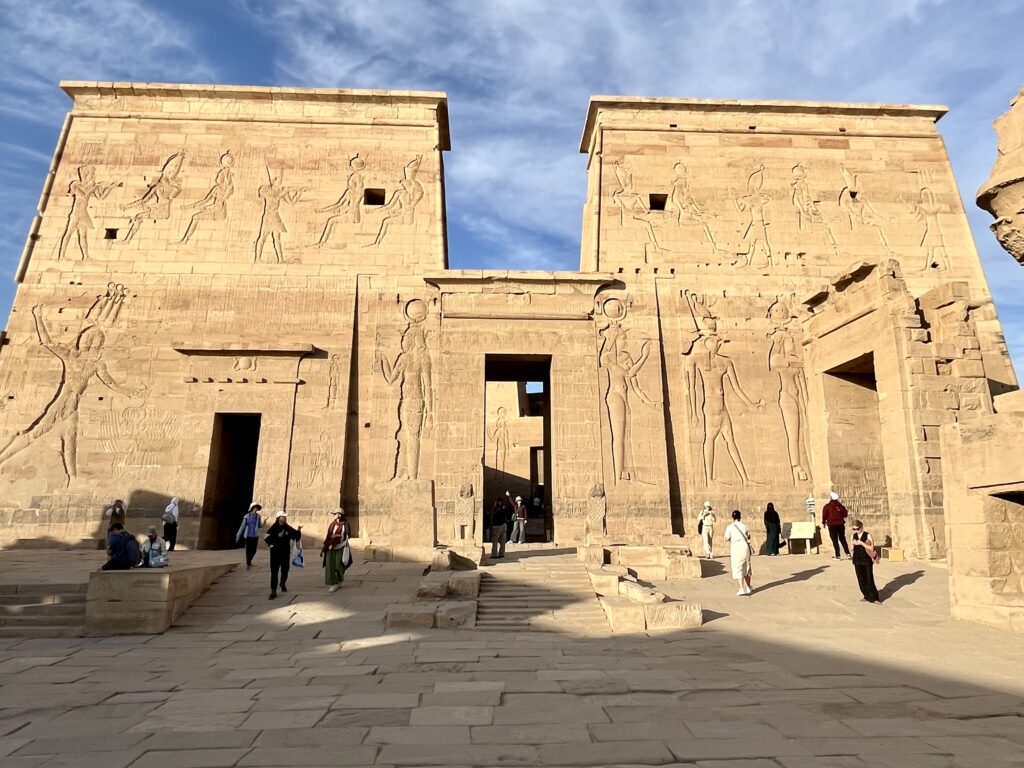
The First Pylon: The Greek King’s “Egyptian Audition”
Carved during the Ptolemaic Period (around 50 BCE), this massive gateway was the ultimate PR move. The person you see swinging a club at his enemies is Ptolemy XII—the father of the famous Cleopatra. Even though he was technically Greek, he wanted everyone to know he was a “real” Egyptian Pharaoh. This “smiting” scene is a 3,000-year-old Egyptian art trope that says: “I’m in charge, and the gods are on my side.”
👁 Who are on the Left Tower (the West Pylon)
The Bottom Row (The “Heavy Hitters”) – The Pharaoh (Ptolemy XII), the giant wearing the Atef crown (the tall one with feathers on the sides) and swinging the mace. Then The Goddess Isis, with the cow horns and solar disc on her head. She is holding a scepter and an ankh (the key of life), essentially “signing off” on the King’s victory.
The Top Row:First Triad – The Pharaoh (Ptolemy XII) offering a jar of wine, Horus, the falcon-headed god who is the first one to receive a gift because he is the prince of the island, and Hathor, usually shown behind Horus here to represent joy and motherhood.
The Top Row:Second Triad – The Pharaoh (Ptolemy XII) performing a second ritual, Isis seated with her husband Osiris, and human-headed Osiris, the father of Horus and husband of Isis, wearing the Atef Crown.
👁 Who are on the Right Tower (the East Pylon)
While the left tower was about “don’t mess with me,” the Right Tower (East Pylon) is a much softer, family-focused scene. Here, the King isn’t swinging a mace; he’s bringing gifts to the gods of the house.
The Bottom Row (The “Triple Threat”) – The Queen (Cleopatra VII’s Ancestor) depicted performing the rituals herself. Then the “Bird Man” (Horus), standing behind his mother, Isis, wearing the Double Crown. The giant figure to the right is Isis, the “boss” of the island, receiving the offering from the Queen.
The Top Row:First Triad – Isis, the “hostess” of the temple, sitting on her throne, followed by Hathor, here to represent joy and motherhood, and the Pharaoh (Ptolemy XII), approaching the two seated goddesses to bring them a gift.
The Top Row:Second Triad – Isis again (it’s her temple anyway), supporting her husband Osiris, followed by human-headed Osiris, the father of Horus and husband of Isis, wearing the Atef Crown. Finally the Pharaoh (Ptolemy XII), performing a second ritual.
🎯 Trivia Worth Knowing: The Flagpole Slots
Do you see those long, vertical “hollows” cut into the face of the towers? Those aren’t for drainage! In ancient times, they held massive wooden flagpoles—likely tipped with gold or electrum. Imagine giant, colorful banners fluttering 60 feet in the air above the crowd. It would have looked more like a grand palace entrance than a quiet temple.
🎯 Why is the Goddess in the middle?
This is a “Power Flip.” In most Egyptian temples, the male god (like Amun or Ra) sits on the throne and the goddess stands behind him. But because Philae is Isis’s Island, she takes the seat of honor in the middle, and her son Horus stands behind her to protect her. To the Greeks and Romans, Isis wasn’t just a local Egyptian goddess; she was the “Queen of all Elements” and the “Lady of the Stars.” They saw her as a version of their own goddesses (like Demeter or Aphrodite) but much more powerful.
The Greek queens of Egypt (all named Cleopatra, Berenice, or Arsinoe) were often seen as the living “Image of Isis” on earth.
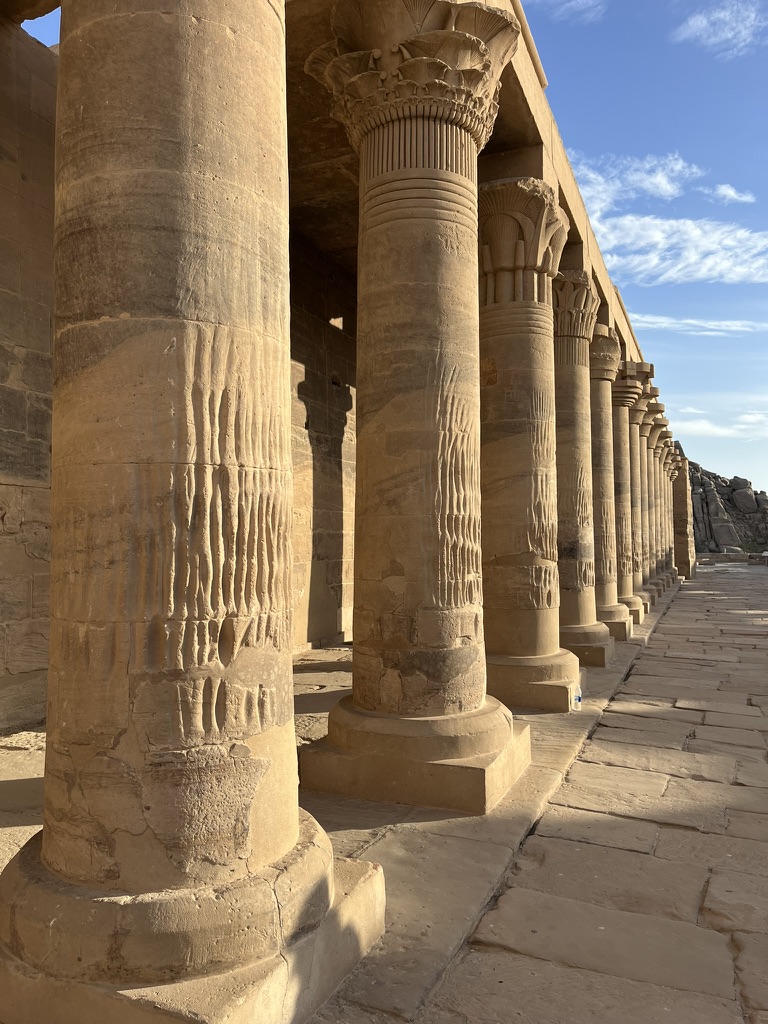
The West Colonnade: A “Floral” Walkway to the Divine
This stunning row of columns is the West Colonnade, and it’s one of the most photographed spots on Philae. It creates a grand, shaded path that leads travelers straight toward the First Pylon (which you can see standing tall in the background of the first photo).
What makes these columns special isn’t just their size—it’s the fact that they were designed to look like a stone garden.
👁 The “Bouquet” Capitals
Look at the very top of each column (the capitals). Notice how each one is slightly different?
The Meaning: Walking through this colonnade was meant to feel like walking through a primordial marsh. In Egyptian mythology, the world began as a swamp of creation. By walking past these “stone plants,” you were symbolically leaving the chaotic world and entering the sacred space where life began.
The Inspiration: During the Greco-Roman period, architects moved away from simple designs and started carving elaborate “composite” capitals. They represent different water plants found along the Nile, like papyrus, lotus, and palm fronds.
👁 The “Open Papyrus”
If you look closely at the shafts of the columns in the foreground, you’ll see vertical, wavy ridges. Because the Roman Empire eventually converted to Christianity and shut down the pagan temples, the workers literally dropped their tools. You are looking at a “Work in Progress” that has been paused for nearly 2,000 years. Many of these columns are actually unfinished. The stone was brought to the island and “rough-cut,” with the plan to carve detailed hieroglyphs and smooth reliefs later.
Look at the column individually. The column right in front of you features a Papyrus capital in full bloom. This represents the papyrus plant when its head is fully open. In Egyptian art, the papyrus was a symbol of Lower Egypt and the concept of “flourishing.” Notice that it flares out wide, like a bell or an umbrella.
Move your eyes to the next pillar. This one is noticeably different—it looks sharper and more “feathery.” It mimics the spreading branches of a Date Palm, a symbol of longevity and the sun. While papyrus represents the marsh, the palm represents the fertile banks that provided food and shade.
The third one is the most complex. It’s a “mix-and-match” design that the Greeks and Romans loved. Note that it combines lotus buds at the base with papyrus flowers peeking out from behind. By mixing the plants together, the architects were making a grand statement that all of nature was bowing down to the goddess Isis.
🤔 Does Philae Have The Most Columns
While Philae is famous for its long, elegant walkways, it doesn’t actually hold the record for the most columns in Egypt. That title belongs to the Great Hypostyle Hall at Karnak, which boasts a staggering 134 massive pillars.
Philae is essentially a collection of several small temples and structures, so the columns are spread out. The West Colonnade has 31 columns still standing. The East Colonnade has 17. If you count every standing pillar across the island, you’re looking at roughly 80 to 90 columns.
🌊 The “Drowning” Temple
When the first Aswan Low Dam was built in 1902, the water levels rose and partially flooded the island. For decades, tourists would take rowboats between the columns of the West Colonnade. While it looked romantic, the Nile was slowly eating the stone away.
When the High Dam was built in the 1960s, the situation became critical: the temple was going to be completely and permanently submerged. To save it, UNESCO and the Egyptian government performed a massive “Lego” operation – they used explosives and heavy machinery to reshape Agilkia Island (the new island) to look exactly like the original Philae Island, so the temple would sit in its correct orientation.
They built a giant wall (a cofferdam) around the island and pumped the water out so the temple could dry for the first time in years. Every single stone—roughly 40,000 blocks—was cleaned, numbered, and sliced into manageable pieces. Some of these blocks weighed up to 25 tons!
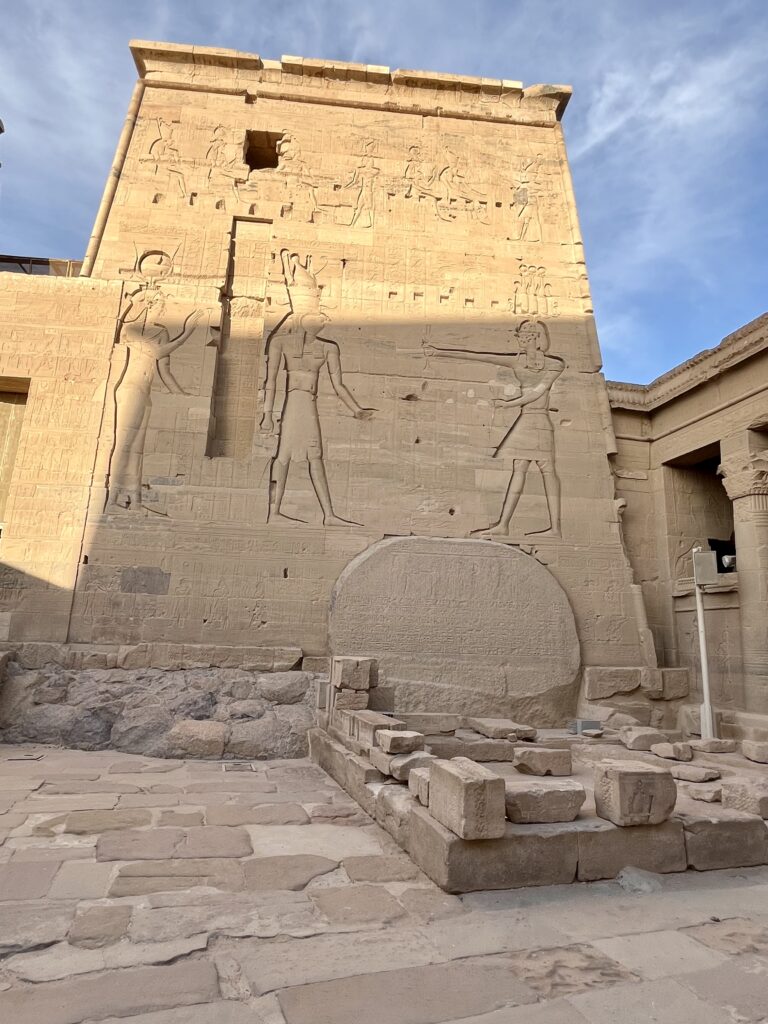
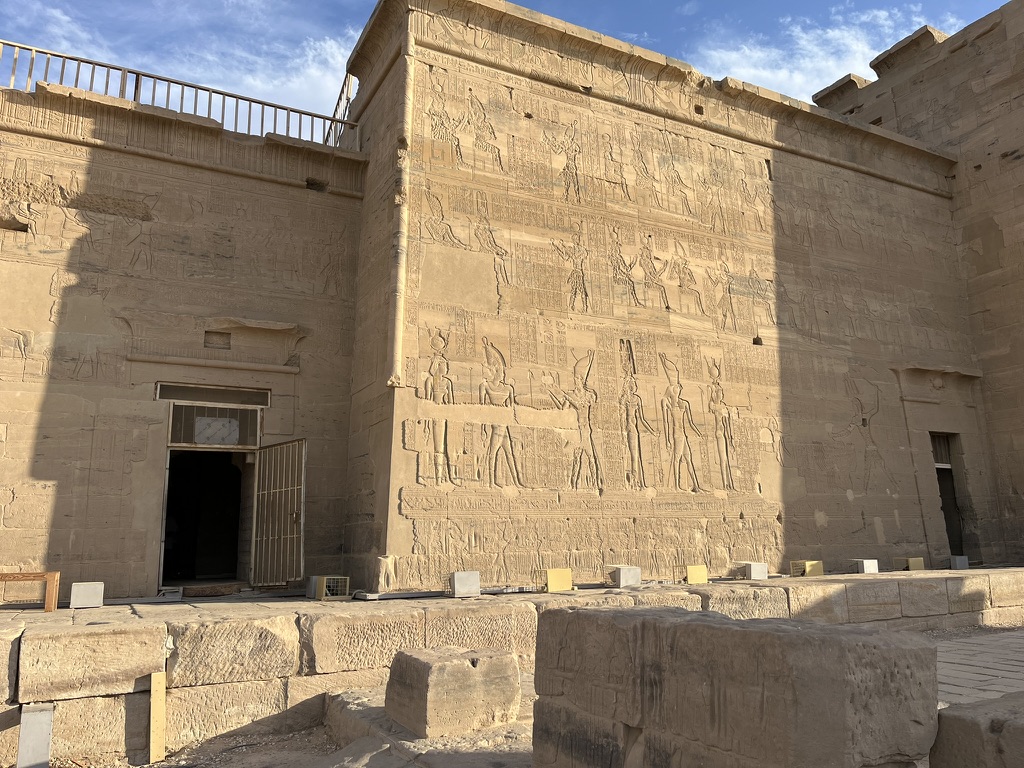
The “Power Trio” on the Second Pylon
In this photo of the Second Pylon, you have a much clearer view of that “Triple Threat” we were talking about earlier! Since the light is hitting it differently, the figures stand out much better than in the wide shot.
From right to left (following the direction they are facing), you can see the royal and divine family in action:
The Pharaoh (Standing Right): This is the clearest figure. He is facing left, holding his arm out in an offering gesture. You can see his royal kilt perfectly here. He is wearing the Pschent (the Double Crown), which looks like a tall white mitre with a red “curly” piece at the front.
The “Bird Man” Horus (Center): Standing directly in front of the King. This is a great view of him! He has the distinct falcon head and is also wearing a tall, complex crown. He is the protector and son of the house.
The Goddess Isis (Left): She is the figure on the far left of this group, facing the King and Horus. She is wearing her signature cow horns and solar disc. In this scene, she is the one welcoming the King into the inner parts of the temple.
🧐 The “Mystery Slab” at the Bottom
The most interesting thing in this photo is that giant, rounded stone sitting at the base of the wall. That is a Stela (an ancient stone billboard). These were used to record important decrees or historical events. Because this one is rounded at the top, it’s often called a “lunette stela.” It’s covered in hundreds of tiny lines of hieroglyphs that would have acted like the “official press release” for the temple’s construction or a royal donation.
It’s famous because it contains a decree written in two languages. It helped archaeologists confirm some of the translations they found on the actual Rosetta Stone!
🎯 The Square HoleandThe Shadow Line
Look at the very top left of the pylon tower. There is a square window/hole. That wasn’t just for ventilation. It leads to a narrow, internal staircase that goes all the way to the roof of the pylon. High-ranking priests would climb up there to perform astronomical observations or to watch the sunrise over the Nile.
Also, notice the diagonal shadow cutting across the wall?
Ancient Egyptian architects were masters of light. They often designed these pylons so that at certain times of the day (like the summer solstice), the shadows would align perfectly with the carved figures, making them “pop” out or disappear in a dramatic way.
🕵️♂️ Why There Is A First and A Second Pylon
In Egyptian temple architecture, the use of multiple pylons (ceremonial gateways) like those at Philae serves both a practical and a deeply spiritual purpose. Think of them as the “chapters” of a book; as you pass through each one, the story changes and the world of the “outside” fades away.
Ancient Egyptian temples were designed based on the concept of the “Onion” Effect, “Creating Gradual Sacredness.”The First Pylon is the boundary between the common world and the temple. It’s large and aggressive (like the “Smiting Scene” you saw) to keep out chaos and “purify” anyone entering. The Second Pylon acts as a second filter. Once you pass through the First Pylon, you are in the Forecourt. Passing through the Second Pylon brings you into the Hypostyle Hall and eventually the Sanctuary.
The further you go, the darker, quieter, and more exclusive the temple becomes. By the time you reach the area behind the Second Pylon, only the highest priests and the King were traditionally allowed to enter.
✍️ Second Pylon Before the First Pylon Was Finished
In Philae, the Second Pylon was actually started before the First Pylon was finished in its current form. Ptolemy VI began the Second Pylon, but as the temple grew in fame and wealth, later rulers (Ptolemy XII) decided the temple needed a even grander “front door,” so they built the First Pylon further out. The two pylons as a “Physical Volume Knob.” The First Pylon turns down the noise of the Nile and the markets. The Second Pylon turns down the light. By the time you pass the second gate, you aren’t just in a building anymore—you’re in the ‘House of the Goddess’ where the outside world no longer exists.
The Birth House (Mammisi) at Philae Temple
A view of the exterior reliefs on the Mammisi, where the walls tell the story of the divine birth of Horus. Located in the forecourt between the two massive pylons, this structure was essential for legitimizing the Pharaoh’s power by linking his lineage directly to the gods Isis and Osiris.
🏛️ The “Divine” Birth
The word Mammisi is Coptic for “Birth House.” These were built to celebrate the birth of the god Horus. By building these, the Ptolemaic kings (who were actually Greek) were essentially telling the Egyptian people, “The gods birthed me, too,” to prove they were the rightful rulers.
🕵️♂️ The Original “Hidden Camera”
In some Mammisis, there are small secret chambers or “crypts” built into the thick walls. These were used to store precious temple treasures or cult statues away from public view.
🎶 A Multi-Tasking Temple
While dedicated to Isis, the Birth House at Philae also heavily features Hathor, the goddess of music, love, and joy. You can often find her face on the tops of the columns (capitals) inside, identifiable by her distinctive cow ears.
✍️ The Roman Touch
Even though the temple is ancient Egyptian in style, Roman Emperors like Augustus and Tiberius added their own carvings here to keep the tradition going and stay on the good side of the local priesthood.
Bringing the Gifts: The Hapi Figures
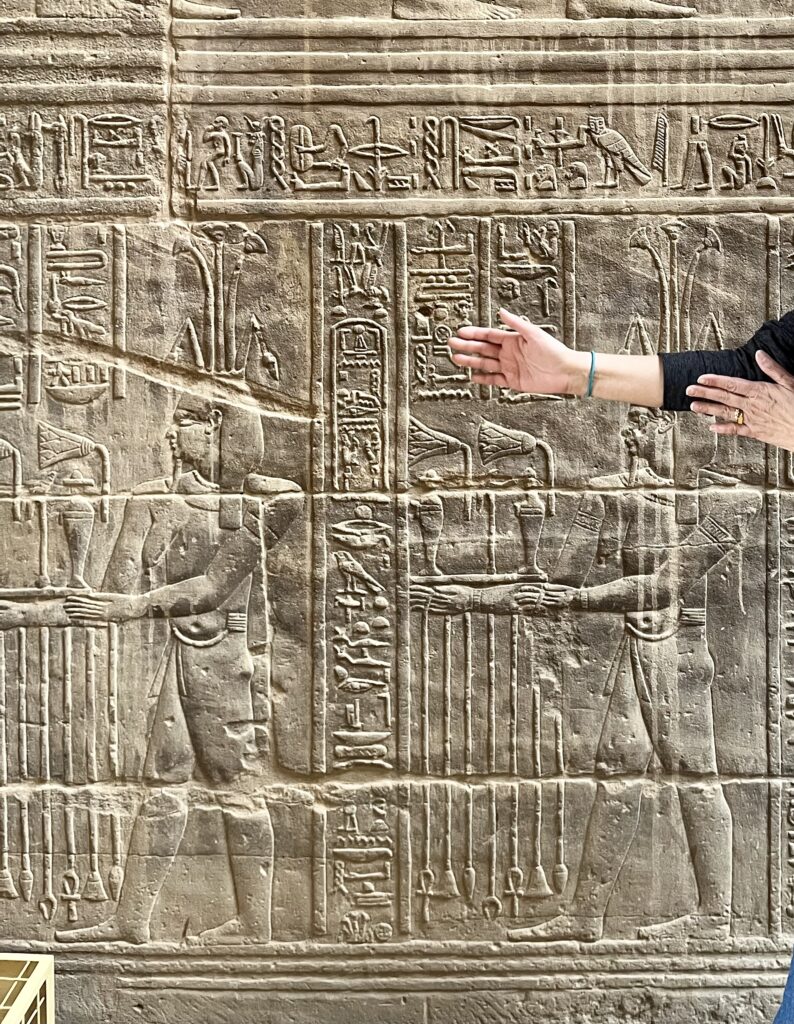
In this relief, the Nile god Hapi appears twice—once for the North and once for the South. Instead of a sword or a shield, he carries a tray of flowers and jars of sacred water. This is not the Pharaoh; it is Hapi, the god of the Nile flood. Each Hapi is holding a libation vase (a tall, thin jar) and a tray of offerings.
Notice their identical “prosperous” bellies and “pendulous” breasts. This wasn’t an insult; it was a symbol of abundance and fertility. He is well-fed because the river is providing.
They are walking toward the inner temple to bring the water and plants of the Nile to the goddess Isis. Look at the very bottom of the relief—those hanging symbols (the circles with crosses) are Ankhs. It’s the artist’s way of saying that the Nile doesn’t just bring water; it brings the very essence of Life.
🧐 The “Royal Review”
The row of smaller carvings at the very top (above the horizontal band) acts like a “Heavenly Header” for the scene below. These aren’t just decorative borders; they represent the gods who are witnessing and blessing the offerings.
The Seated Gods: You can see several figures sitting on small, square thrones. These are various local deities of the First Cataract. They are facing toward the center, essentially “accepting” the delivery of Nile water and plants that the Hapi figures are bringing in the main scene.
The Standing Pharaoh: Look for the smaller figure standing in front of the seated gods. He is usually depicted with one hand raised in a salute. This is the King acting as the middleman between the Nile (Hapi) and the Gods.
The Bird (The Horus/Ra Symbol): Toward the right of that top strip, you’ll see a hawk or falcon. That is Horus of Edfu (the Behdety), appearing as a protective symbol to ensure the ritual is done correctly.
🧩 The Divine “Cartouche”
Look closely at the vertical rectangular boxes between the seated figures. Those are the names of the gods. In the Roman era (when this part of Philae was finished), they used very complex, “cryptic” hieroglyphs that only the highest priests could read.
🧐 Why Are There Seven Lines?
Don’t just look at the gods; look at what’s falling from their fingers. Look at the seven tall, vertical stems they are holding. Those are stylized lotus and papyrus stalks. Notice how the plants “flop” over at the top. This represents the weight of the blossoms and the richness of the Nile.
The number seven was highly significant in Egyptian magic. It represented completeness (like the 7 stars of the Big Dipper or the 7 Hathors who predicted a child’s fate). By having seven lines of symbols dripping from their hands, the artist is saying that the Nile provides total and complete prosperity.
✍️ The Four Sacred Barcode
The seven lines of symbols has four distinct shapes —Life (Ankh), Power (Was), Eternity (Shen), and Peace (Hotep)—act like a divine barcode. It’s the ancient way of showing that the Nile doesn’t just bring water; it brings a complete ‘starter pack’ for a successful civilization.
1. The Ankh (The Loop) — 𓋹, a cross with a rounded loop at the top. This is the “big one.” It signifies that the water being brought by Hapi isn’t just liquid—it is the biological spark that keeps Egypt alive.
2. The “Hept” / Offering Loaf (The Semi-Circle) — 𓊵, a small dome shaped semi-circle sitting on a mat. This is the root of the word Hotep (as in Imhotep). It signifies that the offerings are “sufficient” and that the gods are happy.
3. The Shen Ring (The Circle) — 𓍹, a simple elongated heart shaped circle resting on a flat horizontal line. The word Shen comes from the root meaning “to encircle.” It represents the sun’s path and the idea that the Nile’s cycle will continue forever.
4. The Was-Scepter (The Staff) — 𓌂, a long, straight line with a small “animal head” at the top and a forked “U” tilted “hook” at the bottom. This tells the reader that the Nile flood is what gives the King the power to rule. Without food from the river, there is no kingdom.
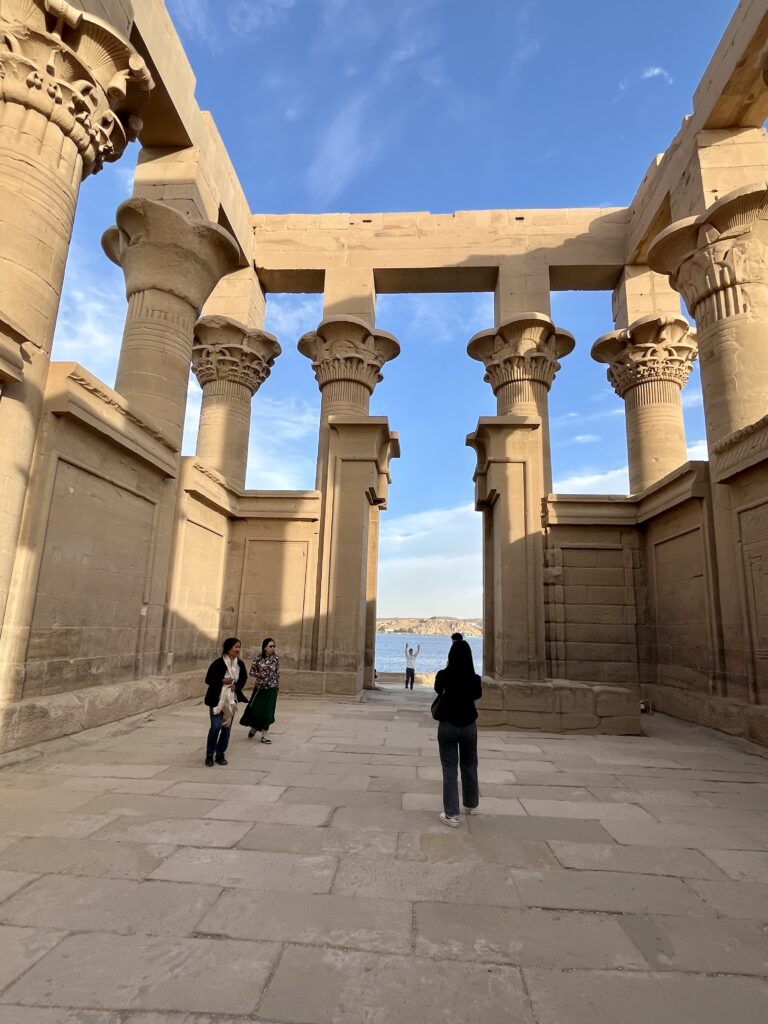
Trajan’s Kiosk: The “Pharaoh’s Bed”
This is one of the most iconic structures at Philae, often called Trajan’s Kiosk (or more affectionately by locals, “The Pharaoh’s Bed”). While it looks like a small temple, it actually served a very specific purpose for the religious festivals on the island.
Think of this as a “Divine Waiting Room.” During the Great Festival of Isis, the statue of the goddess would be carried in a sacred boat (barque) from the main temple. This kiosk was built right at the water’s edge to serve as a covered shelter where the barque could be set down so the priests could rest or perform rituals before moving the goddess across the water to the neighboring island of Bigeh (where Osiris was said to be buried).
🧩 The Roman Connection
Even though it looks 100% Egyptian, this was actually built by the Roman Emperor Trajan (around 100 AD). If you look at the low walls between the columns (the “screen walls”), you’ll notice they are mostly blank. Only two of them were ever carved with scenes of Trajan offering gifts to Isis and Horus. The rest are smooth stone, waiting for a carver who never arrived.
The Style: You can see the Roman influence in how “open” it is. Traditional Egyptian temples are dark and enclosed, but the Romans loved air, light, and symmetry.
🎯 The “Missing” Roof
Look up at the top of the columns. You can see the massive stone cross-beams that still span the distance between the pillars.
The Mystery: It’s debated whether the kiosk ever had a solid stone roof. Most archaeologists believe it was originally covered with wooden beams and colorful fabric awnings to keep the sun off the sacred barque while still letting the Nile breeze flow through.
✍️ The “Nile View”
This is the best spot on the island for a photo because it perfectly frames the blue water of the Nile between the ancient stone.
Trajan’s Kiosk is the ultimate ancient ‘gazebos.’ Built by a Roman Emperor who never actually visited Philae, it stands as a beautiful half-finished bridge between Roman ambition and Egyptian faith.
🧩 The High-Water Mark
When the first Aswan Low Dam was built in 1902, the water levels rose and partially flooded the Philae island. The Philae temple one sees now is moved piece by from Philae island to the new home, the Agilkia Island.
Look closely at the bottom third of the wall, do you see how the stone is a slightly different color or looks more “pitted”?
That is the original water line.
Even though the temple was cleaned and moved, the decades it spent underwater left a permanent “bathtub ring” on the stone. It’s a literal scar from its time beneath the Nile.
The Legend of the 14 Pieces
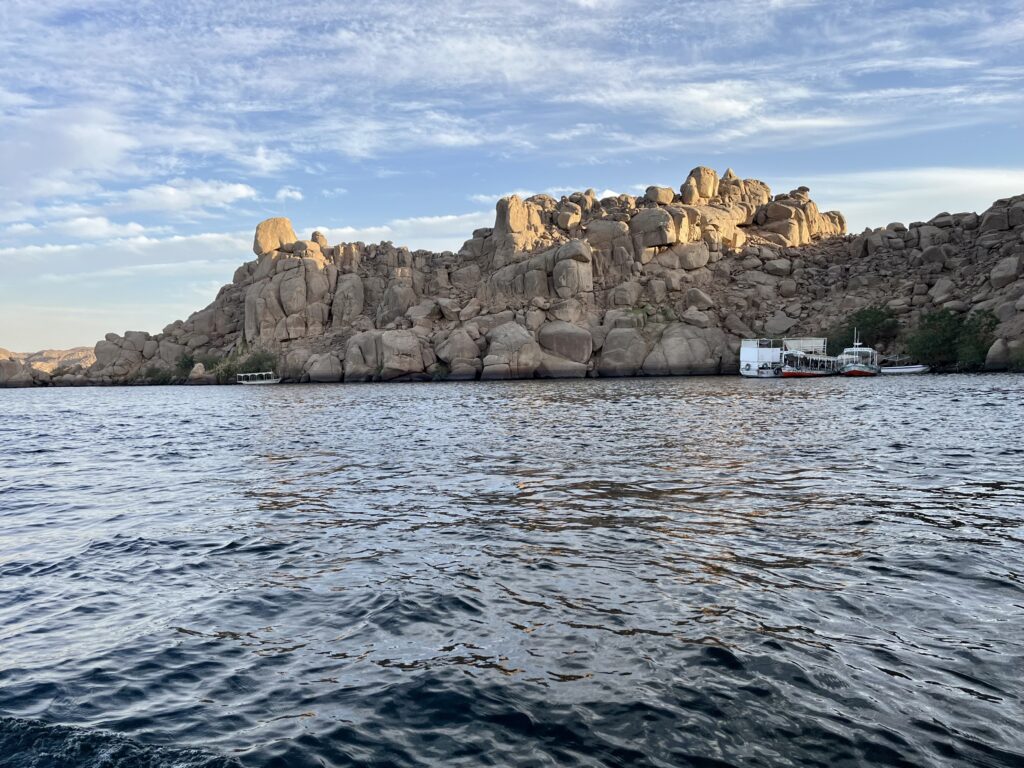
If you look across the water from the temple, you’ll see a wall of jagged granite. That is Bigeh Island—the forbidden neighbor. While we can walk freely through Philae today, for thousands of years, Bigeh was so sacred that even the Pharaoh might have been denied entry. It was the silent, stone heart of the Osiris legend.
The story goes that Seth (the god of chaos) was jealous of his brother Osiris (the king of Egypt). Seth tricked Osiris into a chest, sealed it, and eventually cut his body into 14 pieces, scattering them across the Nile Valley.
Isis, the devoted wife who is celebrated at Philae, traveled the length of Egypt to find every piece. She found 13 of them, but the 14th piece (his phallus) had been eaten by a fish in the Nile. Using her magic, she fashioned a replacement, brought Osiris back to life just long enough to conceive a son—Horus.
Standing on the boat back from the Philae Temple, looking at these silent granite sentinels, you realize why the ancients chose this spot for their most sacred temple. It feels like the world is still holding its breath, waiting for Isis to find that last hidden piece.
🧐 Did it happen at Philae?
Technically, the “finding” happened all over Egypt, but Philae is the grand finale of the story.
The Mourning Place: Philae was built as the place where Isis could stay and perform rituals to look after her husband’s tomb on Bigeh. Every ten days, the statue of Isis was carried from the temple you visited over to Bigeh to “visit” him.
The Burial Ground: The island in the picture that you can see from Trajan’s Kiosk is called Bigeh Island. According to local legend, that is where the left leg of Osiris was found and buried. Because a piece of him was there, the island was considered so holy that no human (except high priests) was allowed to step foot on it.
✍️ The 14th Piece Mystery
Why did the story end with a missing piece? Because a Lepidotus fish (a type of Nile carp) supposedly ate it. To this day, the area is famous for its Nile Perch, but for 3,000 years, the priests at Philae refused to touch them out of respect for Osiris.
𖤍 The Bird’s Eye View
Ancient artists often drew Isis with wings attached to her arms. They believed she chose a Kestrel (a small falcon) as her shape because of its ability to “hover” in the wind—allowing her to stay perfectly still over a rocky island while searching for her husband’s remains.
🧩 The Mummy and The Falcon
In Egyptian reliefs, Osiris is one of the easiest gods to identify because he breaks the “standard” rules of how figures are drawn. While other gods look like they are ready for action, Osiris is always depicted in a state of frozen, eternal peace, the Mummy.
When Isis was trying to bring Osiris back to life, she took the form of a bird (a kite or kestrel) to flap her wings over him and “breathe” life back into him. However, Osiris actually chose to stay as the Lord of the Dead. He stayed as the first “mummy,” ruling the underworld while his son Horus ruled the earth.
Horus is the “Bird Man” you saw all over the walls. He was born to avenge his father. He chose the form of the falcon because it is the supreme predator of the sky—the perfect symbol for a king who was going to hunt down his uncle Seth.
📍 Related Dairies and Guides
[My 12-Day Egypt Diary (Part 2)]: Aswan, Abu Simbel, and Sailing the Nile — the cruise decision, Nubian village, Philae, Abu Simbel at dawn, Kom Ombo, Edfu, the Esna Lock, and arriving Luxor by river.
[Egypt Cultural Guide] — hospitality, food, hidden gems, and what Egypt gives you beyond the monuments.
[My 12-Day Egypt Diary (Part 1)]: Pyramids, Planning, and the Chaos of Cairo — arrival, the Citadel, Coptic Cairo, Giza, the GEM, and getting wonderfully lost in Islamic Cairo.
[My 12-Day Egypt Diary (Part 3)]: Luxor’s Tombs and the Journey Home — Karnak, Luxor Temple, the Valley of the Kings, Hatshepsut, Deir el-Medina, Medinet Habu, feluccas at sunset, and a 3 a.m. farewell to Cairo.
Next in the series: Decipher Egyptian Gods Through Pictures (Part 3): Karnak – Coming Soon
Hi, I’m Frank J – Egypt Self-Guided Travel. I explore Egypt solo and share tips, stories, and practical advice to help you plan your own adventures safely and enjoyably.