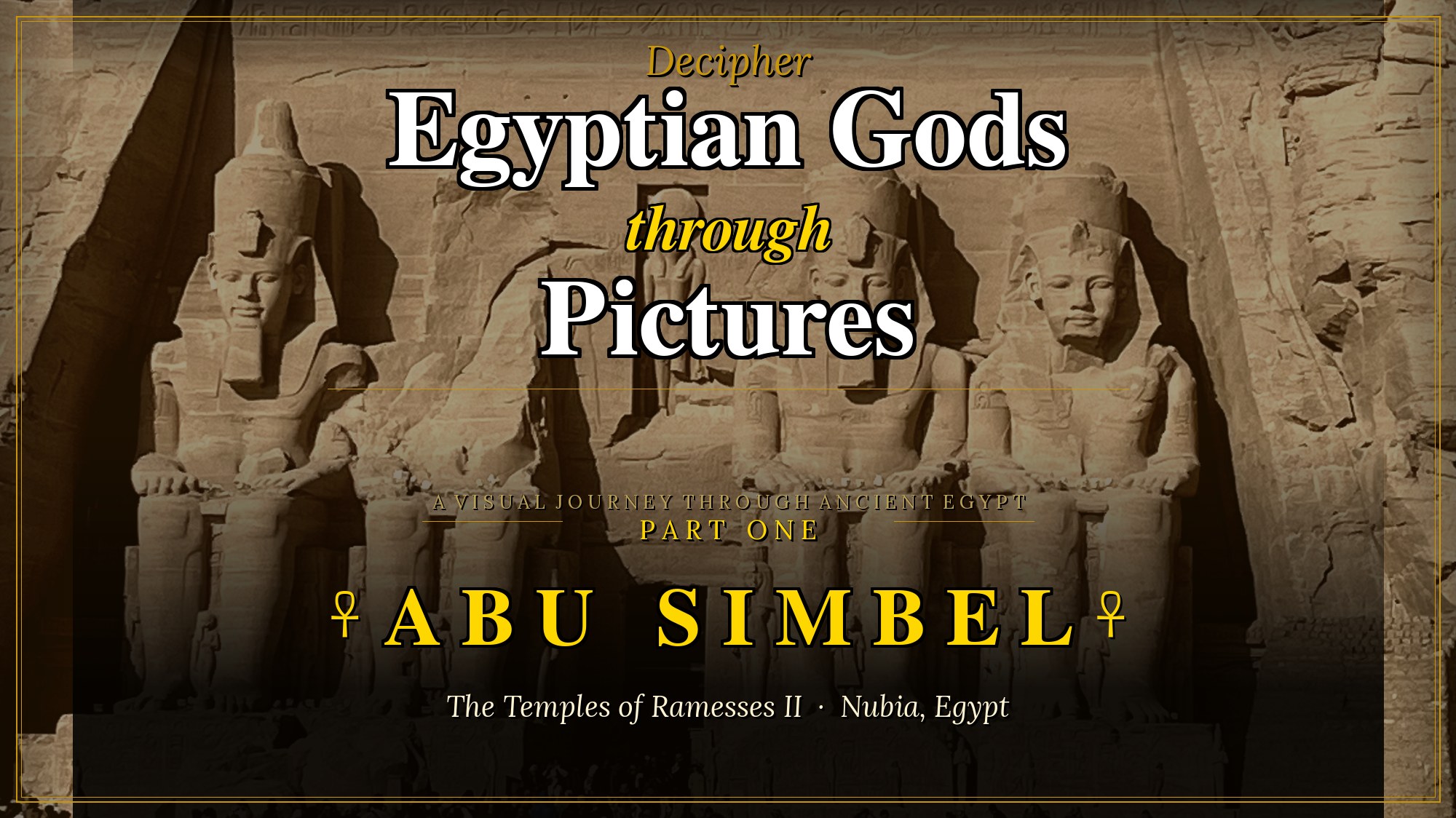
Let’s get something straight right away: Abu Simbel should not exist. Not way out here in the middle of nowhere. Not at this absurd scale. Not in this condition after 3,200 years. The fact that you can stand in front of it today is the result of two separate acts of jaw-dropping audacity — one from an ancient pharaoh who thought he was basically a god, and one from the 20th century that proves we’ve always been a little unhinged when we put our minds to it.
🔍 Decipher Egyptian Gods Through Pictures — Full Series
This is Part 1 of a new series: DecipherEgyptian Gods Through Pictures. We’re breaking down the history of these sites through my own photography. Whether you’re a trivia buff prepping for Jeopardy or a parent trying to keep a 7-year-old engaged, these “Tini-Tiny Details” will help you “read” the walls like an expert.
In This Guide
Egyptian Gods Abu Simbel – Fast Facts Before You Look at the Pictures
Around 1264 BCE, Pharaoh Ramesses II decided he needed two temples carved directly into a sandstone cliff in Nubia — the southern frontier of his empire, deep in what is today southern Egypt near the Sudan border. Not in Luxor, the religious capital. Not in Memphis, the political one. Out here. On the edge of the known world. Why? Because Nubia was borderlands territory, and Ramesses wanted every trader, traveller, and potential invader passing through to look up and think: oh. Oh no. We are not doing this. It worked.
In the 1960s, Egypt built the Aswan High Dam. Great for electricity. Catastrophic for anything sitting near the Nile south of Aswan — including Abu Simbel, which was about to spend eternity at the bottom of a lake. So UNESCO called in 50 countries, raised what would be about $700 million in today’s money, and spent four years physically cutting both temples into 807 numbered blocks, hoisting them 65 metres up the cliff, and reassembling them piece by piece. The temples were saved.
The Basics
Detail
Built by
Ramesses II (also known as Ramesses the Great), Pharaoh of the 19th Dynasty.
Date built
Approximately 1264–1244 BCE, 19th Dynasty — during the New Kingdom period of ancient Egypt, the height of Egyptian imperial power Moved in 1964–1968, by UNESCO, to save it from the rising waters of the Aswan High Dam
Location
Southern Egypt (ancient Nubia), on the west bank of the Nile; today on the shore of Lake Nasser
What it is
Two temples: the Great Temple (dedicated to Ramesses II and three gods) and the Small Temple (dedicated to his chief wife, Nefertari, and goddess Hathor)
The Facade: The King’s Giant “Selfies”
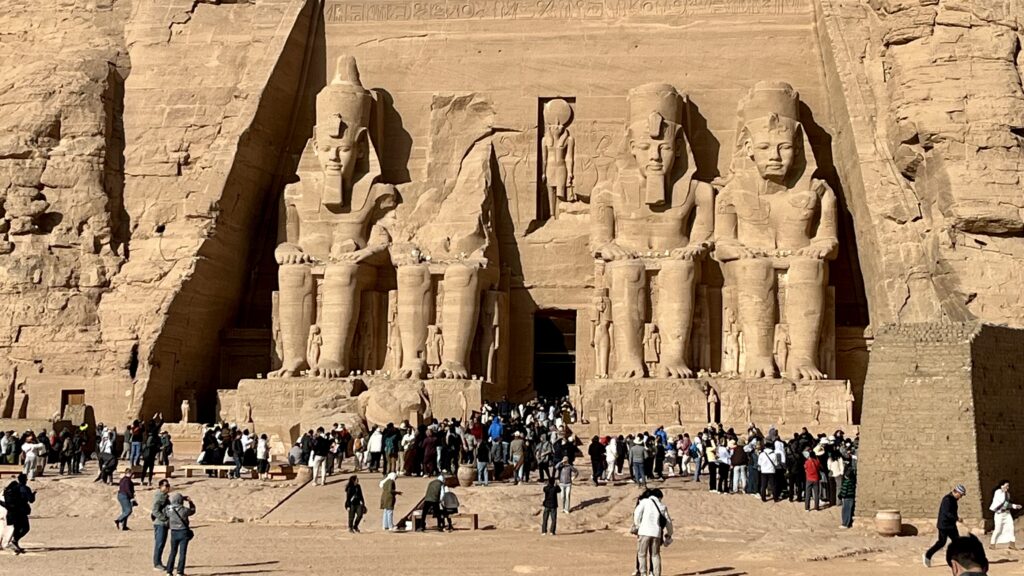
Carved around 1264 BCE, these 65-foot statues of Ramesses II are the ultimate power move. Each one is twenty meters tall — roughly the height of a six-story building. He didn’t just build a temple; he carved his own face four times into a mountain to guard the southern border.
👁 Wait, Who Are the Tiny People by the Legs?
On the left of the first colossus you’ll find Nefertari (his favourite wife) and Mut-Tuy (his mom). Beside the second colossus, some of his sons. They look small not because Ramesses was being rude, but because this is just how Egyptian art works — you scaled figures by importance.
🎯 Trivia Worth Knowing
See the second colossus from the left? The top half — torso and head — is missing. It fell during an earthquake, probably around 27 BCE. When engineers moved the temples in the 1960s, they made a conscious decision NOT to put it back together. The pieces still sit right where they landed, at the statue’s feet, exactly where they’ve been for over 2,000 years.
👁 The “Real” Boss
Above the central doorway, tucked into a niche between the second and third colossi, sits a god wearing a solar disc crown. That’s Ra-Horakhty — the falcon-headed sun god. Ramesses made himself four times bigger than the sun god, which tells you a lot about his ego!
✍️ The “Age” Progression
If you look closely at the faces from left to right, you can see Ramesses “age.”, or can you? Academics say that all four were commissioned as a set to celebrate his 30-year jubilee, when he was 45 years old. Legend says that he went from a young man in his20s all the way to his 70s. Who do you believe?
The Great Hypostyle Hall: Standing Among Giants
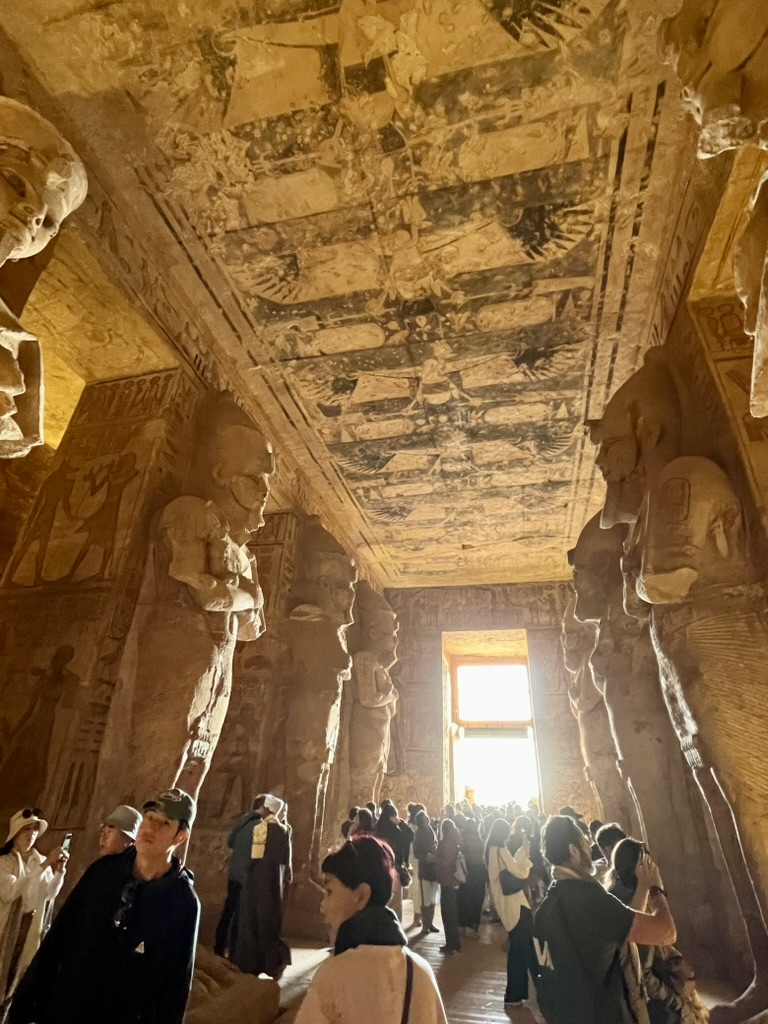
Once you pass the giant statues outside, you enter the Great Hypostyle Hall. This massive room is held up by eight enormous pillars, each carved into the shape of Ramesses II as the god Osiris. By showing himself as Osiris, the god of the afterlife, the King was telling everyone that his power didn’t just end on earth—it lasted forever. Standing here feels like the underground experience found in the West Bank tombs, but on a much grander, imperial scale.
🎯 Vultures in the Sky
Look up at the ceiling! You can see beautiful paintings of Nekhbet, the vulture goddess, with her wings spread wide across the entire length of the hall. She is holding symbols of protection to keep the temple safe.
🎯 Double Crown vs White Crown
The four statues on the left wear the Double Crown of Upper and Lower Egypt, while the four on the right wear the White Crown of Upper Egypt. This was a visual way to show the King ruled every single inch of the Nile.
✍️ The Light Show
Notice how the sun streams through the entrance. During the twice-yearly Solar Alignment, this light shoots perfectly down the center of this hall to reach the secret sanctuary 200 feet in the back.
✍️ What does “Hypostyle” actually mean?
The word comes from the Ancient Greek hypóstylos, which literally means “under columns” (hypo = under; stylos = column). In architecture, it refers to a large hall where the roof is supported by rows of columns.
The Inner Sanctuary – The Solar Alignment
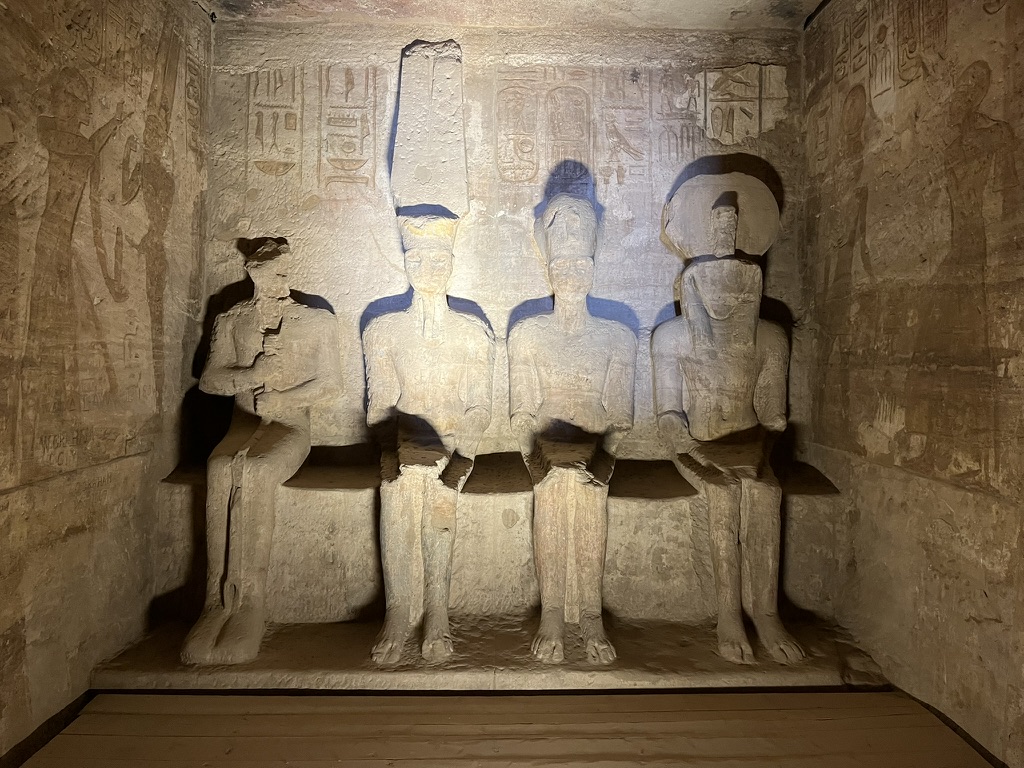
If you walk 200 feet deep into the temple, you find a tiny, dark room. This is the Sanctuary, where the most important “bosses” of Egypt sit together.
The Four Friends sitting on the bench from left to right are
Ptah: The creator god of Memphis, often shown mammiform with a close-fitting cap. Associated with darkness and the underworld.
Amun-Ra: The king of the gods from Thebes, recognizable by his tall, two-feathered crown.
Ramesses II: The King himself acting like a god, seated as an equal among the gods.
Ra-Horakhty: The falcon-headed sun god.
🎯 The Sun Laser
Notice Amun-Ra and Ra-Horakhty. They are both forms of the supreme sun god. This temple is specifically aligned so that on two days a year (historically, the king’s birthday and coronation), the sun’s rays shine directly into this back room, illuminating the two sun gods and the King Ramesses II, the deified king.
🎯 Trivia Worth Knowing
When the temples were reassembled in 1968, engineers tried to recreate the solar alignment exactly. They almost got it right. The alignment now happens one day later than originally intended — October 23 and February 23 instead of October 22 and February 22. Whether this was an unavoidable consequence of the relocation or a minor positioning error is still occasionally debated among archaeologists and engineers.
✍️ The God of Shadows
During the “Sun Laser” show, the light hits three of the statues but leaves Ptah (the guy on the far left) in the dark. That’s because he’s the God of the Underworld—he likes the dark!
👁 The King Who Unites the Gods
This grouping is a masterstroke of religious politics. It unites the chief deities of Egypt’s major religious centers (Memphis and Thebes) and places Ramesses right between them.
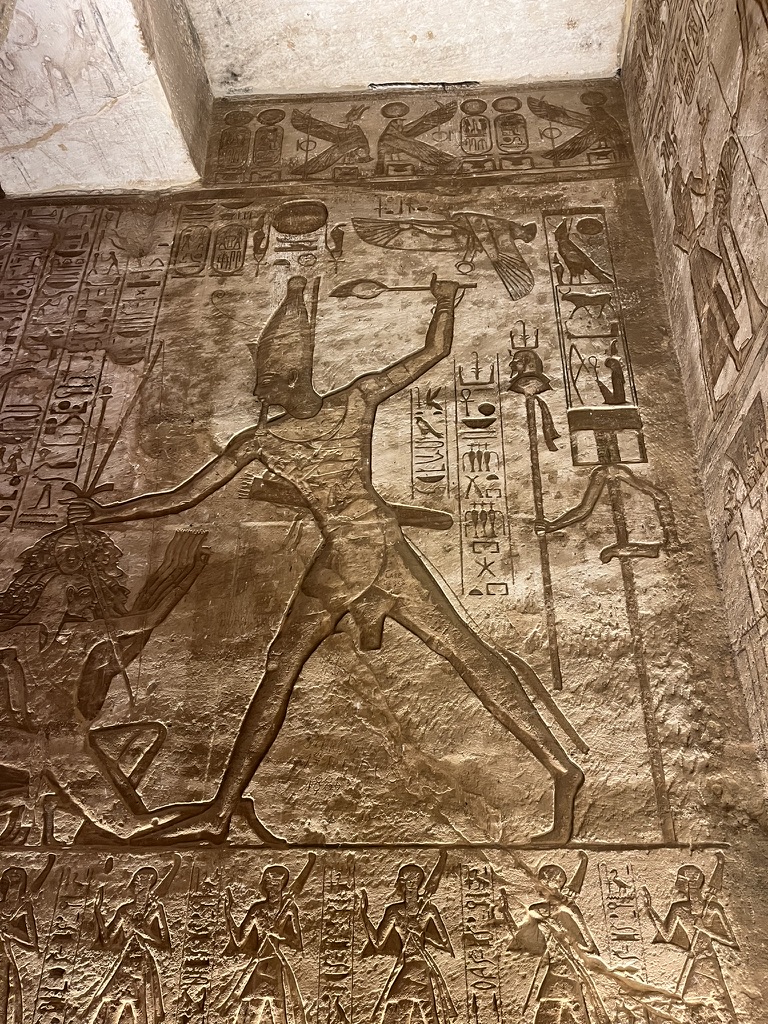
The Pharaoh’s Might: Victory in Stone
This classic “Smiting” scene is located inside the Great Temple. It is one of the most famous pieces of royal propaganda in history, showing the Pharaoh destroying the “enemies of Egypt” to protect his people. Look at the group of people the King is holding by the hair. Their faces represent different cultures—Libyans, Syrians, and Nubians. It’s a way of saying he has conquered the entire world.
👁 The Bull’s Tail
Look at the back of the King’s skirt. Do you see the little tail hanging down? This is a Bull’s Tail, a symbol of strength and power that Pharaohs wore for thousands of years.
☥ The Divine High-Five
Look at the falcon headed god Amun-Ra stands just out of frame on the right side, handing the King the “Sword of Victory.” It’s the ancient version of a divine seal of approval for the King’s military might.
👁 The Falcon’s Protection
Look above the King’s head for a winged sun disc and a vulture spreading its wings. This is a protective deity ensuring that no harm comes to the Pharaoh during the fight.
👑 The “Mini-Me” Army: The Royal Princes
At first glance, the row of soldiers carved beneath the King and his captives look like standard infantry. But they are actually the Princes of Egypt—the sons of Ramesses II. He famously had over 50 sons (and roughly as many daughters), and he used the walls of his temples as a permanent family tree.
They are usually shown with the “Sidelock of Youth” (a braid on one side of the head), and wearing the military uniforms of high-ranking officers.
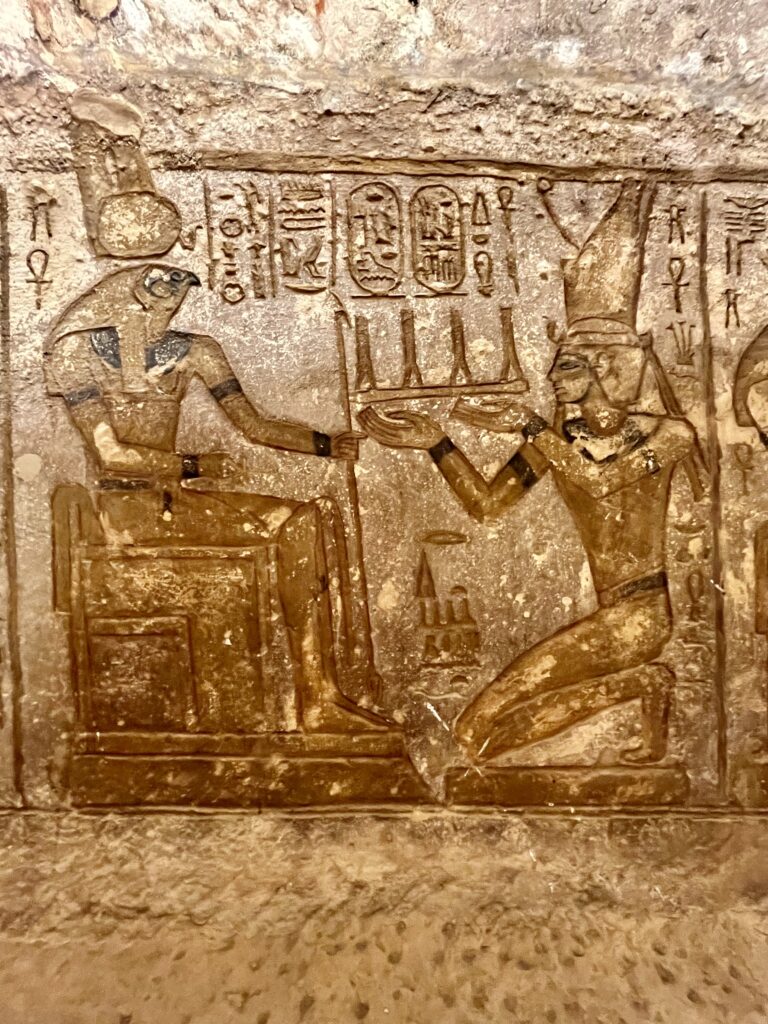
The Offering
This interior relief from the Great Temple of Abu Simbel depicts a sacred ritual of divine offering and legitimization. Carved during the 19th Dynasty around 1264 BCE, it shows Pharaoh Ramesses II (on the right) kneeling in a position of humble devotion before the seated deity Ra-Horakhty, presenting an elaborate offering to the god. The object he holds resembles a row of sacred vessels or incense burners, used in temple rituals to please the divine.
Ra-Horakhty is a manifestation of the sun god Ra. He is identified by the large solar disc atop his head and the falcon face.
👁 The Scepter of Power
Ra-Horakhty holds a Was scepter, a symbol of power and dominion, emphasizing his status as a supreme ruler of the cosmos.
☥ The Double Crown
The Pharaoh wears the Pschent, or Double Crown, which symbolizes his unified rule over both Upper and Lower Egypt.
👁 The Cartouchesand The Ankhs
Positioned between the two figures are royal cartouches. These oval frames enclose the hieroglyphic names of Ramesses II, acting as a permanent signature of his identity and his relationship with the god.
Several Ankh symbols (☥) are visible in the surrounding hieroglyphs, representing the “breath of life” bestowed by the gods upon the King.
🎯 Sunk Relief Technique
This carving is a prime example of sunk relief, where the outlines are cut deep into the sandstone. This technique was favored for its ability to create sharp, readable shadows in the dim light of the temple’s interior chambers.
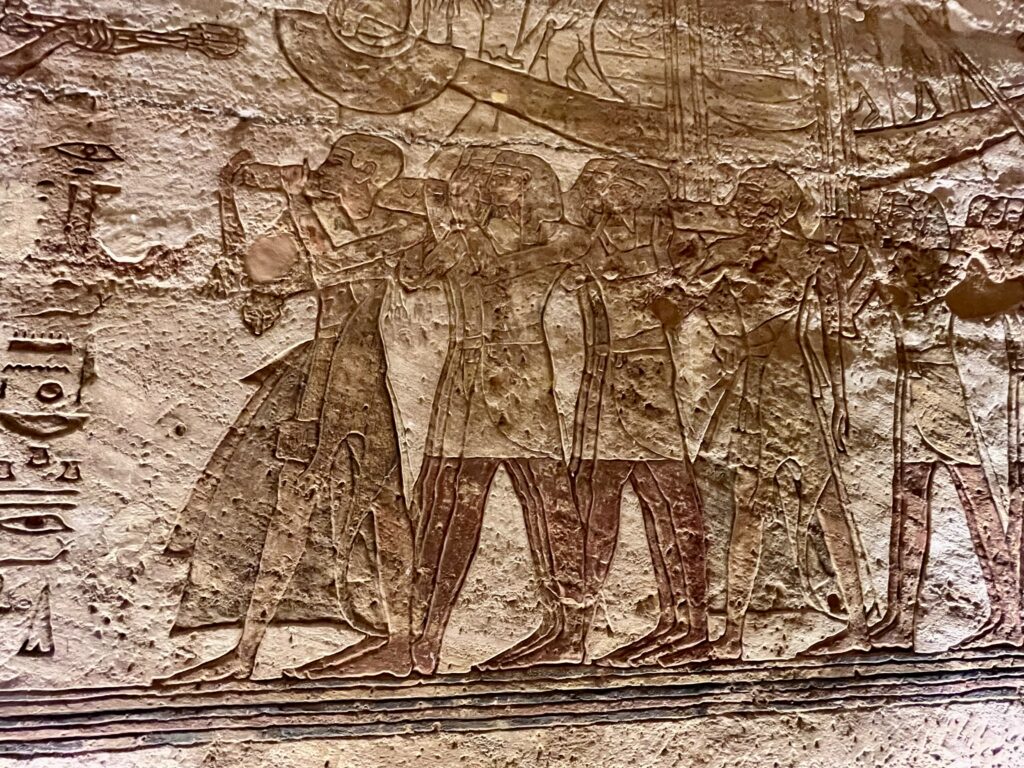
The God on the Go: The Sacred Boat Parade
This detailed relief, found inside the Hypostyle Hall of the Great Temple, shows a scene that was once filled with music, incense, and cheering crowds. It depicts the ritual of the Sacred Bark—a divine “parade float” used to carry the statue of a god out of his dark, private room so the regular people of Egypt could feel his presence.
👁 The “Invisible” Passenger
Even though you see a big shrine on the boat, you can’t see the god himself. The figure inside is Amun-Ra. His name literally means “The Hidden One,” and his actual statue was so holy that only the King and the High Priest were allowed to look at it. The front (prow) and the back (stern) of the boat is decorated with ram heads? The ram was the sacred animal of Amun-Ra. It’s like a divine “hood ornament” that tells the crowd exactly which VIP is traveling.
✍️ The Priest “Engine”
Look at the row of men underneath the boat. These are the priests carrying the heavy wooden bark on their shoulders. If you look at their heads, you’ll notice they are shaved bald—a requirement for temple priests to stay “ritually pure” while handling the god’s transport.
👑 The Divine Boat
In Egypt, the Nile was the only way to travel, so the people believed the gods traveled by boat, too—even through the sky! These barks were often covered in gold and jewels to reflect the sun.
Look at the spaces around the boat. You’ll see the cartouches of Ramesses II again. By putting his name all over this religious parade, he was reminding everyone that he was the one making sure the gods were happy and the festivals kept running.
🎯 Trivia Worth Knowing
During these festivals, people would actually stand in the crowd and shout questions at the boat! If the boat tipped forward, it was a “Yes”; if it tipped back, it was a “No.” It was called an Oracle, and it was how regular people got “direct” advice from Amun-Ra.
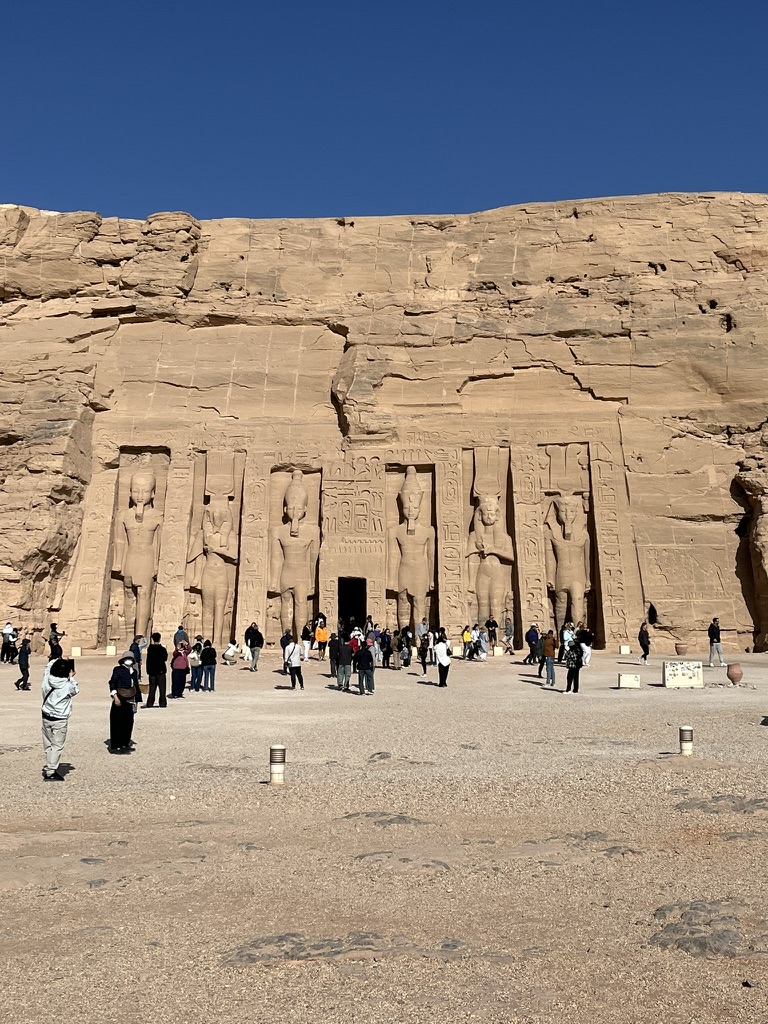
Goddess Hathor’s Temple (The Small Temple)
Just north of the Great Temple is this smaller structure dedicated to Ramesses’ favorite wife, Queen Nefertari. It is also dedicated to the goddess Hathor. From left to right: Ramesses II – Nefertari as Hathor– Ramesses II – Ramesses II – Nefertari as Hathor – Ramesses II.
The relationship between the two women is so intentionally blurred that by the end you can’t quite tell where one ends and the other begins. Which, honestly, is the point. Nefertari is wearing the full Hathor crown: cow horns, sun disk, double feathers on top. She is not dressed as “the queen who comes along.” She is dressed as a goddess. And tiny figures of their children stand at the legs of each colossus, which at this point is practically the Egyptian equivalent of a family portrait.
The statues on this facade are unique because Queen Nefertari is depicted at the same height as her husband, Ramesses II. If you’ve spent any time looking at Egyptian temples, this will immediately look wrong to you, and that’s the right reaction, because it basically never happened. Ramesses must really loved Queen Nefertari.
👁 Wait, Who Actually Was Nefertari?
Nefertari (c. 1295–1255 BCE) was Ramesses’ chief wife and by far the most celebrated. He had at least eight wives — he was not a man who operated on a small scale — but Nefertari is the one who got the temple, the poetry, and a tomb in the Valley of the Queens that is still considered the finest painted tomb in all of Egypt. She died sometime around Year 25 of his reign. Ramesses outlived her by roughly 40 years.
✍️ The Deity Connection
In Egyptian theology, Queen Nefertari is associated with Hathor. Hathor is a multifaceted goddess. She is shown here in human form, but adorned with her specific identifying symbols: large cow horns encircling a solar disc. In other reliefs inside, she appears as a sacred cow emerging from the mountain.
Just as Ramesses II identified himself with the powerful sun god Ra-Horakhty, Nefertari identified herself with the loving, maternal, and musical goddess Hathor. By honoring his wife as Hathor, Ramesses balances the aggressive solar power of his Great Temple with the protective and nourishing energy of the Small Temple.
🎯 Trivia Worth Knowing
The two most famous women in ancient Egyptian history are Nefertari and Hatshepsut. Hatshepsut was the female pharaoh who ruled Egypt in her own right for over 20 years. Nefertari never ruled — her fame comes entirely from being loved by a pharaoh who was very good at making things last. Both are extraordinary. The reasons are completely different.
👑 Nefertari Is Not Nefertiti
It’s an easy mistake—both names start with “Nefert-,” both lived in ancient Egypt, and both were legendary queens. But they were not the same person. Nefertari was the beloved wife of Ramesses II and most romantically praised though The Small Temple of Abu Simbel and one of the most beautiful tombs in the Valley of the Queens. Queens Nefertiti was the famous queen of Akhenaten, the pharaoh who tried to revolutionize Egyptian religion, who lived about 200 years earlier is often called the most beautiful woman of ancient Egypt. Her most famous “monument,” ironically, is not a temple at all — it’s the stunning Bust of Nefertiti, now displayed in the Neues Museum in Berlin.
If you mix them up in Egypt, don’t worry—you’re in good company. Even some tour guides occasionally do it… usually right before someone quietly Googles it.
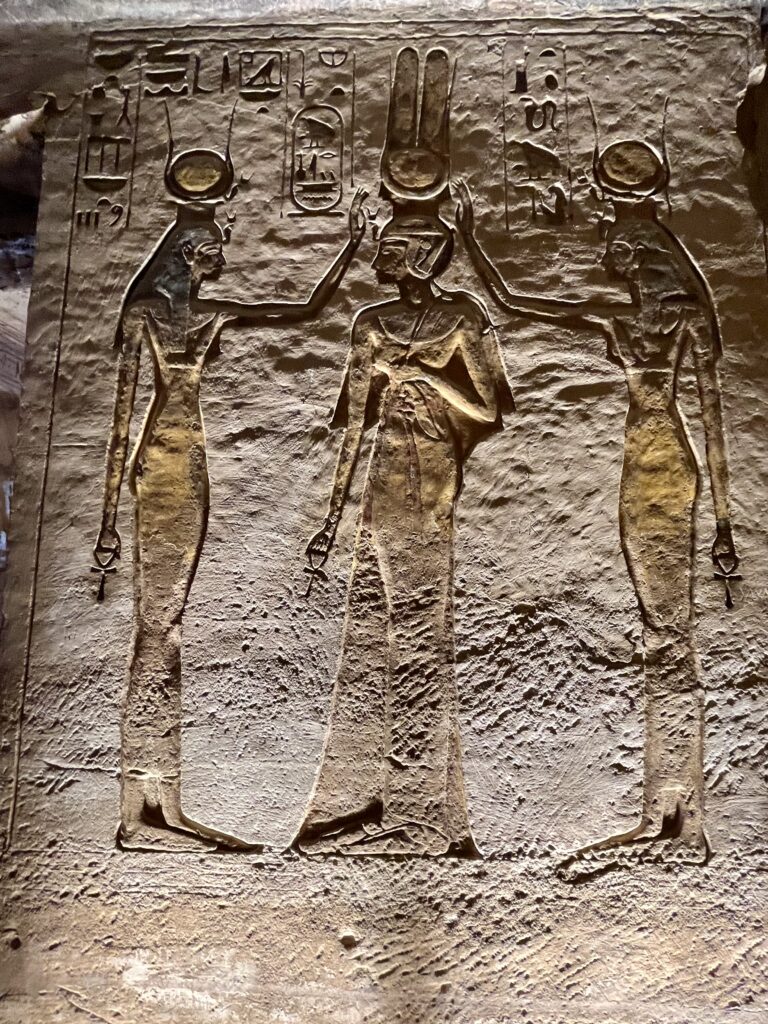
The Divine Crowning: A Royal Blessing
Inside the Small Temple of Nefertari, the walls aren’t just decorated; they tell a high-stakes story of divine approval. This specific relief, carved during the 19th Dynasty (around 1250 BCE), shows Queen Nefertari standing in the center as she is blessed and crowned by two of the most powerful female deities in Egypt: Isis and Hathor. This wasn’t just for show—it was a visual “Blue Checkmark” that proved the Queen was chosen by the gods to rule alongside Ramesses II.
👁 How to Tell Who is Isis and Who is Hathor
The goddess on the far left is Isis, the Mother Goddess. You can tell it is her by the throne symbol sitting on top of her head. As the mother of Horus, her presence here means the royal family is under her direct protection. The goddess on the right is Hathor, the Goddess of Joy. She is wearing her signature cow horns with a solar disc in the middle. Because this temple is dedicated to her, she appears frequently to show that Nefertari is her earthly representative.
☥ The Ankh (Key of Life)
Look at what each figure is holding in their lower hand. That loop-shaped cross is an Ankh, the symbol for “Life”. The goddesses are literally bringing life-force to the Queen.
🎯 Technical Precision
Notice how deep the carvings are. Even after 3,200 years, the lines are crisp and clear. This is “New Kingdom” art at its peak—where the translucent fabrics of their dresses are suggested by just a few delicate lines in the stone.
👑 The Two-pronged Headdress Atop Nefertari
The two-pronged headdress you see atop Nefertari in that relief is actually a combination of two very important symbols: Cow Horns and a Solar Disc. In the world of ancient Egyptian “emojis,” this was the ultimate visual ID.
The Cow Horns represent the goddess Hathor. By wearing these horns, Nefertari isn’t just “dressed up”—the carvings are telling the viewer that the Queen is the living, breathing version of Hathor on Earth.
The circle sitting right in the middle of those horns is the Sun Disc. This represents the god Ra (the Sun). Placing it inside the horns shows the connection between the female power of the goddess and the life-giving power of the sun.
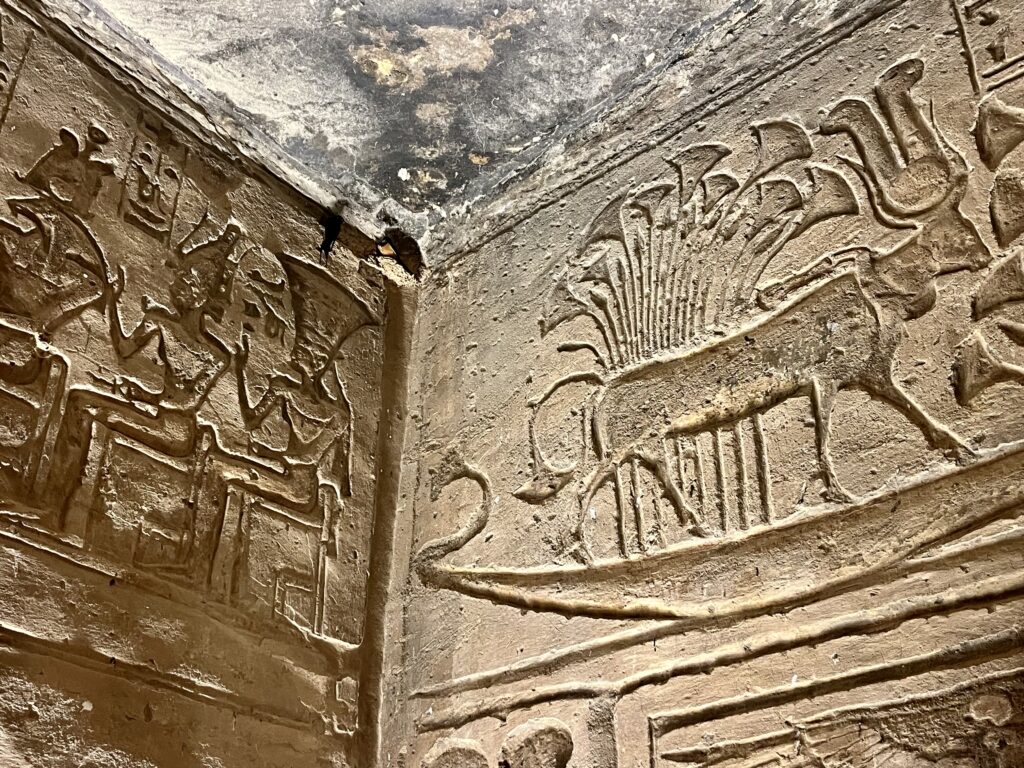
The Sky Cow: Hathor’s Sacred Journey
If you walk into the side chambers of the Small Temple, you’ll find this beautiful, unique relief of a cow standing on a boat. This isn’t just a farm animal taking a cruise! This is the goddess Hathor in her original animal form. While we saw her with cow horns on the front of the temple, here she is shown as the “Great Celestial Cow” who was believed to carry the sun across the sky every day.
✍️ The “Boat” of the Heavens
Notice the cow is standing on a curved boat. In Ancient Egypt, the sky was seen as a vast ocean of water. The gods didn’t walk through the clouds; they sailed through the stars on “Celestial Barks.”
☥ The Divine Crownand The Seated Gods
Even as a cow, she is still wearing the Horns and Solar Disc crown. This is the “ID tag” we learned about earlier—it’s how you can tell this is a goddess and not just a regular cow.
On the left wall, you can see seated figures with their hands raised in a gesture of “Adoration.” They are welcoming the goddess as she arrives on her boat.
🎯 The Papyrus Marsh
Look at the tall, fan-shaped plants behind the cow. Those are Papyrus stalks. This scene represents the “Marshes of the Delta,” where Egyptian mythology says the gods were born and hidden. It’s like a stone painting of a secret, sacred garden.
👁 The Cobra
If you look at the very front (or back, depending on your view point) of the boat, there is a tiny Uraeus (rearing cobra). This snake was the “bodyguard” of the gods and the Pharaohs, meant to spit fire at anyone who tried to stop the boat.
The Last Doorway Before Nefertari Becomes a Goddess
The two seated figures carved into the walls flanking the Small Temple’s inner hall, looking through the last doorway before the sanctuary. On the left is almost certainly Hathor herself, the goddess this entire temple was built to honor – and on the right, Isis, seated, wearing her throne-hieroglyph crown.
🤔I Know Who Hathor is, but Who is Isis
Isis is the goddess you called when things went wrong. Her story is one of the most dramatic in all of mythology: her husband Osiris was murdered and dismembered by his brother Set, scattered in pieces across Egypt. Isis spent years searching, found every piece, reassembled him, and briefly brought him back to life long enough to conceive their son Horus. She is, in short, a goddess defined by fierce, unbreakable loyalty and the power to overcome death itself. Her crown is literally a throne hieroglyph sitting on her head — she IS the seat of royal power.
🎯 Why are Hathor and Isis Here, in Nefertari’s Temple
Hathor is here because this is essentially her temple. Nefertari and Hathor are so thoroughly merged throughout the Small Temple that the two are almost interchangeable — Nefertari wears Hathor’s crown, holds Hathor’s sistrum, appears in Hathor’s poses. Ramesses built this temple to declare that his wife was the earthly embodiment of Hathor, the goddess of love and beauty. Which, as love letters go, is pretty hard to top.
Isis is here because of what she represents for Nefertari specifically: protection, resurrection, and eternal life. Isis isn’t crashing Hathor’s temple. By placing Isis at this threshold, the temple is saying that Nefertari — like Osiris before her — will be gathered, protected, and brought through death into eternity.
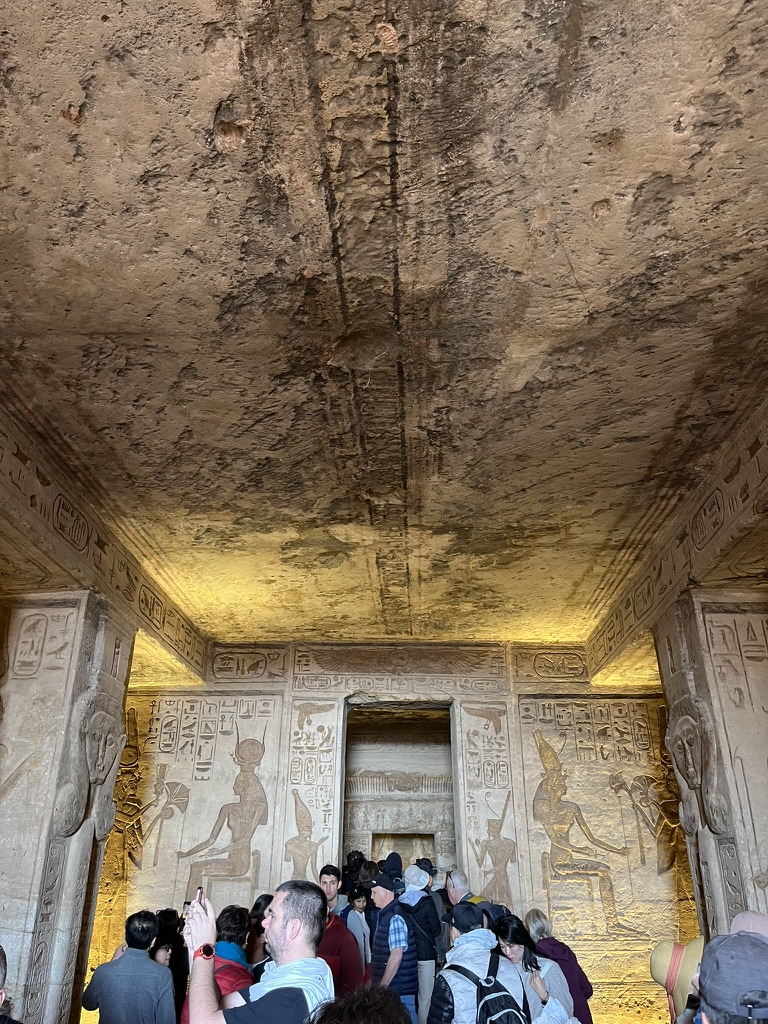
✍️ Dark Streaks AndCrack Running Down the Ceiling
See those dark streaks on the ceiling? That’s 3,000-year-old soot from oil lamps and torches burned during Hathor ceremonies. Every smear up there is the fossilized smoke from an ancient party thrown for a goddess.
That crack running down the ceiling is actually a cut joint from 1968 — one of the seams where engineers sawed the ceiling into blocks to move the entire temple 65 metres uphill before Lake Nasser flooded this site. So in one photo: 3,200-year-old carvings, 3,000-year-old party soot, and 1960s engineering. Egypt really does contain everything.
👁 Hathoric Columns
Noticed the pillars with a serene human face with cow ears on the sides, topped with Hathor’s double-feather and sun disk crown? The face appears on all four sides of each pillar, so wherever you’re standing in the hall, Hathor is looking at you. There’s no angle where you escape her gaze. Whether that’s comforting or slightly unsettling probably depends on how your day is going.
Hathoric columns appear in only a handful of temples across all of Egypt — Dendera (Hathor’s main cult temple), Philae, and here at Abu Simbel’s Small Temple.
📍 Related Dairies and Guides
[My 12-Day Egypt Diary (Part 1)]: Pyramids, Planning, and the Chaos of Cairo — arrival, the Citadel, Coptic Cairo, Giza, the GEM, and getting wonderfully lost in Islamic Cairo.
[My 12-Day Egypt Diary (Part 2)]: Aswan, Abu Simbel, and Sailing the Nile — the cruise decision, Nubian village, Philae, Abu Simbel at dawn, Kom Ombo, Edfu, the Esna Lock, and arriving Luxor by river.
[My 12-Day Egypt Diary (Part 3)]: Luxor’s Tombs and the Journey Home — Karnak, Luxor Temple, the Valley of the Kings, Hatshepsut, Deir el-Medina, Medinet Habu, feluccas at sunset, and a 3 a.m. farewell to Cairo.
[Egypt Cultural Guide] — hospitality, food, hidden gems, and what Egypt gives you beyond the monuments.
Hi, I’m Frank J – Egypt Self-Guided Travel. I explore Egypt solo and share tips, stories, and practical advice to help you plan your own adventures safely and enjoyably.